

It's been six months since the release of Meta Quest 3. What Has Been Improved and What Are the Still Problems of the Famous VR Headset?
The Quest 3 was hailed as a great VR headset, but was severely criticized for its “marginally acceptable” mixed reality. However, as with previous standalone VR headsets, Meta has released several system software updates and development tools in the Quest 3’s first six months on the market. Here, we break down what those are and how they change our decision on whether you should buy it.
See also: Apple Vision Pro 2: Expected by the end of 2026
Mixed Reality Is Better, But Not the Best on the Market

Meta is promoting the Quest 3 as the “first “mainstream” mixed reality headset.” With that in mind, the lack of dynamic occlusion and significant geometry distortion during traversal are severely criticized.
In December, Meta released the Depth API, which allows developers to add this missing dynamic occlusion. However, it requires complex integration from developers and is therefore not supported by almost any application so far. In addition, the depth map that drives it is very low resolution, resulting in some results that are quite ugly to the eye.
The passthrough was updated earlier this month with improved dynamic range and exposure control, making it easier to view on physical displays like monitors and phones. Noise has also been reduced slightly. However, all of this comes at the cost of a slightly darker and less vibrant virtual environment. This new passthrough adjustment moves or sometimes distorts the image, including darkness and intensity, closer to Apple Vision Pro than ever before.
See also: New 777 horsepower electric vehicle from Italdesign
The Quality of the Passage Has Been Improved and New Features Added to Meta Quest 3
Meta has also addressed one of the complaints about the passthrough: that it didn't appear in all systems and UIs and wasn't supported for loading screens. Apps can now use the passthrough on their loading screen, and Meta has added the passthrough to system interfaces like the lock screen and power menu.
These changes may seem pretty small, but together they allow for uninterrupted transitions from about five seconds after putting on the Quest 3 until you take it off, making it feel more like a mixed reality headset and less like a VR headset with mixed reality elements.
Inside-Out Body Tracking Feature Added, But Little Used
Meta Quest 3 was announced with a major feature that came after launch, the Inside-Out Body Tracking Feature.
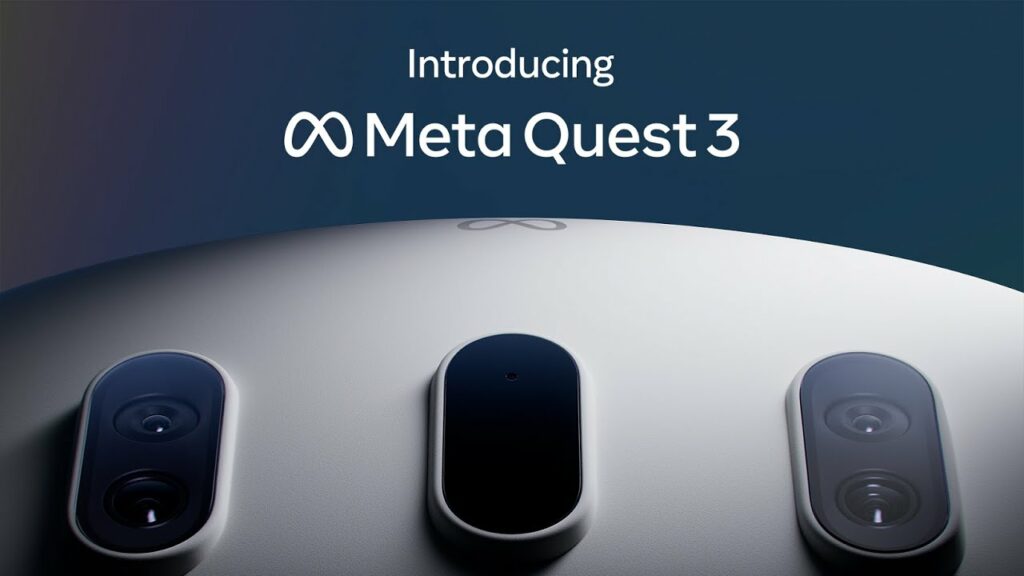
Inside-Out Body Tracking (IOBT) uses the Quest 3’s side cameras, which are focused downward, to track your wrist, elbows, shoulder, and chest using advanced computer vision algorithms. It avoids the problems with inverse kinematics (IK) estimates of the hands, which are often inaccurate and feel awkward because the system simply makes assumptions about the location of your head and hands. When developers integrate IOBT, you’ll see your hands and chest in their actual positions—not an estimate.
IOBT was released in December. However, four months later it is still only being used by a small number of third-party apps, including Swordsman VR, Drunkn Bar Fight, and XRWorkout.
The biggest use for IOBT right now is in Virtual Desktop, which uses it to simulate worn Vive Trackers for body-tracking avatar movement capability in the PC VR of VRChat.
See also: Nokia 3210 returns to the market!
Spatial Videos and Panoramics are now easily viewable in Meta Quest 3

Two of the key uses of Apple Vision Pro, viewing panoramas and 3D “Spatial Video playback” captured from your iPhone, are now easily viewable in Meta Quest 3.
This means you can project that content over a cable for 1/7th the price of the Apple Vision Pro. If you're the kind of person who shoots a lot of photos and videos and enjoys viewing them on AR/VR headsets, this might even be a reason to buy one.

External Microphones Supported
When the Meta Quest 3 was released, users were quite excited to use it on the VR Download podcast but found that its microphone had the same annoying acquisition problem as the Meta Quest Pro.
The v62 update in February brought some improvements to the Quest 3's microphone quality, including specifically addressing the acquisition issue. However, it's still not good enough for VR Download and still sounds noticeably worse than even the Quest 2.
In what may be an admission that the microphone hardware just isn't good enough, the v64 update earlier this month added the ability to use an external microphone on the Quest 3 via the USB-C port. This can include a microphone with a USB-C connector, or any microphone via a USB-C adapter.
See also: Nothing: The New Extremely Competitive Ear & Ear Headphones (a)
Access to SteamVR is Free
At launch, using SteamVR required using Meta's free (Air) Link feature or purchasing Guy Godin's Virtual Desktop. Air Link did not support the 120Hz refresh rate on the Quest 3 and had worse battery life compared to Virtual Desktop.
Meta fixed both of these Link issues in the v62 update in February. But perhaps more importantly, Valve released a free official Steam Link PC VR streaming app in the Quest Store, making it almost seamless to connect directly to SteamVR.
Exclusives Announced
At launch, we noted that while the Quest 3 was a significantly superior headset to the Meta, the Quest 2 still played all the same games for just $200 less.
That difference increased to $300 in March when the Quest 2 dropped to $200. But what changed is that the first games that will run on the Quest 3 but not the Quest 2 have been announced.
Starship Home: Meta's First Exclusive Quest 3

Starship Home will use the 3D mesh backdrop that Quest 3 creates during mixed reality room setup to place virtual objects on your walls and furniture.
Alien: Rogue Incursion: Coming to Quest 3, PSVR 2 and PC VR

Last week, Alien: Rogue Incursion was announced for the Quest 3, PlayStation VR2, and PC VR. Survios hasn't said why it won't be released on the Quest 2, but it's likely that it's one of the few VR games that won't run on standalone headsets.
See also: The New Sony Bravia TV and Audio Lineup for 2024
Final Conclusions: Meta Quest 3 Six Months Later
The Quest 3 is still an excellent VR headset, one that most people looking for a VR headset should buy, without any significant competitive differentiation. Support for spatial video and even panoramic views makes it a good buy for some iPhone owners who aren't interested in VR gaming or VR fitness.
While Meta has made strides in describing mixed reality capabilities, it still suffers from transit distortion and rare dynamic obstruction, and therefore its mixed reality would still be described as “barely acceptable.”
While the Quest 2 has dropped to $200, developers are starting to build around the capabilities of the Quest 3's much more powerful GPU, and graphics updates for existing games have become the norm. And for PC gamers, the new Virtual Desktop runtime and the release of Steam Link have made wireless PC VR better and more convenient than ever before on a standalone cable.
Source: uploadvr
