

The Cr-48 was a laptop that was never sold in stores, had no manufacturer logo, and didn’t even have an official brand name — yet this black, anonymous device from Google changed the way we think about laptops forever. In the latest episode of The Verge ’s Version History podcast , Nilay Patel and Marques Brownlee (MKBHD) join David Pierce to explore the history of Chrome OS and Chromebooks , asking whether Google’s approach was ultimately the right one. The Cr-48 wasn’t just a prototype — it was the beginning of a philosophy that now dominates classrooms around the world.
See also: Google adds AI capabilities to Chromebook Plus devices
Google announced Chrome OS in July 2009 , presenting it as an operating system built around the Chrome browser , cloud applications, and remotely stored data. On November 19, 2009 , the company released the open source version of Chromium OS , allowing developers and hardware manufacturers to test the platform. The idea behind the project was bold: a computer that didn't require any locally installed software, but instead ran entirely over the internet. Services like Gmail , Google Docs , and YouTube were already making browser-based computing more practical than ever.
The time was ripe for such an experiment. Netbooks — small, inexpensive laptops — had gained popularity, but many of them ran on sluggish hardware with conventional operating systems like Windows . Google saw an opportunity: a centrally managed operating system, with automatic updates, few legacy applications, and strong integration with the company’s cloud services, could be both more secure and easier to manage than a conventional Windows PC. At the same time, the strategy strengthened Google ’s search, advertising, productivity, and storage ecosystem .
The Cr-48: The prototype that changed the philosophy of Chromebooks
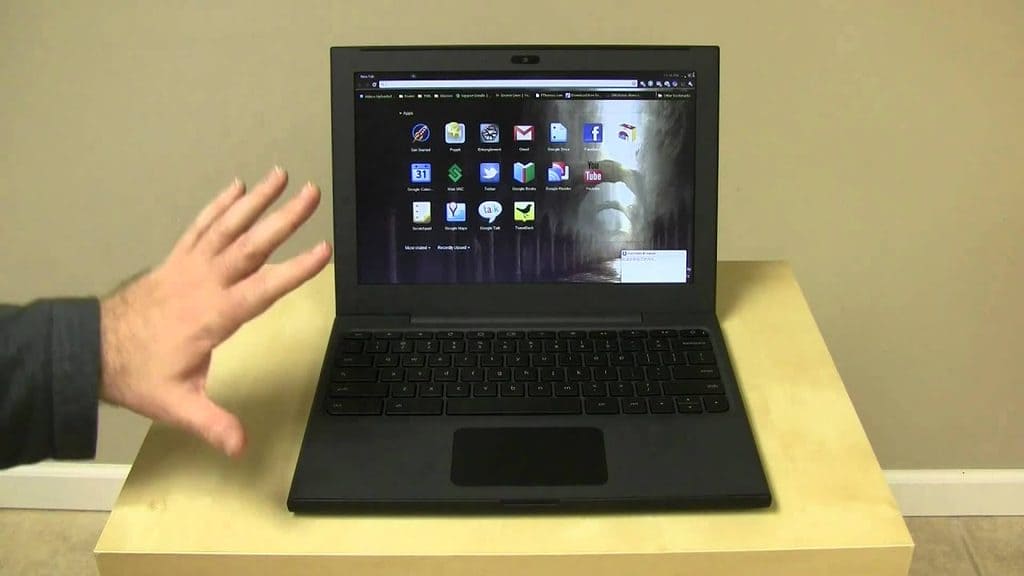
On December 7, 2010, Google unveiled the Cr-48 as part of the Chrome OS Pilot Program. The nondescript, black laptop was manufactured by Inventec and distributed to approximately 60,000 testers between December 2010 and March 2011. It was not a product for sale—it was a real-world research tool. The name "Cr-48" referred to the atomic number of chromium, reinforcing the connection to Chromium and Chrome. The device had no manufacturer logo, no flashy design—just a keyboard optimized for browser use, with a dedicated search key in place of Caps Lock.
Technically, the Cr-48 represented a radical departure from the traditional PC model. It ran Chrome OS , based on the Linux kernel and the Chromium browser . Applications were primarily web apps rather than locally installed software. User settings and data were synchronized via a Google account . The system used verified boot and automatic updates to reduce the likelihood of compromise and simplify maintenance. In addition, the device had a built-in mobile broadband connection, reflecting Google 's expectation that users would always be connected to the Internet.
The pilot also revealed a major limitation: a web-based computer is completely dependent on network access and browser-compatible services. Google responded by gradually adding offline capabilities, local storage, support for Android applications , Linux containers , and broader hardware support. On May 11, 2011 , at Google I/O , the company introduced the first commercial Chromebooks —from Acer and Samsung . The Samsung Chromebook hit shelves on June 15, 2011 , followed by the Acer model in July.
See also: Chromebook: How does it protect schools from cyberattacks?
The dominance of Cr-48 in education and the rise of Chromebooks worldwide
The strongest market for Chromebooks has proven to be education. In January 2012, Google reported that nearly 27,000 Chromebooks had been deployed in schools across 41 U.S. states. The advantages were obvious: low hardware costs, simple management, automatic updates, centralized device policies, and relatively strong resistance to traditional malware. By 2016, Chromebooks accounted for about 58% of the 2.6 million mobile devices purchased by U.S. schools, while their share outside the U.S. was about 64% during the same period. By March 2018, Chromebooks accounted for about 60% of computers purchased by U.S. schools.
The COVID-19 dramatically accelerated this trend. Remote learning and working led to an explosive demand for affordable laptops, and more than 30 million Chromebooks were shipped in 2020 , according to data from Gartner and Canalys. Chromebooks outsold Apple Macs worldwide that year and reached an operating system market share of about 10.8%, up from 6.4% in 2019. The market later shrank as schools and consumers had already purchased devices during the pandemic, with estimated shipments for 2024 at about 17.5 million units.
The arguments in favor of Chrome OS have always been clear: lower total cost of ownership, centralized management, strong security through verified boot, sandboxing , and automatic updates, rapid deployment, and longer practical usability thanks to lightweight software. Critics, on the other hand, pointed to the dependence on Google, compatibility limitations with specialized Windows, privacy concerns — especially in an educational context — and hardware lifecycle issues due to the Auto UpdateExpiration. The dependence on a constant internet connection also remained a point of friction, despite improvements in offline capabilities.
See also: How to print from a Chromebook?
The Cr-48 was never a conventional product. It was a large-scale experiment in usability and business model. Google used its 60,000 testers to assess whether people would accept a computer that behaved more like a managed web terminal than a traditional PC. The answer, it turned out, was yes — at least for millions of students, educators, and professionals who needed a simple, reliable, and affordable device for everyday tasks. The Cr-48 is not measured in units sold, but in the philosophy it inspired — and which today lives on in every classroom with a Chromebook on its desk.
