

Street View and BikeAround: Anne-Christine Hertz is a Swedish inventor working at the Center for Health and Technology in Halland, Sweden. Today, she shares a story about how the Center used Street View to create a device that helps seniors diagnosed with Alzheimer's disease.
Anne-Christine Hertz:
“A few weeks ago, I met 75-year-old Lars Jonsson and his wife, Ingrid. They married when Lars was 40 and have lived a happy and fulfilling life together ever since. Lars suffers from dementia.
Every three seconds someone in the world develops dementia, a condition that causes disability and dependency in older people, robbing them of their memory and judgment. It is not only unbearable and stressful for those who suffer, but also for their loved ones. It was difficult for Ingrid that her husband suddenly had trouble remembering the times they had spent together.
We met Lars and Ingrid when they came to test a device we built to improve the lives of dementia patients. It's called BikeAround and it manages to combine a stationary bike with the unlimited possibilities of Google Street View on a big screen.
In this way, it helps patients experience a virtual tour back in their memory and cycle to places they have visited in the past. When Lars got on the bike, Ingrid asked us to take him back to the town and church where they got married. Lars ’ face lit up with joy when the church appeared in front of him. His wife’s expression when she was sure he remembered it was touching.
The development of the BikeAround system , now owned by the medical unit Camanio Care , began in 2010 at the Health and Technology Center in Halland , Sweden. While researching dementia, we noticed that access to physical exercise for dementia patients was a matter of the community in which they lived. Since dementia patients are recommended to exercise to maintain both their physical and mental health, this was a significant problem. So we were looking for a way to motivate older people with dementia to exercise more in a safe environment.
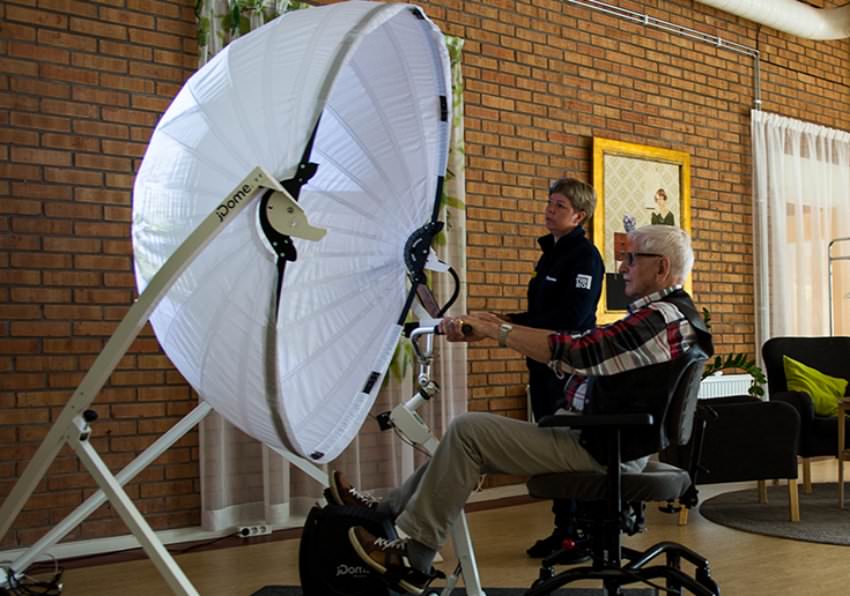
Our most vivid memories are inextricably linked to location. It’s no coincidence that when you recall a significant memory or event from the past, the first thing you think about is: “Where was I when that happened?” BikeAround explores this idea by combining mental and physical stimulation – it places the patient in places they recognize through Street View imagery and then gives them the opportunity to cycle through them.
Today is ’s Day Alzheimer, a day when people and organizations from around the world come together to raise awareness about this incurable disease. Researchers around the world are trying to find new ways to improve the quality of life for people living with the disease. Lars – and that of many other patients – proves that we have created not only a product that improves health, but much more, something that creates emotions and connects people. Patients find BikeAround an outlet so fun – and convenient – that they don’t want to part with it. Neighborhoods they grew up in. Parks they played in as children. Family walks on the beach. They remember again. And that feels like freedom.
I have always seen the transition to the digital age and the spread of technology as a catalyst for expanding the world not only for those who are familiar with technology, but also for older people, who often face digital exclusion. We are excited that we have found a way to make many people living with dementia and their relatives happy. But what is also exciting to me is that this is just one example of how technology can be harnessed to have a real impact on people’s lives. If we look to others and let our imaginations run wild, there is no limit to what we can do.”
