

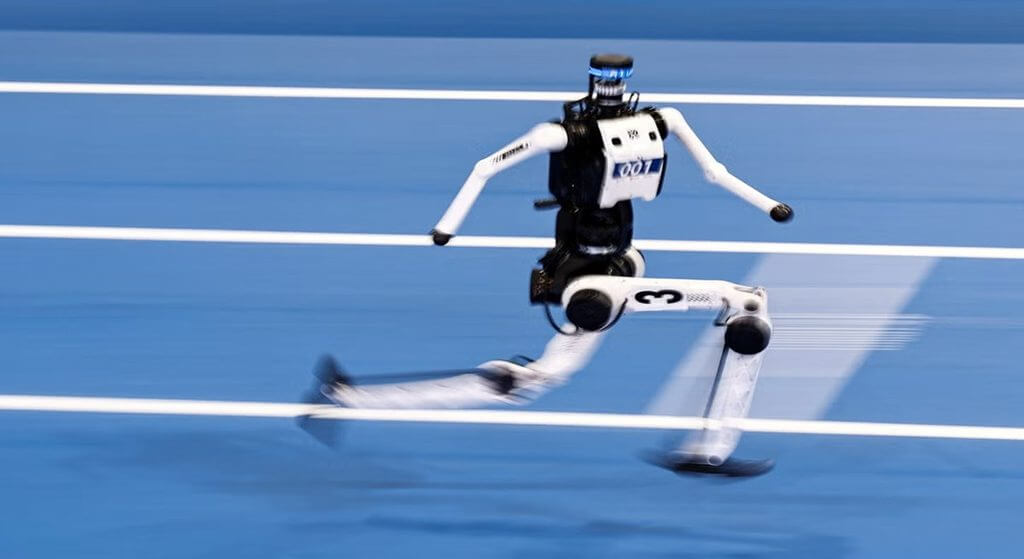
A humanoid robot has made history in track and field, running the 100 meters in just 9.39 seconds , breaking the world record of 9.58 seconds set by Usain Bolt in 2009. The feat took place at the World Humanoid Robot Games in Beijing and impressed the audience, but at the same time it opens up a much more complex debate about what a truly "smart" and useful robot means.
New records in robotic track and field
X-Humanoid 's robot wasn't limited to sprinting. At the same event, the company's humanoid managed to clear 2.88 meters in the high jump , surpassing the human record of 2.45 meters held by Javier Sotomayor. Meanwhile, Honor 's robot clocked a time of 9.32 seconds in the 100-meter dash in a test attempt , showing that technology is evolving at a particularly fast pace.
See also: US: "Block" on Chinese humanoid robots
The event is held on a large scale, with more than 2,000 robots from 16 countries participating in 51 different events. The competitions thus provide an impressive testing ground for the capabilities of modern humanoids.
From remote control to increased autonomy
The most important development, however, is not just about the timing. Compared to the first competitions in 2025, the progress is obvious. At that time, Unitree 's H1 robot won the 400 meters with a time of 88 seconds, while a significant part of the participants relied on remote control .
Today, manufacturers are gradually trying to reduce this dependency and develop machines that can perceive and manage their environment on their own. Even the design changes reveal how focused the development has become. Honor, for example, increased the length of its robot's legs by 10 centimeters, reaching 1.05 meters, with the aim of improving racing performance.

An impressive record does not mean intelligence
But here lies the big catch: A robot that runs extremely fast on a flat and predetermined path does not necessarily mean that it has the corresponding ability to operate in a real space.
As robotics experts have pointed out, running in a controlled environment is a much more specific problem than an everyday task, such as folding laundry. On the track, the route is known, the obstacles are limited, and the conditions are predictable. At home, by contrast, every object can be in a different position, and every movement requires adjustment.
The real test is the unknown world
Yanran Ding from the University of Michigan has pointed out exactly this difference: people often consider an impressive athletic performance to be more difficult than a simple household chore, while for a robot the exact opposite may be true.
See also: Humanoid robot Pemba climbed a volcano at 6,200 m.
Along the same lines, Alan Fern of Oregon State University attributes such successes primarily to engineering, investment, and systematic optimization. The greatest technological leap, according to this approach, is not for a robot to perform a specific movement with extreme precision, but for it to be able to face a space it has never seen before.
Europe invests in everyday utility
This is exactly the field that several European companies are turning to. NEURA Robotics is developing simulation facilities so that robots can be trained in more complex and messy environments . At the same time, London-based Humanoid has secured significant funding and a partnership with Bosch , aiming to produce humanoids on a larger scale.
See also: Unitree H2: An impressive but expressionless humanoid robot
The future of robotics, therefore, may not be determined by which robot wins the next race. The real challenge is to create a machine that can enter a factory, a hospital or a home, understand what is happening around it and safely complete a task that has real value to humans. 9.39 in the 100 meters is impressive. But folding clothes correctly remains perhaps the most difficult and far more meaningful record.
