

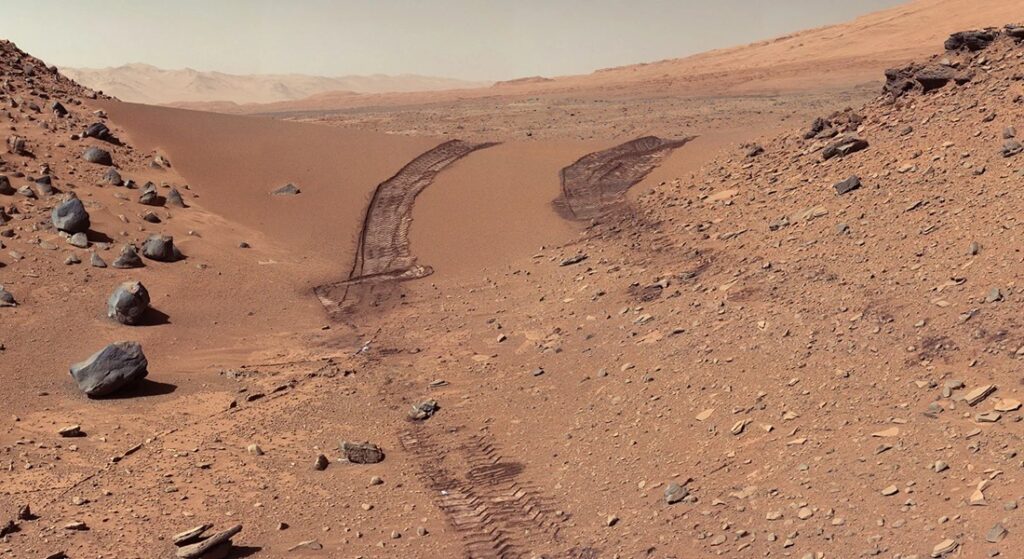
The Perseverance rover captured with its camera an extensive field of so-called "megaripples" on the surface of Mars.
The Perseverance rover to Jezero Crater didn't just give us another stunning photo of Mars. It revealed a whole "world" of geological formations that record, like a record written in sand, how the winds and climate of Mars shape its environment to this day.
On August 13, the rover captured a wide field of so-called “megaripples” – imposing ridges of sand about one meter high that stretch across large areas of the Martian desert. The image was taken at a location scientists call Kerrlaguna, which offers unique opportunities for studying the action of wind on the planet.
"On Mars, the past is written in stone — but the present is written in sand," the statement.
See also: NASA discovered billion-year-old "coral" on Mars

What are megaripples and why do they matter?
Megaripples are somewhere in between two well-known formations: they are larger than the usual ripples we see in Earth's deserts, but smaller than the impressive sand dunes. On Mars, their presence carries special weight, as many researchers believe they are remnants of a time when the atmosphere was thicker and winds were stronger. This means that these ridges act as a "geological diary" that records the planet's climate changes over millions of years.
Interestingly, unlike their rapidly changing counterparts on Earth, the Martian megaripples remain virtually unchanged. The thin layer of coarse grains covering their surface protects them from erosion, making them resistant to Martian winds. However, satellite observations have shown that some of them are moving, albeit slowly – about one meter every nine Earth years. For planetary scientists, this is enough to prove that the Martian surface is not “frozen in time”, but continues to evolve.
The field of Kerrlaguna
Perseverance, with its instruments and cameras, is examining in detail the structure of the megaripples in the Kerrlaguna region, the size of the grains and possible chemical alterations that may indicate the presence of water in the past. Salty crusts on the surface, for example, could be evidence of interactions with liquid elements in the past.
See also: Skyfall: Six helicopters may soon explore Mars
These elements could one day provide critical resources for astronauts who set foot on Mars. Water, even in the form of trapped salts, could play a role in the viability of future missions.

The importance of observations
But why is studying these slow, seemingly "still" sand formations so important? Scientists explain that megaripples provide a window not only into the past but also into the present of the planet. Active dunes, like those examined years ago by the rover Curiosity, show how winds move sand masses today. Megaripples, by contrast, reveal how the same mechanisms operated in different climatic conditions, perhaps when Mars was more hospitable.
Understanding these processes is critical for another reason: the Martian surface is the foundation for any future base or colony. If we know how and at what speed the environment is changing, we can better predict the challenges that crews who will live and work there will face.
The path of Perseverance
The stop at Kerrlaguna came after a failed attempt to climb a rocky slope in the Midtoya area. Although the rover was forced to turn back due to the difficult terrain, the adventure was not in vain. Along the way, it analyzed rocks that had rolled down the slopes, providing data on their geological origin. One of them, “Horneflya,” attracted attention thanks to its shape reminiscent of a medieval helmet – another example of how science and imagination coexist in NASA missions.
See also: The largest Martian meteorite sold for $4.3 million
According to the mission plan, Perseverance will not stay at Kerrlaguna for long. The next big target is an even more extensive area of megaripples, “Lac de Charmes,” where scientists will conduct a more detailed campaign.
