

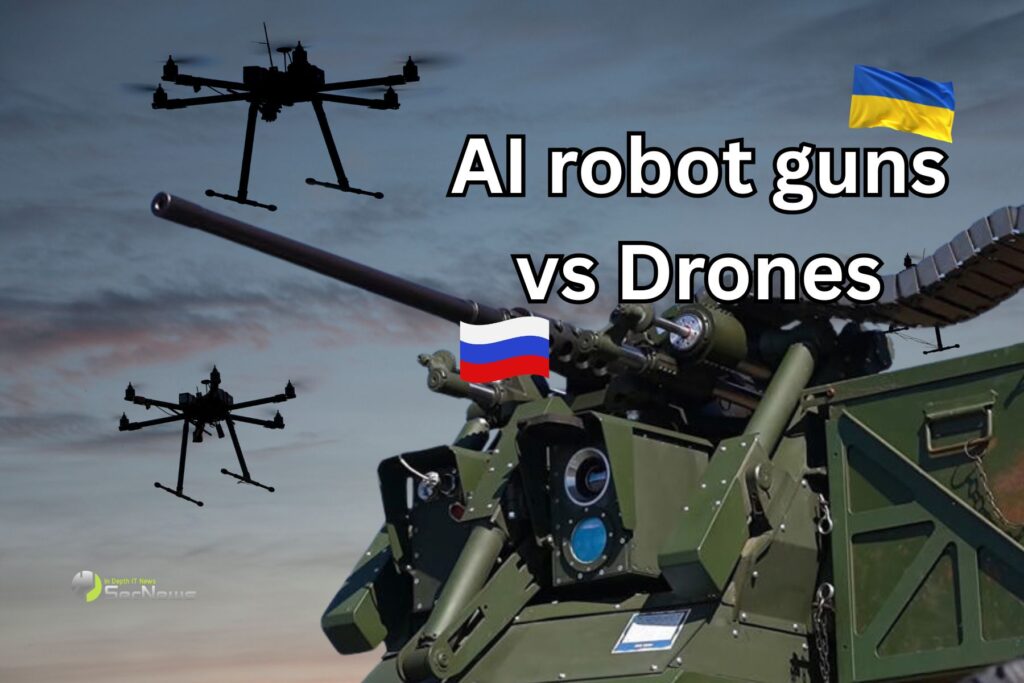
Ukraine is beefing up its defenses against the latest Russian drones, using robotic turrets with artificial intelligence and machine guns. The automated systems have begun to be deployed in key areas of Kiev, aiming to counter the jet-powered unmanned aircraft that travel at higher speeds than older models.
The development was announced on October 5 by the Ukrainian Air Force and is part of a broader effort to find more economical and faster ways to deal with aerial threats.
New generation of Russian drones
In recent years, Shahed drones and their variants have been a significant part of Russian attacks on Ukrainian cities and infrastructure. However, the emergence of faster, jet-powered drones is creating new challenges for air defense.
These aircraft can approach targets at higher speeds, reducing the available reaction time. This makes them more difficult to intercept by conventional means, especially when available air defense missiles must be used sparingly.
See also: Drone data in Ukraine fuels a new market
According to Ukrainian Air Force spokesman Colonel Yuriy Ignat, such drones have already been shot down, including the larger and more powerful Geran-5 version.
Robotic turrets on Kiev bridges
As part of its new defense strategy, Ukraine is placing automated turrets on bridges and other selected locations in the capital. The installations are designed to detect aerial targets and automatically turn weapons toward the threat.
Ignat said the systems leverage optical sensors and artificial intelligence, reducing the need for constant human intervention. The technology can analyze the image received by the sensors, identify potential targets and support the targeting process.
Sergey Beskrestnov , a technology advisor to the Ukrainian president, called the systems an innovative domestic solution for countering drones with AI- controlled machine guns .
According to him, 12 such turrets have already been installed in Kiev, while their number is expected to increase.
Limited range and dependence on conditions
Despite their capabilities, the new turrets are not a stand-alone solution for protecting a city. Ignat himself acknowledged that their operational radius is limited, reaching about a kilometer or a little more.
See also: Two Amazon data centers in the UAE were hit by drones
Their effectiveness also depends on the conditions and the angle at which the aerial target approaches. This means that a drone moving outside the coverage area or following a different trajectory may require another means of interception.
For this reason, robotic turrets are seen as another layer of a multi-layered air defense system and not as a replacement for missile systems or air power.
F-16s remain a critical element
The Ukrainian Air Force still relies heavily on fighter jets to counter the faster drones. As Ignat explained, the altitude and flight speed of some new models limit the available interception options, with F-16s playing a significant role.
Pilots can sometimes shoot down multiple drones during a mission, but ammunition usage remains a significant limitation.
The lack of available missiles leads pilots to utilize their aircraft's guns , while increasing the need for more economical solutions that can operate at lower levels of air defense.

AI is becoming a key tool of war
The development of these turrets is part of a broader trend being recorded in Ukraine: the rapid integration of artificial intelligence into military operations.
The country already uses AI systems to support drones, identify potential targets, process sensor data, and coordinate operations. Automation can reduce the time it takes to identify a threat, which is especially important when the target is moving at high speed.
At the same time, however, the increasing use of AI in air defense creates new requirements in terms of reliability, control and safety. A system that makes decisions in fractions of a second must be able to distinguish a real aerial target from other objects with great accuracy, while also requiring human control mechanisms.
See also: The US banned the best drones in the world
The Ukrainian approach shows that the future of countering drones will not be based on a single weapon. Instead, a network of different technologies is taking shape, where sensors, AI, robotic systems, electronic warfare, artillery and fighter jets work complementary.
The new turrets are a prime example of this transition: artificial intelligence is not replacing human presence, but is increasingly taking on a larger part of the process of detecting and responding to a threat that is evolving faster than ever.
