

The crash of a private Bell 206 on Sifnos on August 17, 2026 claimed the lives of three people — experienced pilot George Raikos, a former officer in the Hellenic Air Force, and newlywed passenger couple Marie Ebert and Alexander Cromie. The editorial team of SecNews avoids any reproduction of images or details of the incident and remains focused on the technical dimension of the issue. As the Authorities collect closed-circuit television (CCTV) and citizen cell phone footage, the role of digital video analysis and flight tracking data in modern aviation accident investigation is highlighted.
The released video footage shows that the helicopter began to rotate in the air shortly before the crash — a pattern that directs investigators' attention to a possible tail rotor. The investigation is being coordinated by EODASAAM (National Organization for the Investigation of Air and Railway Accidents and Transport Safety), in collaboration with a special unit of the Hellenic Police and based on the urgent directive of the Civil Aviation Authority to inspect all Bell 206s in the Greek registry.
See also: Europol: "Strike" in online fraud ring — Victims also in Greece
How digital video analysis reads the last seconds
Video forensics is now a standard tool for any serious aviation accident investigation. Experts extract individual frames in full resolution from every available source (CCTV cameras, mobile phones, car cameras, drones) and examine them one by one, at 25 to 60 frames per second. They measure the angular velocity at which the helicopter rotates around its vertical axis, calculate the tilt of the body by comparing the shadow with the horizon, and “clean up” older video signals to isolate the essential frames. A tail rotor failure leaves a characteristic “signature” in the video: the main body of the helicopter begins to rotate in the opposite direction to the main rotor, as the stopping torque normally provided by the tail rotor disappears.
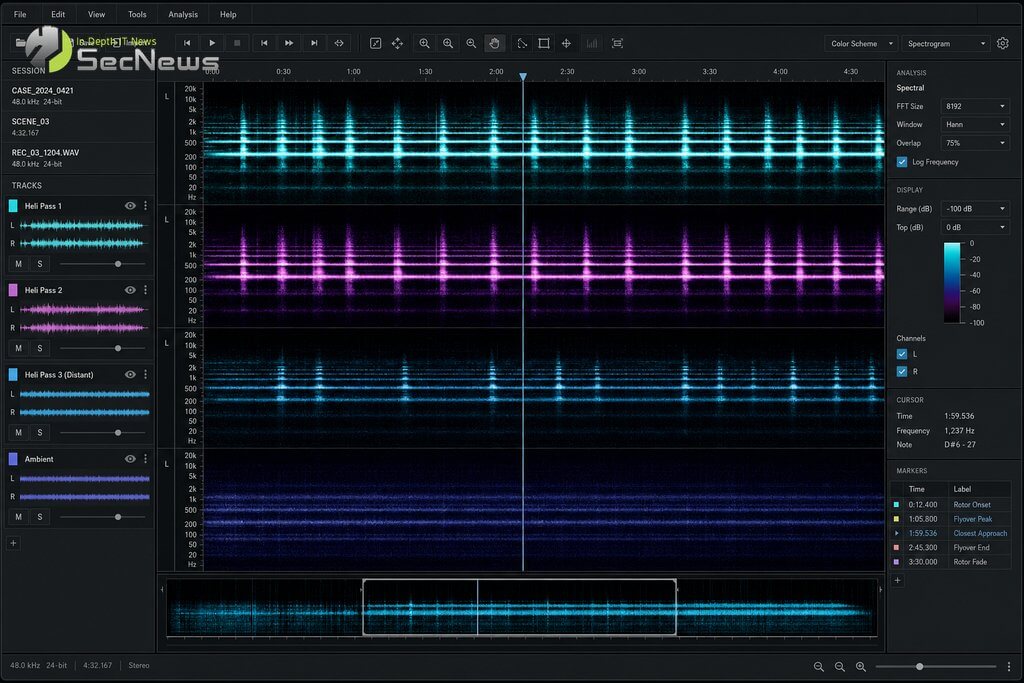
Equally critical is the spectral analysis of sound, i.e. the recording of sound on a frequency graph. Witnesses described a “strange noise” from the main rotor shortly before the crash. Experts convert the audio data into spectrograms with tools such as Audacity, iZotope RX or specialized packages from the US NTSB, and identify changes in the fundamental frequency of the main rotor (typically 20 to 30 cycles per second for helicopters in the Bell 206 class). They also identify harmonic inconsistencies that point to a mechanical failure of the power transmission, as well as the characteristic “slap” sound of the wings — the acoustic identity that each type of helicopter has recorded in reference bases.
Bell 206, ADS-B and open-source flight tracking
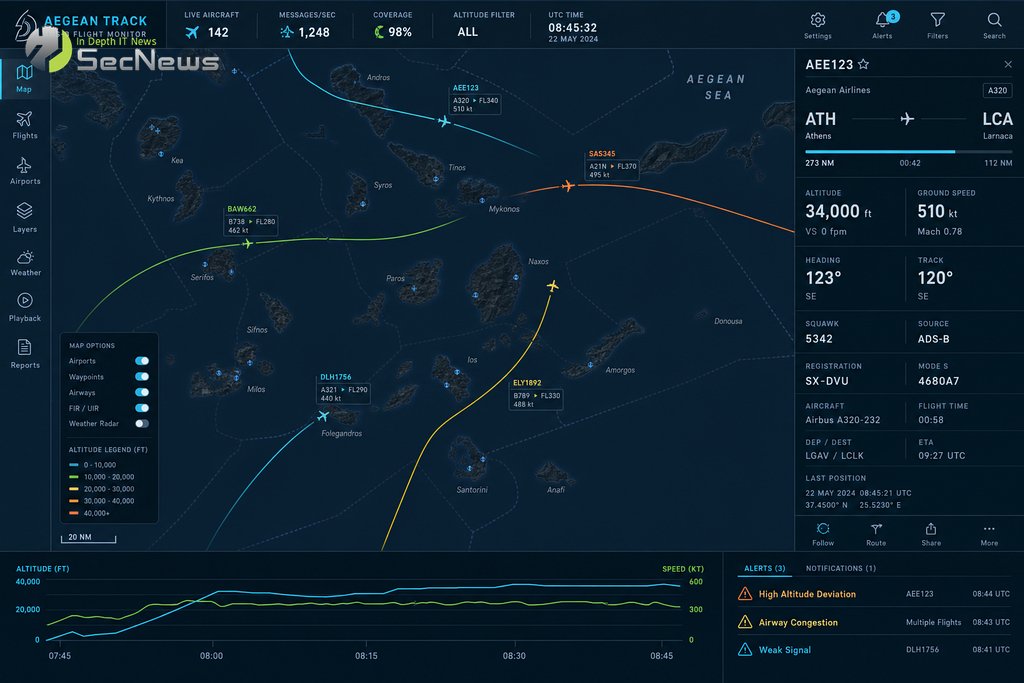
Although the Bell 206 is a 1967 light helicopter by design, many have been upgraded with ADS-B Out, an automatic data transmission system that transmits real-time flight data — geographic position, altitude, speed and direction of travel — on the 1090 MHz frequency. Platforms like FlightRadar24 and the open-access OpenSky archive this data with up-to-the-second accuracy, giving investigators a ready record of the aircraft’s path, speed and altitude profile, and any unusual changes just before the signal is lost.
OpenSky in particular, as a research infrastructure with partner universities such as ETH Zurich, provides free access to historical raw ADS-B data, now becoming an official tool for independent analysis by the research community — analysis that was once only done by government agencies. In the case of a private helicopter, the ability to cross-reference the last recorded ADS-B point with the geographical coordinates of the crash site allows for an immediate estimate of the trajectory in the last few seconds — data that is then compared with the trajectory calculated from the video analysis.
See also: Suspect arrested for global crypto fraud — Arrests also in Greece
Chain of custody: how digital proof is secured
For an ADS-B video or file to be admissible in court, it must maintain an unbroken chain of custody. Authorities obtain the original storage medium (memory card, internal hard drive of the recording system, cloud backup), calculate a cryptographic digest (with algorithms such as SHA-256 or BLAKE3) of the original copy, and work exclusively on working copies. Each action is recorded in an expert log so that in court the expert can prove that no frame has been modified since the moment of seizure.
At the same time, a check is made for signs of tampering using specialized techniques: Error Level Analysis that reveals parts of the image that have been post-processed, analysis of the “noise” of the camera sensor (each camera leaves a unique imprint, like fingerprints), as well as checking the embedded EXIF metadata in mobile videos — because sharing on social media often involves new compression that “cleans” useful traces. The Greek judiciary has begun in recent years to systematically accept this type of analysis, with experts certified in international standards such as ISO/IEC 27037, which defines the proper management of digital evidence.
The broader aviation data security framework
The Sifnos case comes at a time when the Greek regulatory framework is upgrading its digital flight surveillance mechanisms. The Civil Aviation Authority’s emergency directive for the Bell 206 was issued electronically to all companies that operate such helicopters, a process that in 2015 required days of faxing and couriering. At the same time, open flight tracking platforms pose new questions of balance: they provide transparency and a reliable audit trail for each flight, but at the same time give mass access to private flight information — an issue that US authorities (OFAC )and EU regulators have already faced with regard to the private aircraft of oligarchs.
The SecNews technical team will monitor the progress of the EODASAAM investigation and will update with the findings of the report, always focusing on the methodology and not on details that do not add value for readers. Our thoughts are with the families of the victims.
🔒 Protect your privacy with Proton VPN
Swiss VPN from the creators of Proton Mail — strict no-logs policy, strong encryption, and built-in NetShield that blocks ads, trackers, & malware.
- ✔ No-logs, based in Switzerland (except 14-Eyes)
- ✔ NetShield: blocks ads, trackers & malicious domains
- ✔ Covers all devices — free version available
The link is an affiliate link — SecNews may receive a commission at no additional cost to you. It does not affect the independence of our article writing.
