

Shortly after sunrise on June 6, 2025, NASA 's Mars Odyssey 2001 spacecraft captured stunning images of Arsia Mons , one of the largest volcanoes on Mars , as it rose above dense clouds. Arsia Mons is the hazier member of the Tharsis volcanic complex , which consists of three volcanoes that extend in a straight line across the surface of the Red Planet.
With a height exceeding 20 kilometers and a diameter of about 450 kilometers, Arsia Mons is almost twice the size of Earth's largest volcano, Mauna Loa.
See also: Perseverance photographed impressive auroras on Mars
Because the volcano is so tall, it is hidden by Martian clouds, which form when air rising along its slopes cools rapidly. These clouds become densest during aphelion — the period when Mars is at its farthest point in its orbit around the sun. NASA reports that this band of clouds, known as the aphelion cloud zone, covers the planet's equator and is a signature phenomenon of the Red Planet.
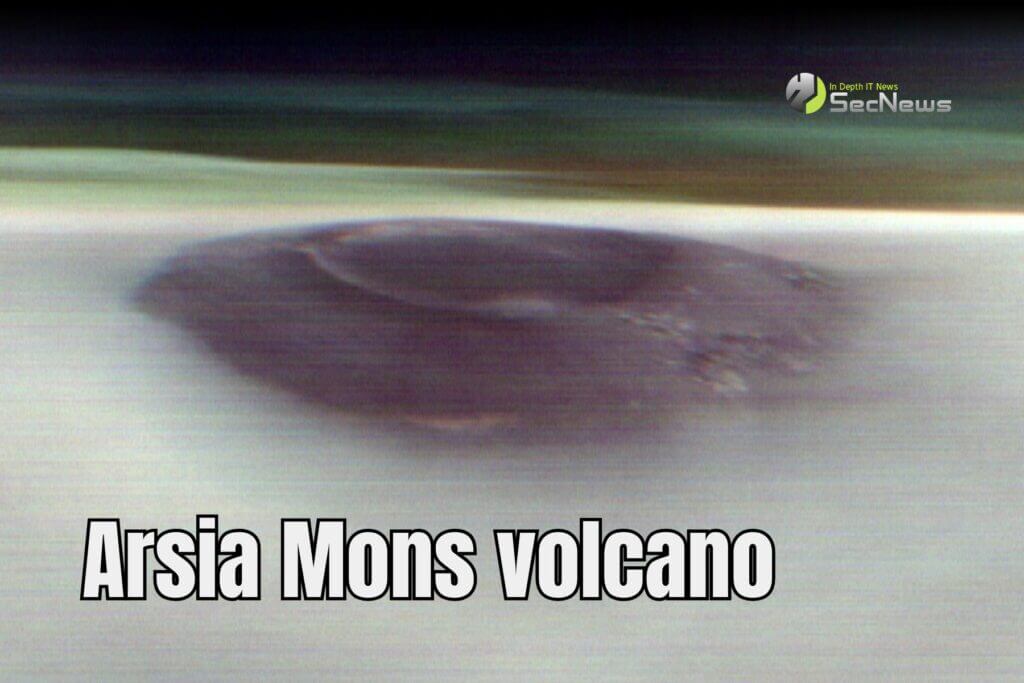
Arsia Mons is the southernmost volcano of the Tharsis triptych and is located in the western hemisphere of Mars, near the planet's equator. The alignment of these three volcanoes suggests the existence of a large fault that is likely responsible for the eruptions that formed them.
See also: Samples of hidden ocean beneath the surface of Mars
Northwest of the group is Olympus Mons, the tallest volcano in the solar system, reaching a height of 25 kilometers.
A new image taken by NASA's Mars Odyssey 2001 orbiter provides the first clear view of the summit of Arsia Mons, an area that has been difficult to photograph due to persistent cloud cover. This new image paves the way for more detailed scientific analyses of the planet's geology and climate. It's also the first time one of the Tharsis volcanoes has been captured on the horizon, offering a perspective reminiscent of the perspective astronauts would have from the International Space Station looking back at Earth.
See also: Elon Musk: The Sun threatens life on Earth – Mars is the solution!

The clouds covering Arsia Mons are composed primarily of water ice, which is retained in the Martian atmosphere for most of the year. According to NASA, the Martian atmosphere contains more water vapor than the upper layers of Earth. Unlike other regions of the planet, where dust storms and carbon dioxide clouds dominate, studying these water clouds helps scientists better understand the Martian atmosphere and weather conditions, critical for planning future missions and a possible human presence on Mars. Overall, the photograph is a valuable tool that promotes understanding and exploration of the planet.
Source: www.space.com
