

NASA 's Perseverance rover continues to provide unique images of the Red Planet, this time through a stunning selfie that captures the rover on the western rim of Jezero Crater . The new photo is not only a stunning snapshot of Mars, but also a valuable scientific tool that helps researchers study some of the oldest geological formations observed so far on the mission.
The image was taken on March 11, during the 1,797th day of the mission. Perseverance is seen perched on a rocky outcrop in the Lac de Charmes area, with the rugged and windswept Martian landscape stretching out in the background. The result may seem like a scene from science fiction, but it is actually one of the most important geological “windows” into the planet’s past.
See also: Curiosity and Perseverance reveal different sides of Mars
A mosaic of 61 images with enormous scientific value
The selfie was created by combining 61 different photostaken by the WATSONon Perseverance's robotic arm. Although the arm was used to capture the images, it remains "invisible" in the final result thanks to the photo editing and stitching process.
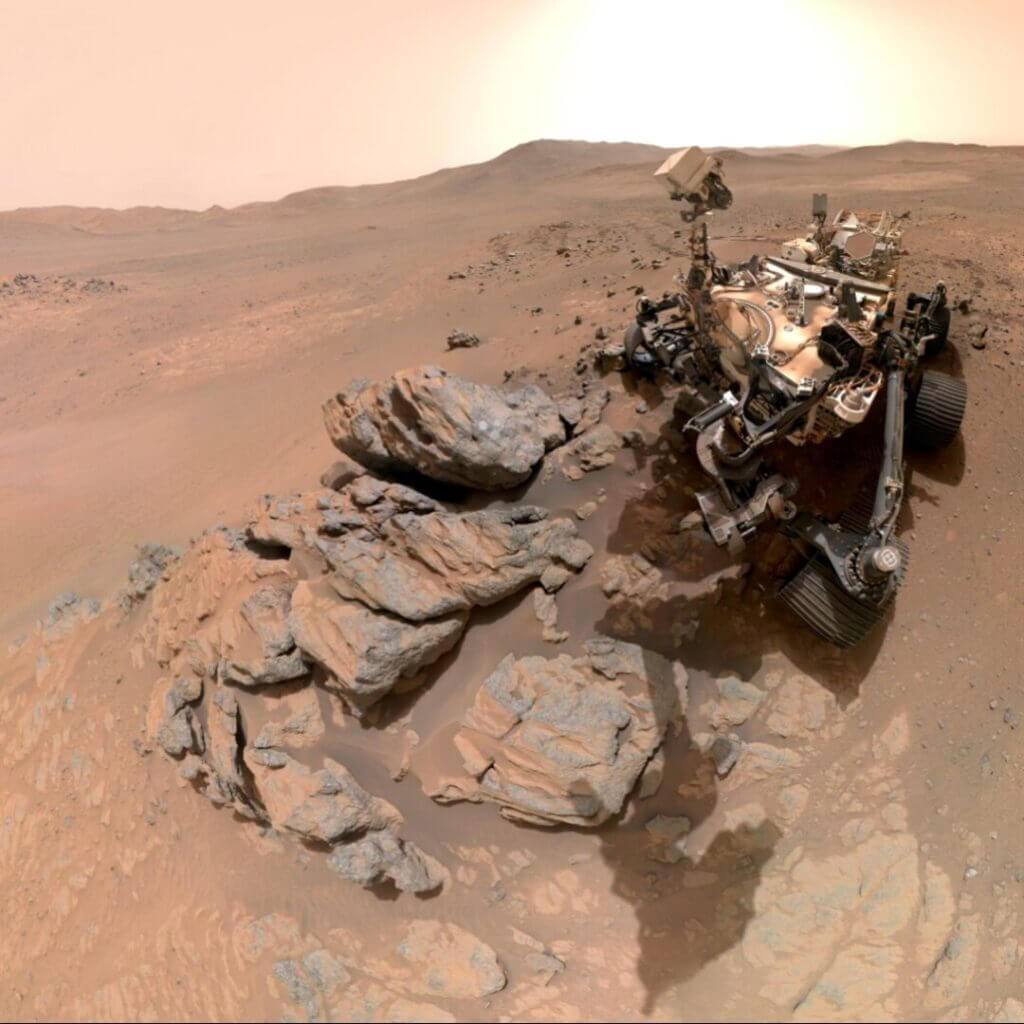
The rover is seen next to a newly drilled rock site where scientists are conducting analyses and collecting samples. The area is considered extremely important, as it may contain evidence from the earliest geological stages of Mars, billions of years ago.
According to Ken Farley, associate program scientist for Perseverance at Caltech, the new landscape likely reveals some of the oldest rocks the mission has examined to date. Of particular interest is a sharp ridge with sharply angular morphology, which differs significantly from the more rounded rocks in the foreground.
Researchers also believe that the area may contain a volcanic mound — a geological feature created when magma solidifies beneath the surface and is gradually revealed through erosion over millions or billions of years.
See also: Scientists have identified 10,000 candidate exoplanets
Jezero Crater May Have Once Hosted Life
Jezero Crater is one of the most important exploration targets on Mars. Scientists believe that about 3.5 to 4 billion years ago it was home to a lake and river delta, making it an ideal spot to search for signs of ancient microbial life.
The presence of water in the past is a key factor in the search for habitability. The sediments and minerals that formed at that time may have preserved chemical traces or microscopic structures associated with biological processes.
Perseverance is now exploring areas where rocks are significantly older than those encountered in the early stages of the mission. Scientists believe these geological layers can reveal information not only about the history of water on Mars but also about the formation of the planet's crust itself.
The mission that prepares the return of samples to Earth
Since landing in February 2021, Perseverance has collected dozens of samples , which are being stored in special titanium tubes. NASA plans to eventually return these samples to Earth via the Mars Sample Return, allowing scientists to analyze them with much more sophisticated laboratory tools.
See also: Giant geological structure on Mars strengthens evidence for ancient ocean
The importance of this process is considered enormous for planetary science. To date, analyses on Mars have been limited by the equipment carried by rovers. Returning real Martian samples to Earth could radically change our understanding of the planet's history.
Perseverance also serves as a technological testbed for future manned missions. Autonomous navigation, new drilling techniques, and advanced analytical instruments are being tested in real-world conditions on Mars.

The new image combines science and human imagination
Perseverance's recent selfie isn't just a stunning image for the public. It's a combination of science, technology, and human exploration ambition. These images help engineers assess the rover's condition, while also providing scientists with valuable data about the environment and geology of Mars.
At the same time, they create a rare sense of connection between Earth and another planet. Each new photo from Perseverance reminds us that humanity is now in an era where space exploration is no longer a science fiction theory, but an everyday reality.
