

A new discovery is changing what we knew about the history of water in our solar system. According to a recent study, liquid water continued to flow on the surface of the parent body of the asteroid Ryugu almost a billion years after its formation. The revelation comes from the analysis of microscopic samples of Ryugu collected by the Japanese Hayabusa2 and which arrived on Earth in December 2020.
The importance of the study is not limited to Ryugu itself, but extends to fundamental questions: how planets formed, what was the role of asteroids in the formation of the Earth, and how the oceans that formed the basis for the emergence of life arose.
See also: Perseverance rover: Did it really find evidence of life on Mars?
An asteroid-time capsule
Ryugu, with its characteristic rotating top shape, belongs to the category of carbonaceous asteroids. These celestial bodies are considered "time capsules" that preserve almost unchanged material from the dawn of our solar system, about 4.6 billion years ago.
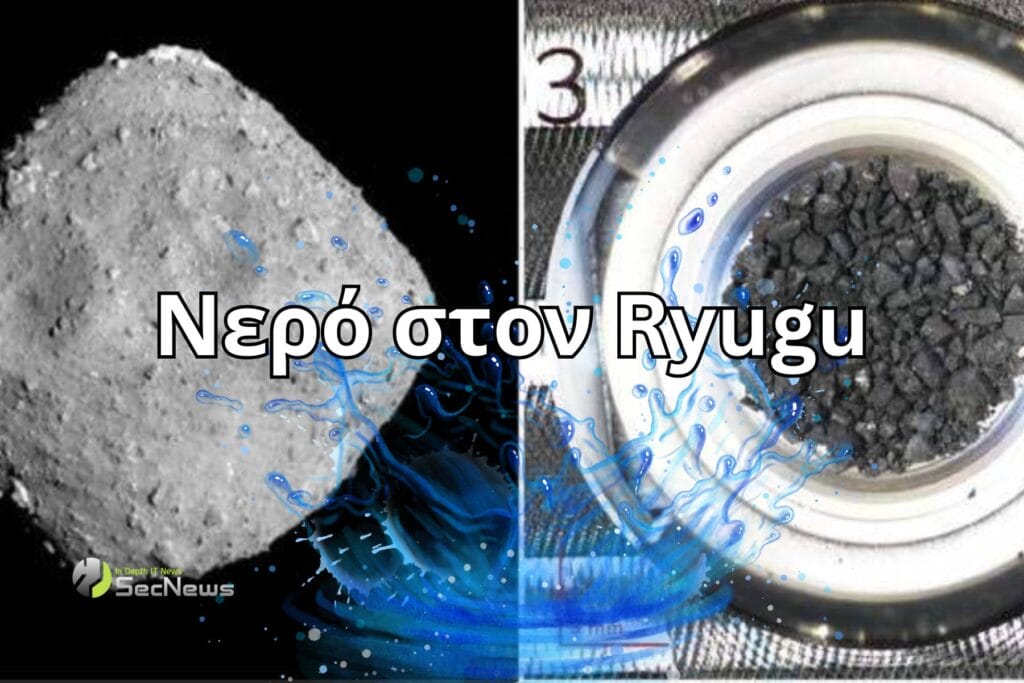
Until now, the prevailing scientific view was that liquid water on these asteroids existed only in their early stages, when heat from radioactive decay melted the ice inside them. Scientists believed that after a few tens of millions of years the water disappeared.
The new research shows that the reality was much more complicated. As Tsuyoshi Iizuka, a member of the research team from the University of Tokyo, said, "Ryugu preserved an impeccable record of water activity, demonstrating that fluids moved through its rocks much later than we expected. This changes the picture we had about the fate of water on asteroids."
The chemistry that revealed the secret
The key to the discovery was found in the study of radioactive isotopes of lutetium and hafnium in the samples. The "imbalance" the researchers detected did not match what we knew from meteorites that have reached Earth. The presence of more hafnium than expected indicated that the lutetium had been washed away by some liquid - a clear indication that liquid water had been circulating in the rocks for a much longer period of time.
See also: Fossilized micrometeorites: Findings for ancient CO2 levels
Scientists concluded that the most likely explanation was a violent impact. Another body hit Ryugu's parent asteroid, releasing ice that was buried deep within. The heat of the collision turned it into water, which then seeped through the rocks. This event likely also led to the breakup of the original body, eventually forming Ryugu itself.
Implications for Earth's history
If Ryugu held water for over a billion years, then the carbonaceous bodies of the solar system may have been much more water-rich than previously thought. This supports the hypothesis that asteroids played a key role in supplying Earth with waterthrough successive impacts on its surface.

This idea is not new, but the current study gives it strong support. If Earth did indeed receive water from bodies like Ryugu, then its early oceans and, by extension, the conditions for the emergence of life take on a different interpretation. As Iizuka emphasizes, "it suggests that the building blocks of our planet were much wetter than we imagined. This forces us to reconsider the initial conditions for the habitability of Earth."
The technological challenge
Remarkably, all of these conclusions were derived from samples that correspond to a fraction of a grain of rice. To achieve this analysis, the team developed new element separation techniques and highly precise methods for studying isotopes.
"The small sample size was a huge challenge," Iizuka admitted. "We had to design chemical processes that minimized material loss while simultaneously isolating different elements from the same fragment. Without that, we wouldn't have been able to detect such subtle signs of late water activity."
See also: James Webb: New discovery shatters planet formation theories
The next step
The team now plans to study phosphate veins in Ryugu samples, which could more accurately reveal the age of hydrological activity. They will also compare their results with analyses from the asteroid Bennu, samples of which will arrive on Earth in 2023 via NASA's OSIRIS-REx mission.
If the same evidence of late water presence is found on Bennu, then we may be talking about a broader phenomenon affecting many carbonaceous asteroids – and not a unique peculiarity of Ryugu.
A new picture of the solar system
The study, published in the journal Nature, sheds light on a more complex picture of the history of our solar system. Asteroids, previously thought of as frozen remnants of the past, are now proving to harbor more dynamic and prolonged processes.
This discovery not only answers the question "where did Earth's water come from", but also opens new avenues for understanding planetary evolution. Instead of seeing asteroids as passive witnesses, we are beginning to recognize them as active co-shapers of our planetary landscape.
