

Brad Smith , Microsoft ’s vice chairman and president , has officially taken control of the company’s communications division, in a move that marks a major overhaul of the tech giant’s public image strategy. Microsoft is moving the communications division out of the marketing department and into the Corporate, External, and Legal Affairs (CELA) organization, under Smith ’s leadership . The change comes at a critical time for the company as competition in artificial intelligence intensifies and the media landscape rapidly transforms.
See also: Fake LastPass Authenticator installer exploits Microsoft signed driver

The decision was announced in an internal memo from CEO Satya Nadella , who expressed gratitude to outgoing Frank Shaw , Microsoft 's Chief Communications Officer for nearly 17 years . Shaw had announced earlier this month that he was leaving the company after nearly three decades of service, leaving behind a significant void in Microsoft 's communications strategy . Nadella highlighted Shaw 's role as an advisor at critical times for the company, acknowledging his contributions to shaping Microsoft 's public image in recent years.
Brent Colburn , vice president of global public affairs, has been named interim chief communications officer to help manage the transition. Microsoft is already searching for a permanent replacement for Shaw , reviewing both internal and external candidates. The search process is expected to be completed by the end of this year.
Brad Smith and Microsoft's new communications strategy
Brad Smith is no stranger to the role of Microsoft. As vice president and president of the company, he travels the world meeting with governments, regulators, and customers, representing Microsoft on policy, legislation, and corporate strategy. The transfer of communications responsibility from Chief Marketing Officer Takeshi Numoto to Smith reflects a deeper philosophical shift: Microsoft wants its communications to be more authentic, more technical, and more directly connected to the essence of its work.
Nadella , and others close to Microsoftto become a bigger part of the company’s narrative. This approach is reminiscent of how AI startups, where researchers and engineers lead presentations, blog posts, and public communications. Companies like OpenAI and Anthropic have successfully adopted this model, giving their technical experts a voice in the public sphere.
As GeekWire points out, Microsoft ’s move is similar to how AI startups operate , with researchers leading the communications. This is no coincidence: Microsoft is in fierce competition with Google , Anthropic , and OpenAI to establish itself as one of the top AI labs in the world. According to Mustafa Suleyman , CEO of Microsoft AI , the goal is for Microsoft to become “ one of the top four labs in the world .”
See also: Microsoft 365: 5,700 accounts targeted in TeamFiltration campaign
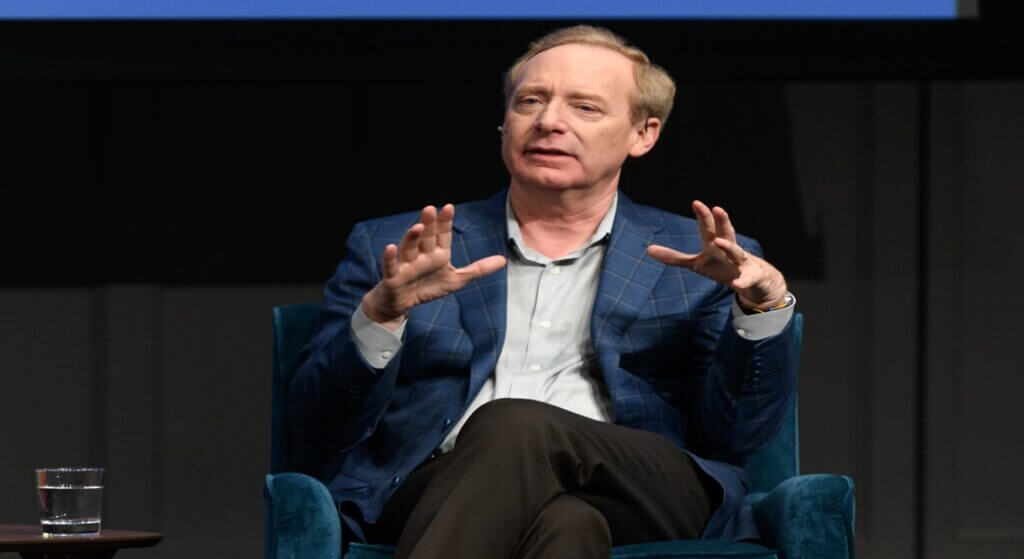
Brad Smith: His role in Microsoft's new communications landscape
Brad Smith is known for his ability to communicate complex ideas clearly and persuasively. He has played a central role in issues such as digital security, data protection, artificial intelligence regulation, and Microsoft with governments worldwide. This experience makes him ideal for a role that requires not only communication skills, but also a deep understanding of the business and technology environment.
Nadella stressed that Smith “authentically embodies the voice of Microsoft,” bringing a deep understanding of the business, strong stakeholder relationships, and the ability to communicate complex ideas with clarity and persuasion. These attributes are especially valuable in an era when public trust in big tech companies is under question and transparency is a critical success factor.
The restructuring comes at a time when Microsoft is facing multiple challenges: competition in the artificial intelligence space, regulatory pressures in the US and Europe, and the need to maintain customer and investor trust. In this context, choosing an experienced legal and political executive like Brad Smith to lead communications is not just an organizational change — it is a strategic decision.
The significance of change for Microsoft and the industry
The integration of communications into the CELA under Brad Smith reflects a broader trend in the technology industry: companies recognize that communications is not just about marketing, but about corporate governance, legal compliance, and public policy. Combining these functions under a single leadership allows for more coherent and effective communication to all stakeholders.
Nadella described today’s media environment as “increasingly fragmented and noisy,” emphasizing the need for Microsoft to stay focused on its mission, earn trust every day, and find new ways to directly communicate with all stakeholders. In this context, empowering “internal voices” — engineers, researchers, salespeople — is a central element of the new strategy.
It's worth noting that Suleyman, in an interview with The Verge earlier this year, stated that his goal for Microsoft is to create the best frontier models in the world. The communications restructuring under Brad Smith seems to serve exactly that goal: to present Microsoft as a serious player in the AI space, capable of competing on equal terms with OpenAI, Google DeepMind , and Anthropic.
See also: EvilTokens: Microsoft dismantles AI-powered phishing platform

In short, assigning Microsoft to Brad Smith is a bold and strategically deliberate move. In a world where trust in tech companies is eroding and competition in artificial intelligence is intensifying, Microsoft is choosing to put one of its most trusted and experienced representatives forward. The impact of this change will be seen in the coming months, as the company searches for Shaw and shapes its new communications identity.
