

China is taking another major step in boosting its space capabilities, announcing plans to develop a comprehensive early warning system for asteroids approaching Earth. Although official announcements from the China National Space Administration (CNSA) were not accompanied by extensive technical details, recent scientific publications and presentations to international organizations reveal that Beijing is working on a particularly ambitious planetary defense.
The initiative was unveiled on June 30, International Asteroid Day, underscoring the importance China attaches to preventing potential space threats. The plan is based on a combination of ground-based observatories and satellite infrastructure, creating a single monitoring network that will be able to detect objects that currently go unnoticed.
A network that will operate day and night
According to Li Mingtao, chief scientist of the CNSA's Asteroid Monitoring and Early Warning Research Center, there is currently no known asteroid that directly threatens Earth. However, that does not mean that the risk does not exist.
See also: Hayabusa2: Impressive pass by asteroid Torifune
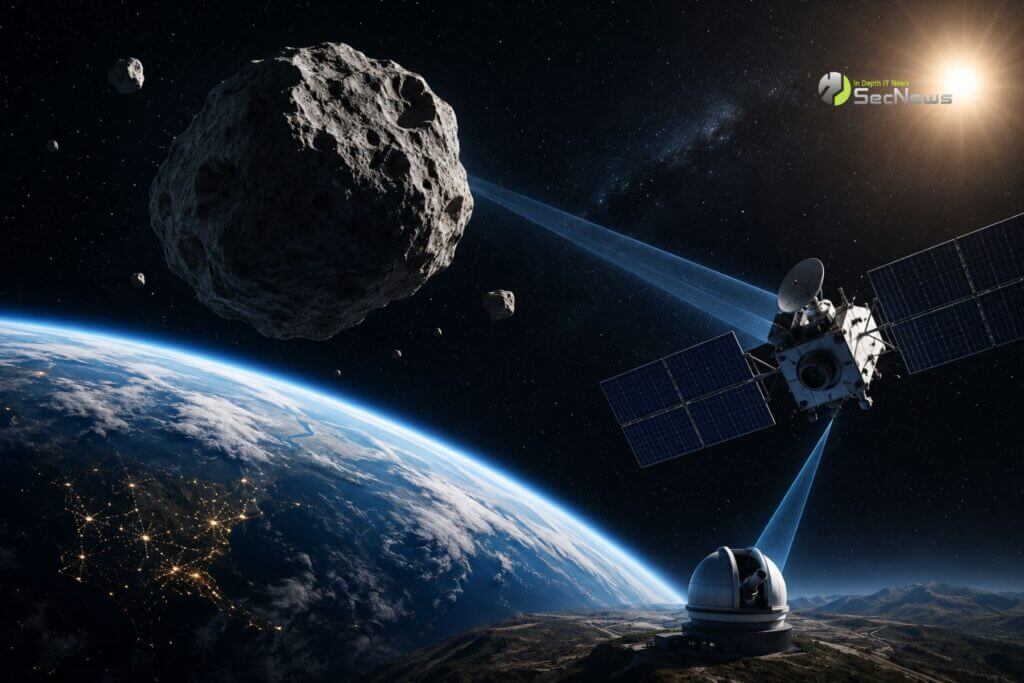
The biggest challenge is that a significant percentage of asteroids approaching our planet remain unknown. For this reason, China plans to install large optical telescopes in strategically selected areas, which will work with a constellation of tracking satellites.
The great advantage of space observatories is that they are not affected by clouds, weather conditions or the alternation of day and night. At the same time, they will be able to detect asteroids approaching Earth from the direction of the Sun, an area where ground-based observations are significantly difficult due to intense solar radiation.
The lesson from the Chelyabinsk meteorite
The need for better surveillance is not theoretical. In 2013, the meteorite that exploded over Chelyabinsk, Russia, caused widespread damage and injured more than 1,500 people.
The object approached Earth directly from the direction of the Sun and was only detected after it had already entered the atmosphere . The incident is still considered one of the strongest arguments in favor of the creation of space-based early warning systems
See also: 3 billion years old: The oldest asteroid crater on Earth
Thousands of asteroids remain unknown
According to data presented by CNSA, scientists have already recorded more than 40,000 asteroids moving near Earth.
See also: 3 billion years old: The oldest asteroid crater on Earth
Most large asteroids, with a diameter of more than one kilometer, have now been identified at a rate exceeding 95%, which significantly reduces the risk of a global catastrophe without warning.
But the picture changes in the smaller categories. Asteroids with a diameter of about 140 meters, which can cause complete destruction in an entire region or even a small country, have been recorded in less than 50% of cases. This means that tens of thousands of potentially dangerous objects have still not been detected.
The possible orbits of Chinese satellites
Recently published scientific studies reveal that Chinese researchers are considering four different orbits for future surveillance satellites.
Among these, the L1 Lagrange point of the Sun-Earth system, approximately 1.5 million kilometers from our planet, as well as orbits that follow or precede the Earth in its orbit around the Sun.
Also being considered is a heliocentric orbit similar to that of Venus, which offers an ideal viewing angle for detecting objects approaching from the sun's side, as well as a distant retrograde orbit around Earth.

Beyond telescopes, radars are also coming
The Chinese strategy is not limited to visual observations. The plans also include the use of ground-based radars, which can calculate the orbits of asteroids with much greater accuracy when they approach Earth.
See also: Asteroid the size of a blue whale is heading towards Earth – how you will see it
The China Compound Eye (Fuyan) project, an advanced facility near Chongqing, which is already used to monitor Solar System objects , is also expected to play a significant role
Following the collapse of the historic Arecibo in Puerto Rico in 2020, the international scientific community is looking for new radar infrastructure. If China invests aggressively in this area, it could fill a significant gap in global monitoring capabilities.

International cooperation and the eye on 2029
Experts say planetary defense cannot be the responsibility of just one country. NASA is developing the NEO Surveyor, while the European Space Agency is moving ahead with the NEOMIR, aiming to enhance asteroid detection from space. At the same time, China is preparing its own mission to test asteroid deflection techniques, similar to NASA's successful DART mission.
International cooperation is even more important in view of 2029, when the asteroid Apophis will make one of the closest passes ever recorded, passing within a distance of geostationary satellites. The same year has already been designated the International Year of Planetary Defense, reminding us that, despite significant progress in recent years, humanity is still aware of less than half of the potentially hazardous asteroids in Earth's neighborhood. The development of new monitoring systems and the exchange of data between space agencies will be key factors in responding to any future threat in a timely manner.
