

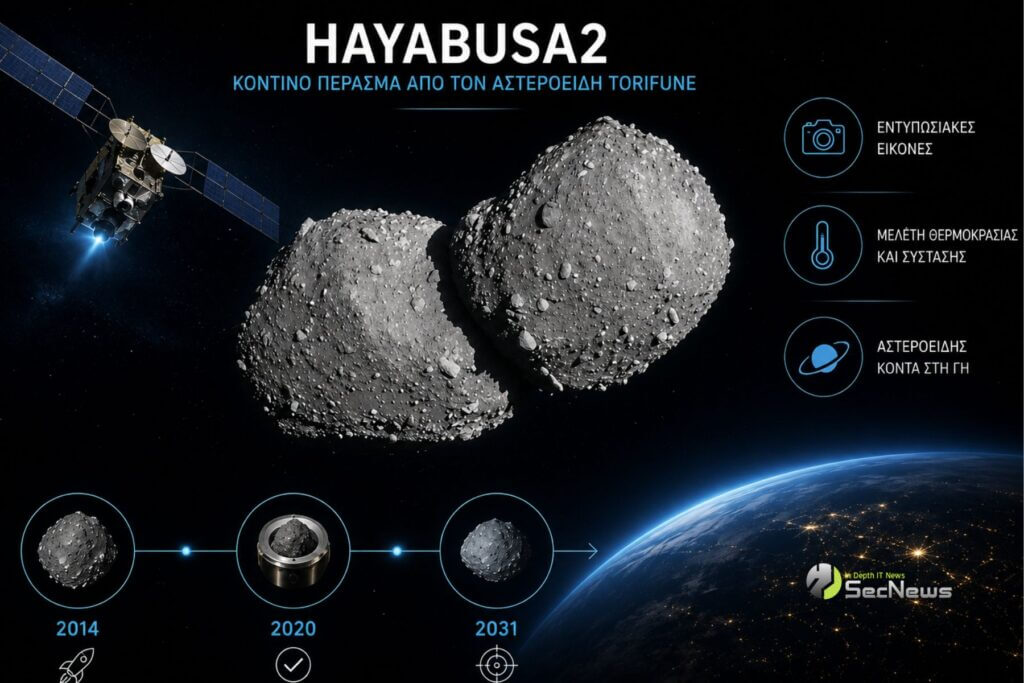
The Japan Aerospace Exploration Agency (JAXA) Hayabusa2 spacecraft has achieved another major milestone in its multi-year mission, making an extremely close flyby of the asteroid Torifune . The space rock, estimated to be about 450 meters long, is located nearly 100 million kilometers from Earth, and is another stop in the ambitious program of exploring small bodies in the Solar System .
The approach took place on July 5 and is considered one of the most demanding high-speed passes ever attempted by a spacecraft near an asteroid. Despite technical difficulties, Hayabusa2 successfully completed the maneuver, confirming once again the reliability of its systems and JAXA's extensive experience in deep space missions.
High-resolution images reveal new evidence
During the flyby, Hayabusa2 captured stunning images of Torifune with its optical camera, which it successfully transmitted to JAXA control stations. The images provide scientists with a clearer picture of the morphology and geological features of the asteroid's surface.
See also: Researchers observed the event horizon of a black hole very closely
The spacecraft also collected additional scientific data, which will be gradually transmitted to Earth and analyzed in the coming months. This information is expected to contribute to a better understanding of the composition and evolution of asteroids that move close to our planet's orbit.
Thermal imaging reveals extreme conditions
Of particular interest are the images taken by the Mid-Infrared Camera (TIR). This scientific instrument allows the measurement of surface temperature, thermal inertia and soil roughness, data that help researchers draw more reliable conclusions about the asteroid's structure.
The first thermal images show strong temperature differences between bright and shadowy areas. The areas directly exposed to sunlight appear significantly warmer, while the areas remaining in shadow are noticeably cooler, confirming the particularly inhospitable environment that prevails in such celestial bodies.
A near-Earth asteroid of particular interest
Torifune completes one orbit around the Sun every 383 days and rotates on its axis approximately every five hours. It belongs to the Apollo asteroid, a class of objects whose orbits intersect with Earth's.
See also: GJ 3378b: Probabilities of alien life on a nearby "super-Gaia" planet
This approach was not part of the original mission plan. Instead, it was added later as an opportunity for additional scientific research, despite the fact that experts on the team had pointed out that it was a demanding and potentially dangerous maneuver, as several features of Torifune remained unknown until the last minute.
From Ryugu to the next big target
The new success adds to the long list of achievements of Hayabusa2, which was launched in December 2014 with the main goal of collecting samples from the asteroid Ryugu. The mission was completed with complete success in 2020, when the capsule with the valuable material safely returned to Australia.

Analysis of the samples revealed valuable information about the early stages of the formation of the Solar System, while scientists identified organic compounds, including the five nitrogenous bases that are fundamental components of DNA and RNA. The discovery strengthens theories that some of the basic building blocks of life could have been transported to the young Earth via asteroids.
See also: NASA: Rescue mission for Swift space telescope falling towards Earth
Next destination: the tiny 1998 KY26
Hayabusa2's mission is far from over. Its next stop is asteroid 1998 KY26, one of the smallest ever chosen as a target for space exploration. With a diameter of just 11 meters, it is considered an ideal "laboratory" for studying small asteroids and their behavior in space.
Hayabusa2 is scheduled to arrive in 2031, when the spacecraft will attempt to orbit the asteroid and, if conditions permit, make a new landing. The data it will collect is expected to significantly enrich scientists' knowledge of the structure, composition and evolution of these small space bodies, while contributing to a better understanding of the origins of the Solar System.
