

NASA is taking another important step towards implementing the Artemis program , presenting new contracts for robotic lunar landing missions , as well as a particularly ambitious plan to utilize the PROMISE test rover as an exploration mission to the south pole of Earth's natural satellite.
During its monthly briefing on the future lunar base strategy, the space agency announced that Astrobotic, Firefly Aerospace and Intuitive Machines are undertaking a total of four landing missions. These missions will carry scientific instruments and technological equipment, helping to collect critical data before humans return to the Moon.
Gradual approach before human presence
NASA administrator Jared Isaacmanstressed that the agency's strategy is based on the gradual evolution of missions, following the successful model of the Apollo.
As he noted, NASA does not seek to move directly to a permanent human installation, but rather progresses through successive stages of testing, technological maturation, and operational experience. This philosophy reduces risk and allows for the evaluation of critical technologies in real-world conditions.
See also: Maybe the Earth will survive the end of the Sun after all
PROMISE: A Mars rover takes on a new role
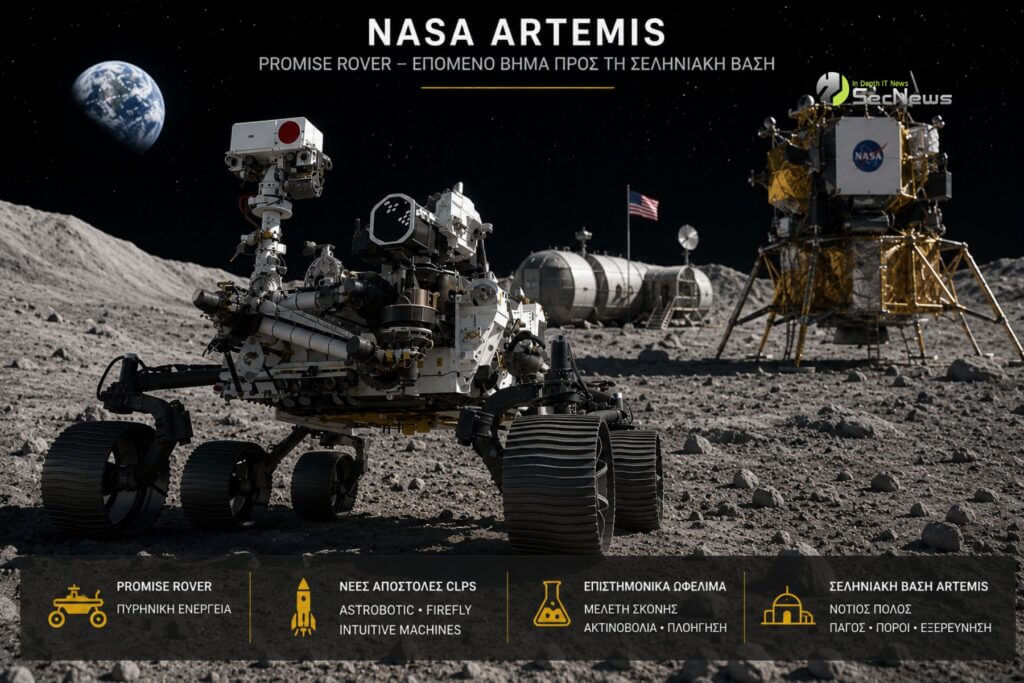
Of particular interest was the revelation of the plan to utilize PROMISE (Polar Rover for Observation, Mapping and In-Situ Exploration), a vehicle that until now has operated as a test platform at NASA's Jet Propulsion Laboratory.
This particular vehicle was built to closely replicate the characteristics of the Curiosity and Perseverance, allowing engineers to test software and procedures before implementing them on real missions to Mars.
NASA is now considering upgrading PROMISE and sending it to the Moon, turning a valuable test tool into an active explorer of the South Pole.
The advantage of nuclear energy
One of the most important advantages of PROMISE is its energy autonomy. The vehicle uses a radioisotope thermoelectric generator (RTG), a technology that generates electricity from the natural decay of radioactive material.
Unlike most lunar rovers that rely solely on solar panels, PROMISE can continue to operate even during the Moon's long periods of darkness. This feature is considered particularly important for the areas around the South Pole, where NASA plans to establish the first permanent human outpost due to the possible existence of reserves of frozen water.
CLPS missions take on a pivotal role
At the same time, NASA continues to invest in the Commercial Lunar Payload Services (CLPS) program, through which private aerospace companies undertake the transportation of scientific cargo to the Moon.
See also: 3 billion years old: The oldest asteroid crater on Earth
By 2029, the agency aims to launch about 20 missions that will serve as a precursor to Artemis manned missions. These include Firefly Aerospace's Blue Ghost, Intuitive Machines' Nova-C, and Astrobotic's Griffin, while Blue Origin continues preparations for Blue Moon Mark 1, despite recent difficulties with the New Glenn rocket program.

Scientific data before astronauts
Each CLPS mission will carry multiple NASA science payloads, including the SCALPSS, which will study the interaction of engine exhaust with lunar dust, laser reflectors for high-precision navigation tests, and space radiation measurement instruments.
This data is considered essential for planning safe long-duration missions, as operating a permanent base requires detailed knowledge of the environment, geological conditions and potential hazards faced by people and equipment.
See also: NASA rover detects unprecedented amount of complex organic molecules on Mars
NASA’s strategy clearly demonstrates that returning to the Moon is not just another space mission, but the first step toward a long-term human presence beyond Earth. Leveraging existing technologies, such as PROMISE, combined with public-private partnerships, accelerates the development of the necessary infrastructure and significantly reduces costs. If today’s tests are successful, the next decade could usher in a new era of space exploration, with the Moon transformed from a mission destination to a permanent staging area for future missions to Mars.
