

New research suggests that Mars may once have been a blue planet, with a vast ocean and many rivers.
An international team of scientists has uncovered striking geological formations on Mars that suggest the planet may have once hosted vast bodies of water, comparable in size to Earth's Arctic Ocean. The discovery is based on satellite images that reveal river deltas and deposits that resemble areas where rivers flow into standing water.
The findings support the theory that Mars was not always a dry, red planet, but was likely a "blue" world with flowing rivers and a large ocean in its northern hemisphere.

Focus on Coprates Chasma
The study, led by scientists from the University of Bern and the Italian INAF–Osservatorio Astronomico di Padova, focused on geological formations near the southeastern edge of Coprates Chasma, part of the vast Valles Marineris canyon system.
See also: Curiosity: Impressive panoramic image of Mount Sharp on Mars
The formations, described as fan-shaped deltas, resemble deposits from rivers flowing into stagnant water — a pattern that, on Earth, is associated with areas where rivers enter lagoons or oceans. The discovery provides strong evidence for the existence of an ancient ocean on Mars, which likely covered large areas of the northern hemisphere.
Mars: Detailed images reveal ancient topography
PhD researcher Ignatius Argadestya , lead author of the study, said the Martian landscape has features of mountainous regions on Earth, but the deltas he observed near the base of one mountain stand out in particular. The data was collected by several spacecraft orbiting Mars, including ESA's ExoMars Trace Gas Orbiter , equipped with the CaSSIS camera system , led by Professor Nicolas Thomas. The CaSSIS camera has been providing high-resolution colour images since 2018, making a key contribution to mapping ancient rivers and deltas on the Martian surface.

Additional images also came from ESA's Mars Express and NASA's Mars Reconnaissance Orbiter spacecraft
See also: Mars: Light-colored rocks suggest there was once a tropical oasis
Ancient coastline sign and blue planet
At the lower elevations of the canyon system, scientists have identified deposits similar to those found on Earth when rivers flow into the oceans. Professor Fritz Schlunegger of the University of Bern points out that the sediment patterns indicate the mouth of a river flowing into an ancient ocean, providing clear evidence of a coastline on Mars.
The size of this ocean, the researchers say, was at least comparable to Earth's Arctic Ocean. While previous studies had suggested its existence, they were often based on less precise or indirect data. The current study, published in npj Space Exploration, offers one of the most comprehensive visual representations to date based on direct optical evidence.
See also: Perseverance: NASA detects "small lightning" on Mars
What remains to be discovered?
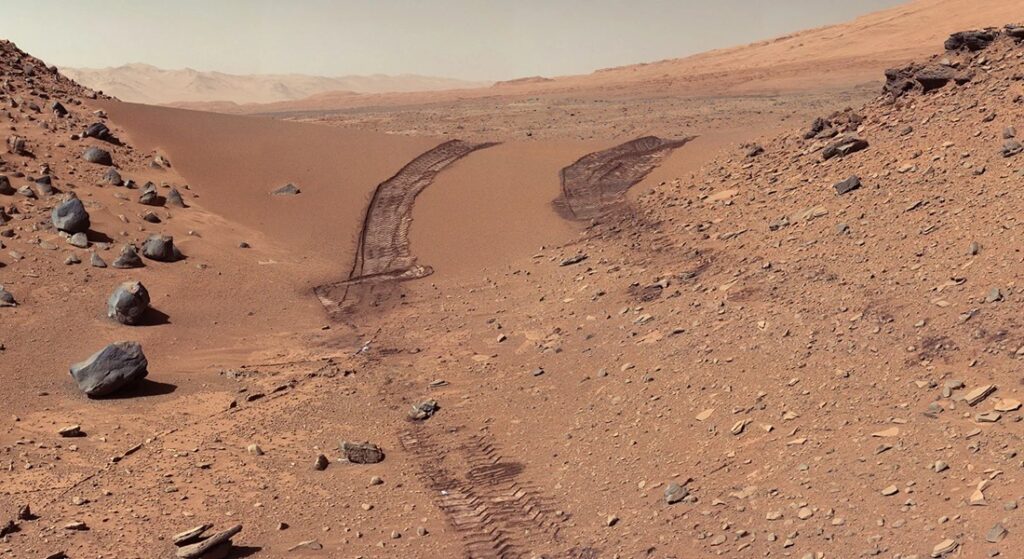
Today, wind-blown dunes on Mars cover much of the delta's ruins, but their original forms are still visible. Scientists now plan to analyze the composition of the region's minerals and soilsto better understand weathering processes and ancient environmental conditions on Mars.
The findings reinforce the idea that Mars was not always a dry planet and that the presence of stable water in the past may have created favorable conditions for possible life. By combining data from multiple missions, the scientific community is now getting closer to understanding the ancient hydrological system of the red planet, opening new horizons in planetary geology and the search for life beyond Earth.
