

A new study suggests that Mars was once a place with humid climates and heavy rainfall, similar to those seen in tropical regions on Earth.
See also: Perseverance: NASA detects "small lightning" on Mars
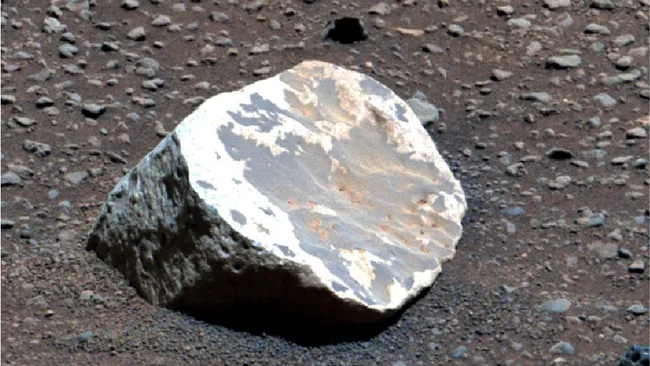
Researchers were struck by unusually light-colored rocks discovered by NASA's Perseverance rover on the surface of Mars. Upon closer analysis, the rocks turned out to be kaolinite, a type of clay rich in aluminum, according to a study published Dec. 1 in the journal Communications Earth & Environment.

On Earth, kaolinite almost always forms in very hot and humid environments, such as those found in rainforests. It usually forms in rocks that have been stripped of all other minerals after millions of years of regular rainfall. However, today's Mars is known for its cold and dry climate. The team of scientists compared the structure of Martian kaolinite, examined with various instruments on Perseverance, with samples from South Africa and San Diego. The rocks appeared remarkably similar, suggesting that they formed in a similar way.
See also: ESCAPADE: Two satellites will reveal how Mars lost its atmosphere
Satellite images of the Martian surface appear to show larger deposits of kaolinite elsewhere on the planet, but Perseverance and other robots have not explored these areas yet.
The presence of kaolinite on Mars strengthens the hypothesis that the Red Planet was once a wet oasis, although exactly when and how it dried out remains a matter of debate.
See also: Volcanic eruptions may have left ice on Mars' equator

Leading theories suggest that the planet lost its water sometime between 3 and 4 billion years ago, when its magnetic field weakened enough for solar winds to strip away its atmosphere. However, this process was likely complex and multifaceted. Scientists believe that studying these ancient clay rocks could provide important information about when and how Mars lost its water.
