

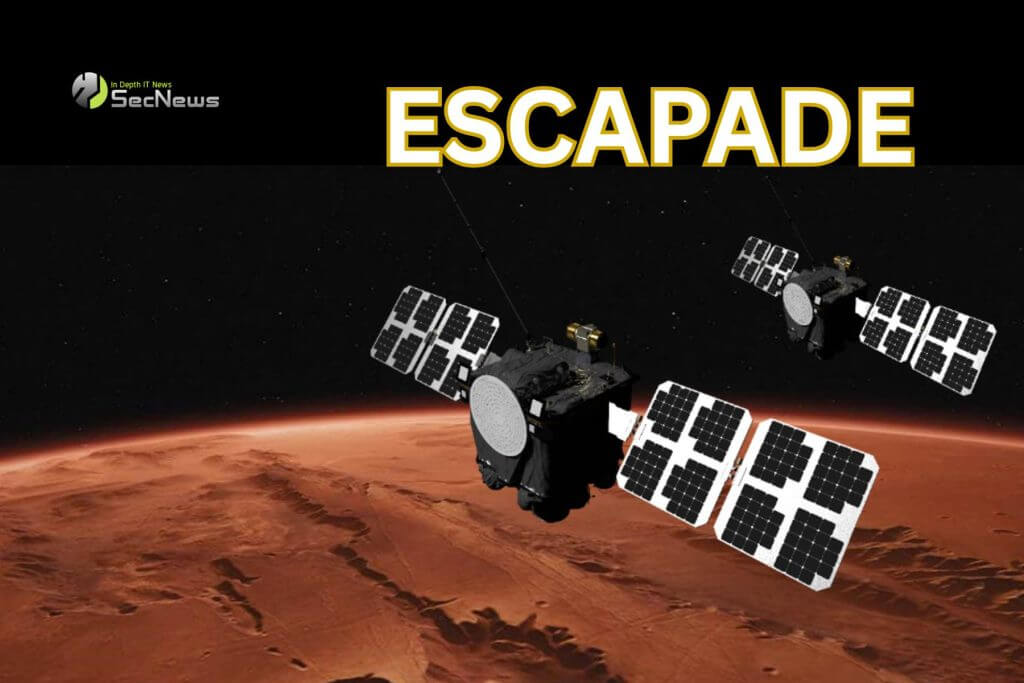
Mars is back in the spotlight for NASA . Two identical satellites will launch together with the aim of shedding light on one of the greatest mysteries of our Solar System: how the Red Planet lost its thick atmosphere and liquid water that once made it hospitable to life. The new mission, called ESCAPADE (Escape and Plasma Acceleration and Dynamics Explorers) , aims to map the processes that transformed a potentially habitable world into a frozen wasteland .
An $80 million mission station
The ESCAPADE launch was scheduled for Sunday, November 9 , but was postponed to noon due to bad weather. The satellites will begin their journey from Cape Canaveral , Florida, aboard New Glenn . The two small satellites, nicknamed Blue and Gold, will orbit Mars and operate in concert, providing the first-ever three-dimensional view of the planet’s interaction with the solar wind — the stream of charged particles constantly spewing out from the Sun.
See also: Strange planet devours 6 billion tons of matter per second
“Understanding how the solar wind affects the Martian atmosphere is critical to understanding its climate evolution,” says Robert Lillis, the mission’s principal investigator and associate director for Planetary Science at the University of California, Berkeley. “ESCAPADE gives us a stereoscopic perspective – two eyes on the Martian sky at once,” he says.
From a watery world to a dry desert
Geological evidence suggests that Mars once had rivers, lakes, and minerals that formed in the presence of water. But about 4 billion years ago, its magnetic field began to weaken. Without this protective "shield," the solar wind gradually stripped away the atmosphere, leaving a thin veil of gases today.
Previous missions, such as Mars Global Surveyor, MAVEN and Hope , have revealed that Mars maintains small magnetic "bubbles" in its crust, but not a single, planetary magnetic field. However, each mission observed only one point at a time. With two satellites simultaneously, ESCAPADE will be able to track changes over minutes, allowing for unprecedented measurements.
See also: On Saturn's Titan, water and oil mix
Scientific collaboration between many universities
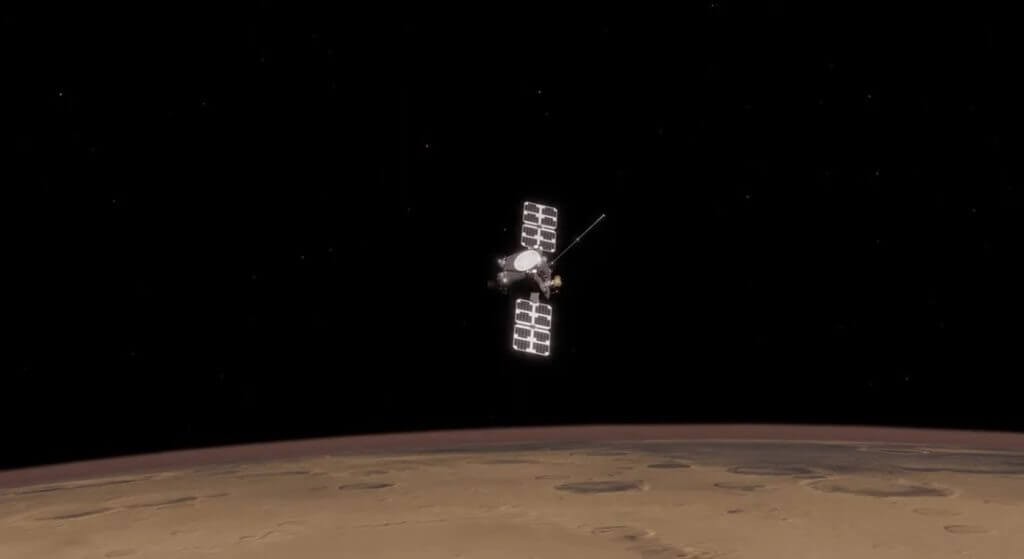
Each satellite, about the size of a photocopier, carries identical instruments. UC Berkeley's electrostatic analyzers will detect charged particles escaping from the planet, the Goddard Space Flight Center's magnetometer will measure the strength of magnetic fields, and plasma sensors from Embry-Riddle University will examine the properties of the plasma.
Additionally, cameras designed by students at Northern Arizona University will capture images of the planet and perhaps capture the mysterious green aurora of Mars – a phenomenon that has only recently been detected.
Smart route via Lagrange Point
Instead of following the classic direct path to Mars, ESCAPADE will first move towards a Lagrange point, a gravitational “balance point” between the Earth and the Sun. It will remain there for about a year before beginning its journey to Mars in 2026. This alternative route could serve as a model for future missions, making them less dependent on the narrow launch windows that occur every two years.
New perspectives for human exploration
When the satellites reach Mars—expected in September 2027—they will spend seven months adjusting their orbits. They will then begin joint observations lasting six months, then separate to map the flow of energy and matter between the Martian atmosphere and the solar wind in three dimensions.
This data could prove valuable for future manned missions. Understanding the behavior of the ionosphere will help improve communication and navigation on its surface — vital for human survival.
See also: Halloween: NASA spotted a scary face on the Sun!
In addition, ESCAPADE measurements may indicate whether liquid water exists underground, as recent seismic data from InSight suggests. Such a finding would be a milestone not only for astrobiology, but also for future human settlement on Mars.

"People are persistent"
"Certainly, establishing a human base on Mars will be a huge challenge," Lillis admits. "But people are persistent."
ESCAPADE is not just another space mission; it is a window into the past and future of Mars — and perhaps, a glimpse into the future of humanity itself.
