

Astronomers discover many planets every day orbiting stars outside our solar system. But in the summer of 2022, teams working on NASA 's Transiting Exoplanet Survey Satellite found some particularly intriguing planets orbiting in the habitable zones of their parent stars, known as super-Earths.
See also: How do planets form? A "baby Jupiter" gives new clues

One of the planets is 30 percent larger than Earth and orbits its star in less than three days. Another is 70 percent larger than Earth and may host a deep ocean. These two exoplanets are called super-Earths and are more massive than Earth but smaller than giants like Uranus and Neptune.
Earth is still the only place in the universe that scientists know of that has life. So it makes sense to focus the search for life on planets with properties similar to Earth's. But the research suggests that astronomers' best chance of finding life on another planet is likely to be on a super-Earth similar to the ones recently discovered.
Most super-Earths orbit cool dwarf stars, which are less massive and live much longer than the sun. Astronomers estimate that there are tens of billions of super-Earths in habitable zones where liquid water could exist in our Milky Way Galaxy. Since all life on Earth uses water, water is considered critical to the habitability of a planet.
Based on current predictions, about a third of all exoplanets are super-Earths, making them the most common type of exoplanet in Milky Way Galaxy . The closest one is just six light-years from Earth.
See also: NASA: More than 5,000 exoplanets have been discovered
Another reason super-Earths are ideal targets in the search for life is that they are much easier to detect and study than Earth-sized planets. There are two methods astronomers use to detect exoplanets. One is to look for a planet's gravitational influence on its parent star , and the other is to look for a brief dip in a star's light as the planet passes in front of it. Both of these detection methods are easier with a larger planet.
So it turns out that Earth is not the best of all possible planets for habitation.
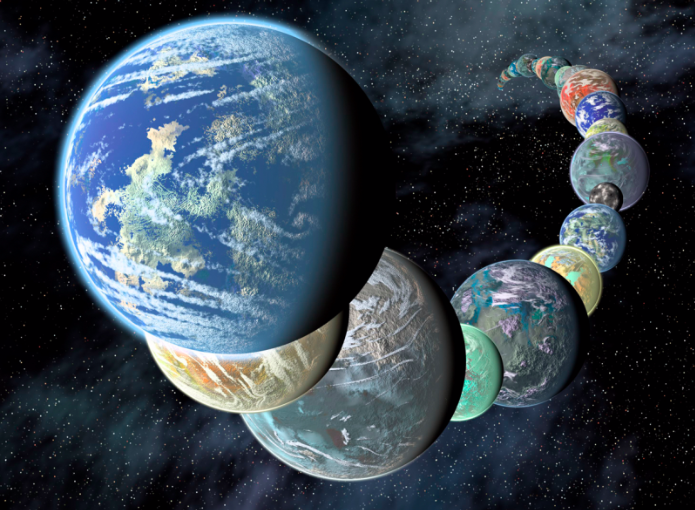
Due to Earth's tectonic activity and changes in the brightness of the sun, the climate has shifted over time from very hot to very cold across the entire planet. Earth was uninhabitable for humans and other larger creatures for most of its 4.5 billion years. Simulations suggest that Earth's long-term habitability was not inevitable, but rather a matter of luck.
Researchers have come up with a list of characteristics that make a planet highly favorable for life. Larger planets are more likely to be geologically active, a trait that scientists believe would promote biological evolution. So, the most habitable planet would have about twice the mass of Earth and be between 20 and 30 percent larger in volume. It would also have oceans that are shallow enough for light to stimulate life all the way to the seafloor and an average temperature of 25 degrees Celsius. It would have an atmosphere thicker than Earth's to act as an insulating blanket. Finally, such a planet would orbit a star older than the sun and have a strong magnetic field that protects against cosmic radiation. Scientists believe that these characteristics combined would make a planet highly habitable.
See also: Researchers searched for aliens in 144 exoplanets and billions of stars
By definition, super-Earths have many of the characteristics of a habitable planet. To date, astronomers have discovered two dozen exoplanets that are theoretically more habitable than Earth.
Recently, there has been an exciting addition to the list of habitable planets. Astronomers have begun to discover exoplanets that have been ejected from their star systems, and there could be billions of them orbiting Milky Way Galaxy . If a super-Earth were ejected from its star system and had a thick atmosphere and a watery surface, it could sustain life for tens of billions of years, far longer than life on Earth could sustain before the sun died.
