

About 322 light-years from Earth, a planet named WASP-189b orbits one of the hottest stars in the universe, HD 133112.
See also: Robot performed laparoscopic surgery on pigs without human assistance
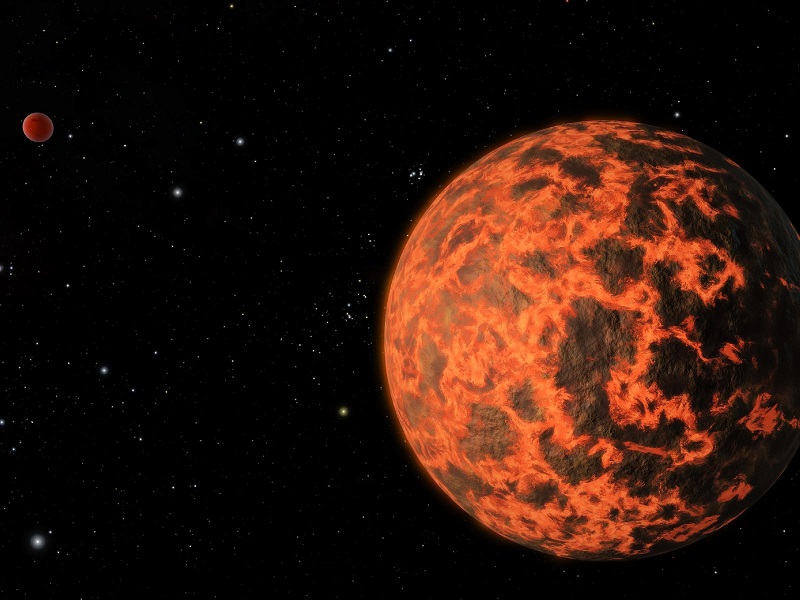
Twenty times closer to its star than we are to the sun, WASP-189b blisters with a daytime temperature of 5,792 degrees Fahrenheit (3,200 degrees Celsius). The hot exoplanet is made of gas and is about 1.5 times the size of Jupiter — something like 1,950 Earths could fit inside it.
See also: SpaceX rocket part is on collision course with the moon
Needless to say, since its discovery in 2018, scientists have understandably argued that WASP-189b is nothing like our home planet. But in a paper published Thursday in the journal Nature Astronomy, a team of researchers has found a way for Earth to relate to its distant cosmic relative. The two could chat about their layered atmospheres, and Earth could gossip about ozone holes and climate change.
Here on Earth, we have an atmospheric layer called the troposphere that starts at sea level and holds a ton of water vapor. Clouds, and therefore weather like rain and snow, come from there. Above that, we have the stratosphere, where the ozone layer is located, which protects us from the sun's ultraviolet radiation.
However, while analyzing WASP-189b by measuring starlight passing through the intensely heated exoplanet's atmosphere, Hoeijmakers and his colleagues found a unique chemical signature that shook up our understanding of planetary atmospheres. It showed that the distant sphere's atmosphere may have layers like Earth's.
As it moved away, the planet WASP-189b emitted signals of iron, chromium, vanadium, magnesium and manganese. But more importantly, says Prinoth, “in our analysis, we saw that the ‘fingerprints’ of the different gases were slightly altered compared to our expectations. We believe that strong winds and other processes caused these changes.”

See also: NASA's James Webb Telescope has reached its final destination
These adjustments varied in the range of elements detected, similar to how Earth's water vapor and ozone are affected differently by natural processes due to the atmospheric layer. This suggests the existence of layers on WASP-189b as well.
The team also discovered traces of titanium oxide in WASP-189b's atmospheric shield. "Titanium oxide absorbs short-wave radiation, such as ultraviolet radiation," said Kevin Heng, an astrophysicist at the University of Bern and co-author of the study. "Its detection could indicate a layer in WASP-189b's atmosphere that interacts with stellar radiation similar to how the ozone layer on Earth does."
So WASP-189b may have its own ozone layer.
Information source: cnet.com
