

After three years of exploring known exoplanets, the James Webb Space Telescope (JWST) has achieved a major milestone: the discovery of a new exoplanet, TWA 7b.
TWA 7b stands out for another reason: it has the lowest mass ever observed (in this way) for an exoplanet to date. Its mass is estimated to be 0.3 times the mass of Jupiter. It is about ten times lighter than any other exoplanet imaged with a similar technique.
See also: Tiny exoplanet similar to Earth found very close to us
The planet was discovered in the star system TWA 7 (or CE Antliae), which is located 111 light-years from Earth. It is a star low-mass, only a few million years old. If that seems like a lot to you, consider that our Sun, a "middle-aged" star, is about 4.6 billion years old.
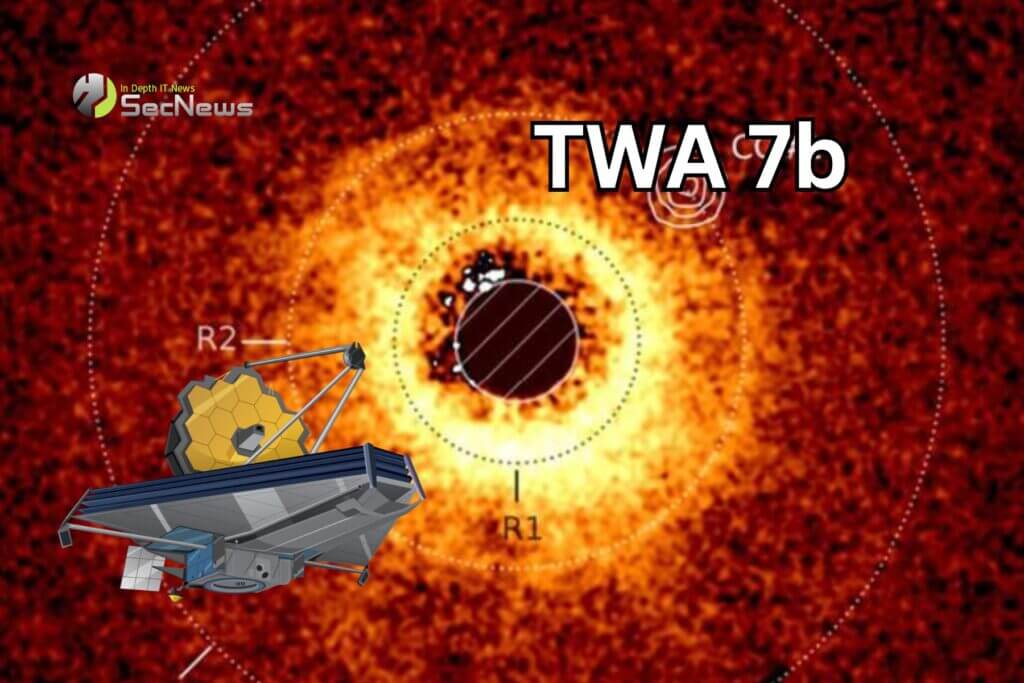
CE Antliae has attracted astronomers' attention since 1999, mainly because of its ideal viewing angle . We see its protoplanetary disk almost "from above", which allows us to observe the structures in this disk, which are shaped by gravitational interactions with invisible planets and planetoids.
CE Antliae 's protoplanetary disk is divided into three distinct rings . One of them is narrow and is flanked by two "dead zones" — regions almost free of material. This unusual structure led scientists to focus observations with the James Webb Space Telescope (JWST) on this point.
See also: James Webb discovered a new type of climate on Pluto
While imaging the ring, the telescope detected a source of infrared emission, which was later identified as a possible young exoplanet. Using simulations, astronomers confirmed the existence of a thin ring and a “gap” in the region corresponding to TWA 7b — just as the JWST data had suggested.
The James Webb Space Telescope is ideal for detecting low-mass exoplanetslike TWA 7b, as they emit faint infrared light — a spectrum that JWST can detect. However, directly imaging such planets is challenging, as the light from their host star can obscure them.
To overcome this obstacle, JWST has a coronagraph, a device that blocks out the blinding light of stars, allowing the Mid-Infrared Instrument (MIRI) to detect the faint infrared signatures of exoplanets.
See also: James Webb discovers lost supermassive black hole

The discovery of exoplanet TWA 7b by the James Webb Space Telescope (JWST) is particularly significant for astronomy. Not only is it the first exoplanet discovered directly by the James Webb, but it also demonstrates that the telescope can detect much smaller and fainter planets than any previous instrument.
It's a clear indication that we've entered a new era in exoplanet imaging. With the telescope's capabilities revealing ever fainter and more distant worlds, many more discoveries are expected in the near future.
Simply put, this is an impressive leap in our ability to see “planetary embryos” in the universe, something that could in the future bring us closer to understanding how an Earth-like planet formed – and perhaps where else it might exist.
Source: www.space.com
