

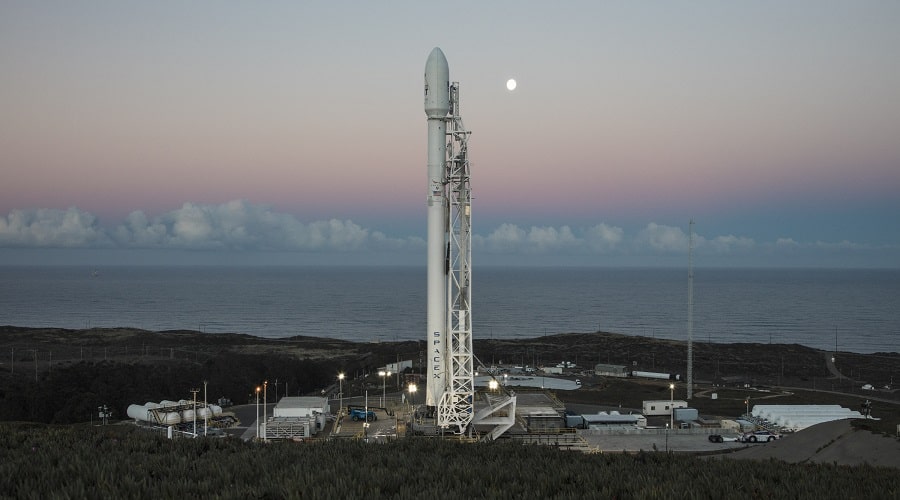
A portion of a Falcon 9 SpaceX rocket is on a collision course with the moon, after 7 years of wandering in space.
The booster was originally launched from Florida in February 2015, as part of an interplanetary mission intended to carry a space weather satellite on a million-mile journey.
See also: NASA's James Webb Telescope has reached its final destination

The rocket launched the Deep Space Climate Observatory, but at some point its second section, weighing four metric tons, broke off.
At this stage it was high enough that it didn't have enough fuel to re-enter Earth's atmosphere, while at the same time "it didn't have the energy to escape the gravity of the Earth-Moon system," meteorologist Eric Berger in a recent post.
“So it’s been following a somewhat chaotic trajectory since February 2015,” Berger added.
Scientists believe that SpaceX's Falcon 9 rocket is on a descent toward the moon at a speed of about 2.58 km/s.
See also: Sun down: When will the sun finally explode and what will happen to us then
An expert who deals with the observation of space objects near Earth estimates that the rocket will likely hit the "dark" side of the moon, near the equator, on March 4.
According to the expert, this is the first known case of a large piece of space "junk" falling on the moon.
The exact point where the rocket remains unclear due to the unpredictable effect of sunlight on the rocket and “ambiguity in the measurement of rotation periods” that can slightly alter its trajectory.
The expert believes that the above can only have a small effect on the movement of the SpaceX rocket and that the impact with the moon will occur on March 4. Of course, he added that further observations are needed to determine the exact time and location of the impact.
See also: Earth's interior is cooling faster than previously thought
As for whether the collision could be observed from Earth, the scientist says it would likely go unnoticed.
Jonathan McDowell, an astrophysicist at Harvard University, also said that the SpaceX rocket's collision with the Moon "is not a big deal."
On the other hand, space enthusiasts believe that the impact could provide valuable data.
Source: The Guardian
