

Our Solar System today is much calmer than it used to be. There are now fewer rocks and fewer collisions, because much of the material has been accreted into planets. However, this is not the case for interstellar objects: there is no reason to believe that fewer ISOs are entering the Solar System today than in the past. This means that they pose a potential impact risk to Earth. But can we quantify this risk?
See also: "Enigmatic" object discovered by the James Webb telescope
A new study, “The Distribution of Earth-Impacting Interstellar Objects,” examines just that question. Lead author is Darryl Seligman, an assistant professor in the Department of Physics and Astronomy at Michigan State University. The paper is available online at arxiv.org.
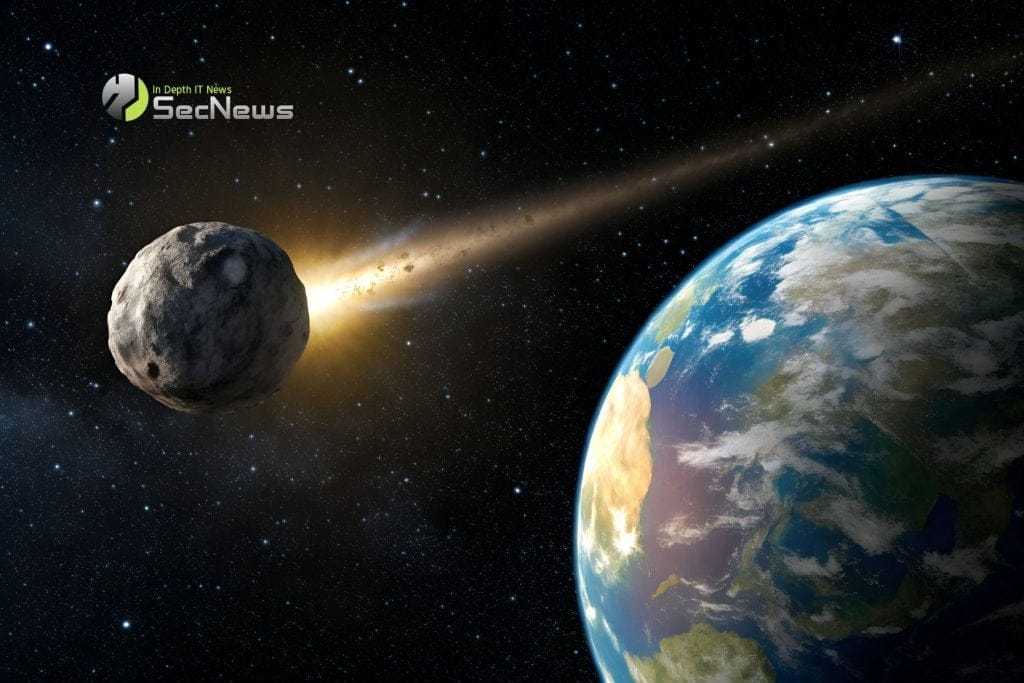
The study doesn't estimate how many interstellar objects there are, because there isn't enough data to set such a limit. It only looks at their expected distribution. The researchers used simulations to understand the issue. The results show that ISOs are twice as likely to come from two directions: the solar apex and the galactic plane.
See also: Invisible asteroids around Venus may threaten Earth

The simulations also show that ISOs coming from these regions have higher velocities. Interestingly, however, those that can actually hit Earth have lower velocities. This is because the subset of ISOs that can hit Earth tends to be extremely low-eccentricity objects. The Sun's gravity has a greater effect on such objects and can trap slower-moving ones, altering their path so that they intersect Earth's orbit.
Seasons also play a role. ISOs with the highest impact velocities are more likely to occur in the spring, because that's when Earth is moving toward the solar apex. In the winter, however, there are more potential impactors because Earth is facing the solar antiapex, the direction the Sun is moving away from. In terms of where on Earth the most at risk from an interstellar object is, low latitudes near the equator are the most exposed.
See also: Potentially hazardous asteroid will pass close to Earth on Thursday

This study offers us insight into where interstellar objects that may impact Earth are most likely to come from, when such an impact is most likely to occur, and where on Earth they are most likely to hit.
