

Picture Passwords: Humans are better at recognizing images than they are at recognizing letters of the alphabet. That’s why we start out as children with picture books. This is why
we can understand why we can’t remember strong passwords. Abstract characters, the arrangement of letters, numbers, and sequences, in a non-word pattern, do not help with memorization. Strong passwords seem to be beyond human capabilities.
In the days of ASCII terminals and command-line interfaces, passwords had some kind of logic. But today, the web interface is rich in graphics, colorful, and flashy.
So why do we remain stuck with alphanumeric passwords? That’s the question that SemanticLock’s paper:
SemanticLock: An authentication method for Mobile devices using semantically-linked images.
The Idea
Instead of assigning arbitrary alphanumeric symbols in a non-obvious order, you can use a set of images. From these images, you can choose a few that tell a story that makes sense and you won’t forget. The story can be very simple: “I have coffee for breakfast in the morning.”
So when you’re trying to unlock your phone, a website, or an online service, you can simply choose from a set of images to filter your story. Today’s screens could accommodate 12 to 20 images, or icons, which could expand the number of possible combinations.
Below is a graph of images that illustrate the concept:
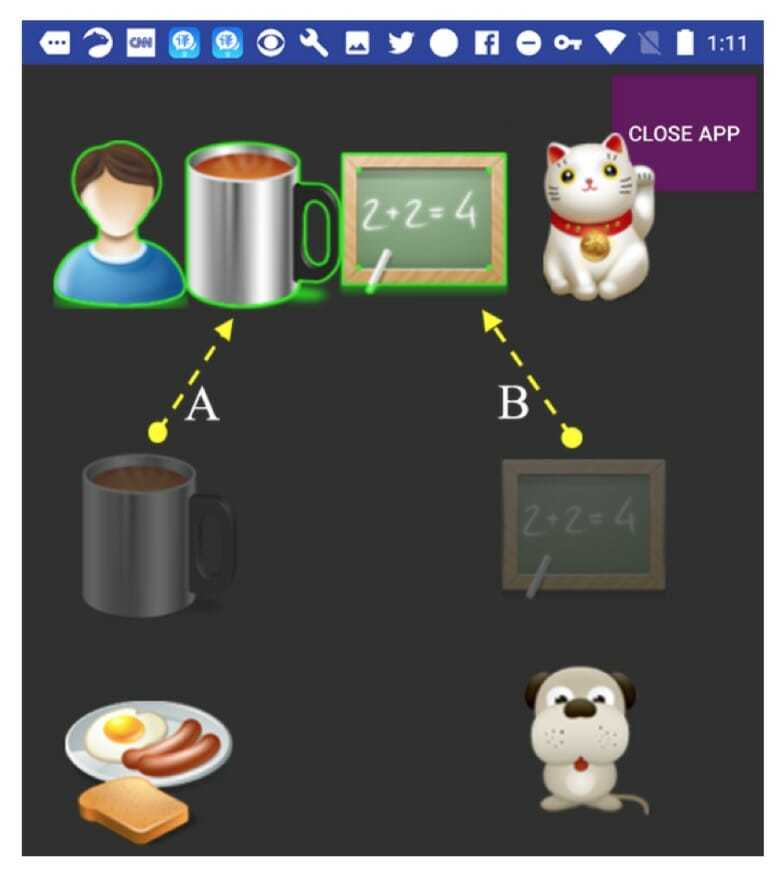 The techniques used by SemanticLock are pattern-based. Users drag their finger over images trying to describe the meaning they’ve created as a password.
Password authentication based on such patterns is faster than PINs, but it is vulnerable to smudging attacks, where the fingerprint on the screen reveals the images. So the images can be reordered to require different gestures to “tell” the same story.
The test results
The researchers examined the advantages of SemanticLock over PIN and Pattern authentication. They found that while Patterns provided faster logins, PINs had the lowest error rate. However, the memorization of SemanticLock stories as passwords was far superior, with only 10% of test participants unable to remember their passwords. This rate was much lower than the other methods.
Researchers have been exploring virtual passwords for more than a decade, but what's novel about this approach is its focus on memorization through stories, which are all too familiar to the human storyteller.
Biometrics certainly simplify the identity problem, but the study we mentioned above suggests that there are ways that could replace passwords.
_________________________
- The free version of Microsoft Teams is now available
- The EU imposed a fine of 4.4 billion on Google for monopoly on Android
- Scientific Linux 6.10: the latest version of 6 has been released
