

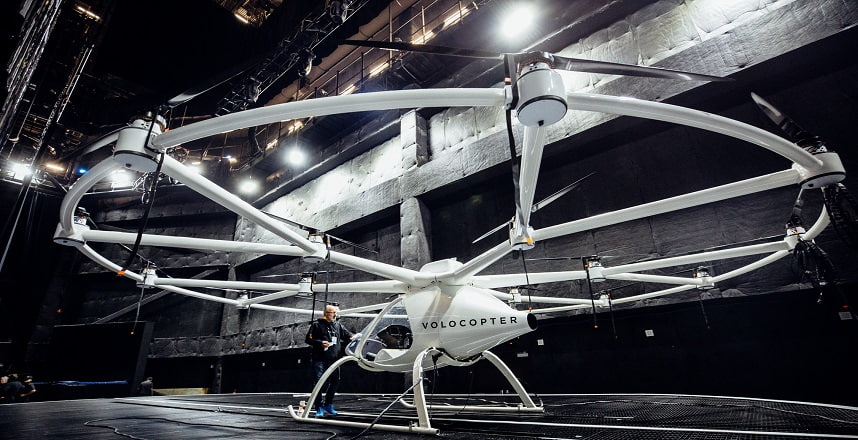
 Whether or not flying taxis ever become a common mode of transportation in the near future, ambitious technology companies will continue to show off their prototypes to the world.
Intel CEO Brian Krzanich may not be one of its creators, but during his CES keynote, he showcased the technology behind the Volocopter, in which he was proud to be one of the first passengers, in December 2017.
The flying vehicle looked like a giant drone that made a short flight via remote control in the central area of the speech. It is an electric multi-purpose car with a capacity of two people. However, it flew without passengers. It can be operated manually, autonomously or remotely controlled.
In a partnership with Volocopter that began years ago, Intel has provided all the flight control solutions needed to fly the drone on its own and ensure the safety of its passengers.
According to Volocopter CEO Florian Reuter, their flying car is like a “flying supercomputer that provides a pleasant and safe ride.” It houses dozens of microprocessors that regularly monitor the atmosphere for winds, turbulence, etc.
The German company's latest product is the Volocopter 2X. The 450kg multi-role vehicle, made up of 18 rotors, is capable of flying up to 17 miles on a single charge at a cruising speed of 43 mph (maximum speed 62 mph). For now, the limited range can be compensated for by using quick-swap batteries.
The Volocopter has managed to get a driver's license in Germany and has also conducted autonomous flight tests in Dubai. It goes without saying that it could take a while for the Volocopter to reach the US, as it would need permission from the Federal Aviation Administration.
