

NASA's ESCAPADE mission aims to shed light on how the solar wind transformed Mars into a cold and inhospitable planet.
Mars was once much more like Earth than we might imagine today. It had a thick atmosphere, plenty of water on its surface, and temperatures that could support milder climates. Now, the Red Planet is cold, arid, and surrounded by an extremely thin atmosphere. This transition was not sudden, but the result of a slow, relentless process that took billions of years.
At the heart of this cosmic transformation is the solar wind: a constant stream of charged particles from the Sun that pound the planets of the solar system. Unlike Earth, Mars has failed to maintain a strong, global magnetic field to protect it. The result? Gradual stripping of the atmosphere, loss of surface water, and a dramatic drop in temperature.
The ESCAPADE mission opens a new chapter
To gain a deeper understanding of how Mars became an inhospitable world, NASA launched the ambitious ESCAPADE (Escape and Plasma Acceleration and Dynamics Explorers) mission, which launched on November 13, 2025. As of February 25, all of the mission's two spacecraft's scientific instruments have been in full operation, collecting critical data both near Earth and en route to Mars.
See also: Rare structures detected at the center of the Milky Way
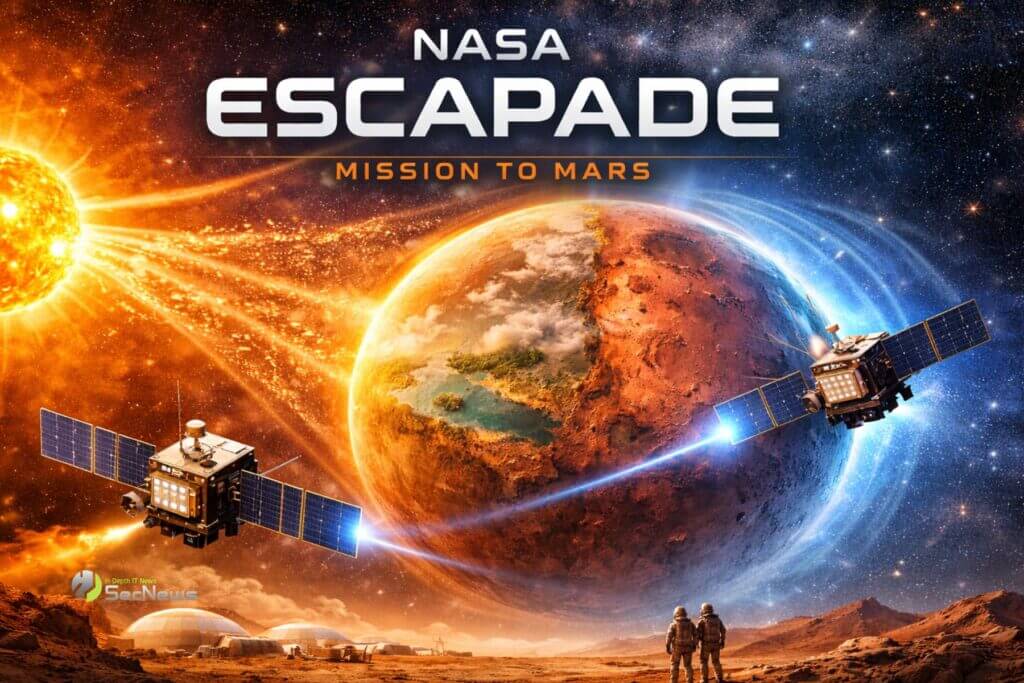
The mission's goal is twofold: to accurately map how the solar wind continues to shape the Martian environment, and to improve our understanding of space weather — a critical factor for any future manned mission.
As stated by Joe Westlake from NASA, ESCAPADE aspires to function as a "space weather station", enhancing the safety of both astronauts and technological systems that will operate on the Red Planet.
Two spaceships, one stereoscopic view
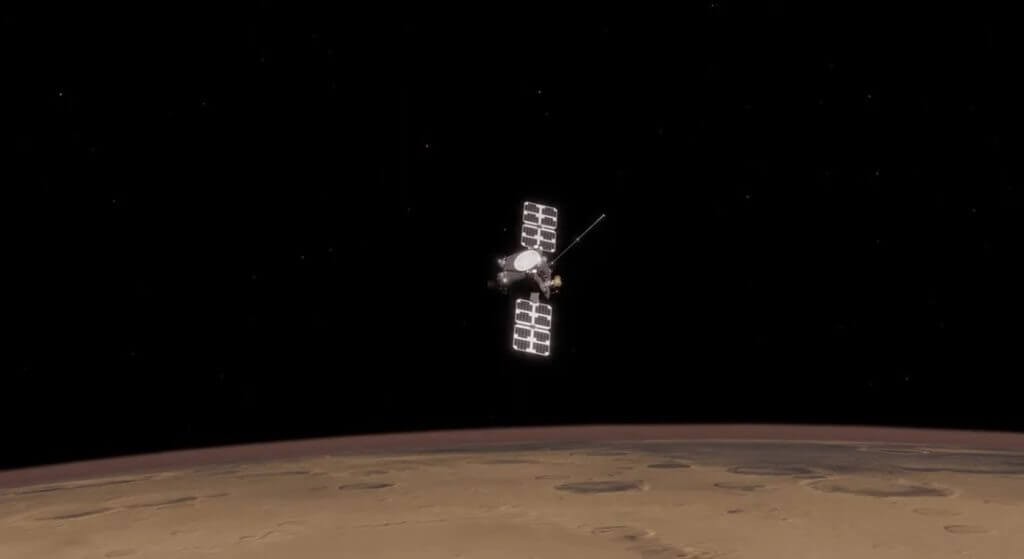
ESCAPADE is the first scientific mission to place two spacecraft in coordinated orbit around Mars. This “stereoscopic” approach allows simultaneous measurements from different points, providing picture of cause and effect .
The twin spacecraft will study magnetosphere — the magnetized environment created by the interaction of the solar wind with the upper atmosphere. Initially, they will follow the same orbit, passing over the same areas within a few minutes of each other. This will allow scientists to detect changes in time windows as small as two minutes, something that would be impossible with a single spacecraft.
See also: Solar flares may cause earthquakes
After six months, the spacecraft will move into different orbits: one closer to the planet and the other further away. This way, the incoming solar wind and the response of the Martian magnetosphere will be recorded simultaneously, fully capturing the dynamic interaction.
Shield for future explorers
Unlike Earth, which is protected by a strong global magnetic field, Mars currently has only fragmented magnetic fields in its crust and an unstable, hybrid magnetosphere. This means that energetic particles from the Sun can reach the surface relatively easily.
For future astronauts, this translates into increased radiation risk. ESCAPADE data will contribute to the formulation of protocols for predicting and managing solar storms, a crucial element for the viability of manned missions.
The mission will also provide new insight into the ionosphere — a layer vital to future communication and navigation systems. If we ever see a “Martian GPS,” understanding this region will be fundamental.
See also: Rare 'planetary parade' returns to the sky this week
A pioneering journey through Lagrange 2
ESCAPADE is not only a scientific breakthrough, but also an orbital one. Unlike traditional missions that launch when Earth and Mars align every 26 months, the spacecraft initially headed for Lagrange Point 2, about a million miles from Earth.

In 2026, they will return for a gravity assist and final acceleration to Mars, with arrival scheduled for 2027. Along the way, they will cross an unexplored region of Earth's magnetotail, opening up new research fields for our own planetary environment.
Funded by Heliophysics Division and involving leading research institutions and companies, ESCAPADE is not just another mission to Mars. It is a technological and scientific leap that brings humanity closer to its next big step: a permanent presence on the Red Planet.
