

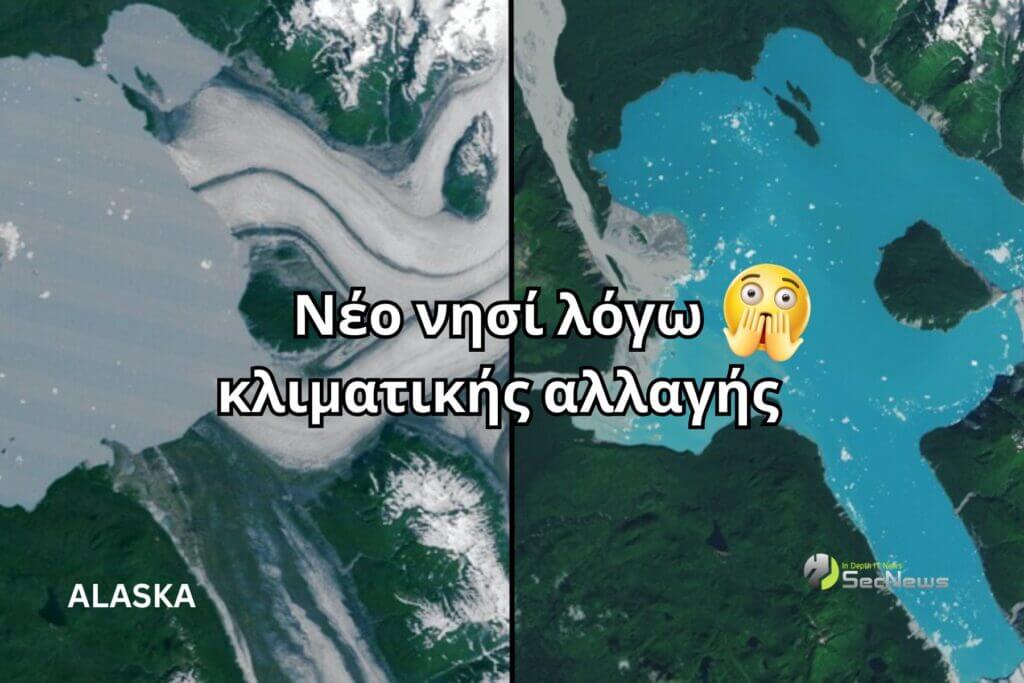
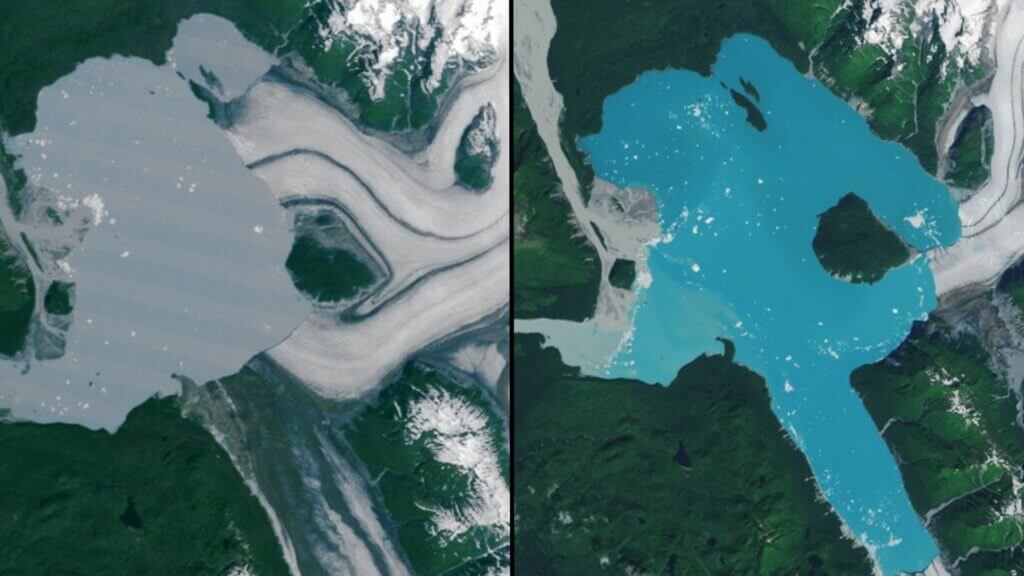
A new island has appeared in Alaska , highlighting once again the dramatic changes caused by global warming . NASA satellite images captured the creation of the island in Lake Alsek , an area that has been closely monitored by scientists for decades due to the rapid retreat of glaciers.
The island was formed by the separation of Prow Knob – a small mountain that was previously connected to the mainland by the Alsek Glacier. As the ice sheets retreated, this mass became isolated and is now completely surrounded by water, recording a striking, yet disturbing, geological transformation.
From the Landsat images in the present
NASA compared two key images: the first was taken on July 5, 1984 by the Landsat 5, while the second on August 6, 2025 by Landsat 9.The difference between the two images captures with impressive clarity the course of nature in just four decades. In the place where there once was a coherent ice mass, now stretches Lake Alsek, which has "swallowed" dozens of square kilometers of ice and land.
See also: Research: Melting glaciers are causing more frequent volcanic eruptions
Calculations show that from 1984 to the present, the lake has increased from 45 to about 75 square kilometers. Its growth is fueled not only by the melt of the Alsek glacier itself, but also by neighboring glacial lakes such as Harlequin and Grand Plateau.
An island of 5 square kilometers
The new island covers an area of about 5 square kilometers – the size of a small city. Researchers estimate that its final formation was completed in less than a month, between July 13 and August 6, 2025. This time window highlights the rapid pace at which landscape changeswhen conditions are favorable for glacier destabilization.
The isolation of Prow Knob is not just a geological event. According to experts, the loss of connection to the glacier makes Alsek less stable and more prone to calving. This means that large chunks of ice can now “break off” and fall into the lake with greater frequency, changing both the dynamics of the aquatic ecosystem and the local geomorphology.
A living laboratory for climate change
The case of the Alsek Glacier is not unique. Glaciers in southeast Alaska are among the fastest-retreating in the world. For glaciologists, the region acts as a “window into the future,” revealing how climate change can reshape landscapes in just a few decades.
See also: Hidden world discovered under Antarctic glacier
The changes are not limited to geomorphology. The gradual appearance of new lakes and islands creates new ecosystems, but at the same time threatens the old ones. The melting of ice alters the supply of fresh water, affects the salinity of the waters and by extension the fauna and flora of the region. It is enough to think that Lake Alsek, which a few decades ago was almost nonexistent, is today larger than Manhattan.
Cutting‑edge technology in the service of science
This event could not have been recorded in such detail without the contribution of satellite technologies. Landsat sensors – which have been recording data for half a century – offer a unique record of Earth observation . Through them, scientists are able to accurately measure changes in the size of glaciers, the spread of lakes and the consequences of melting ice on a global scale.
High-resolution images have not only scientific value, but also political value. They provide tangible evidence of the impacts of climate change, which can be used in international discussions and agreements to limit greenhouse gas emissions.
See also: Glacier disappearance – The consequences of climate change in two images
The future of Alaska and beyond
The emergence of the new island is a reminder that the Earth is in constant transformation. However, unlike the geological changes of the past that spanned thousands of years, today's changes are occurring at an alarmingly rapid pace.
If temperatures continue to rise, Alaska's glaciers will continue to retreat, releasing vast amounts of water and radically changing the region's hydrology. This could affect not only local ecosystems, but also coastal communities, tourism, and even global sea levels.
The new island in Lake Alsek is not just a geographical curiosity. It is a living testament to the power of nature and the speed with which climate change is shaping our planet. Thanks to the power of satellites and modern technology, we can monitor these changes in real time – but the challenge remains: will humanity be able to curb the cause of them?
