

Scientists discovered water, and indeed “significant amounts of water” in the “Grand Canyon” on Mars.
Mars has its own version of the Grand Canyon, and scientists recently learned that this special place is home to water, and in “significant quantities.” According to the European Space Agency, this discovery was made thanks to an orbiter spacecraft exploring the red planet.
The ExoMars Trace Gas Orbiter, launched in 2016 as a joint mission between the European Space Agency and Russia's Roscosmos, detected water in the Valles Marineris on Mars. This canyon system is 10 times longer, five times deeper, and 20 times wider than the Grand Canyon.
See also: NASA: Parker Solar Probe “touched” the Sun for the first time
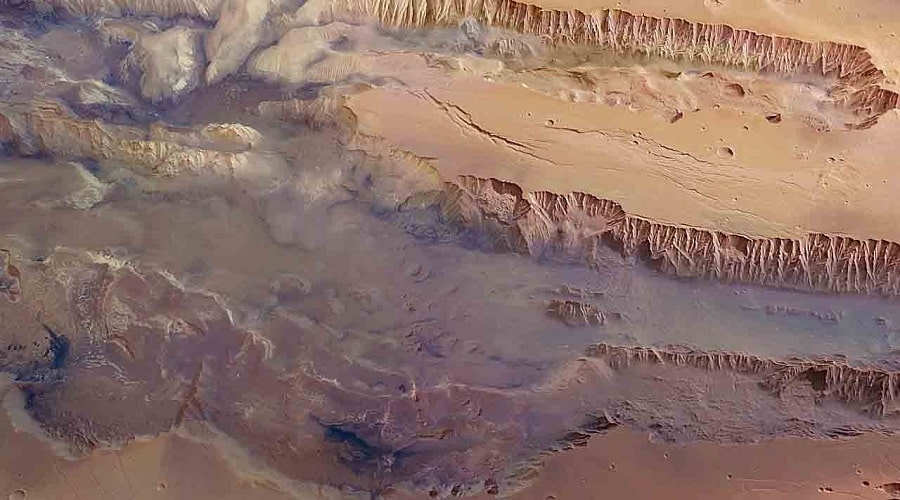
The water, according to observations, lies beneath the surface of this canyon system and was detected by the FREND . This instrument is able to map hydrogen in the upper layer of the Martian soil.
The majority of water on Mars is located in the planet's polar regions and is found in the form of ice. The interesting thing is that the Mariner Valley is located south of the planet's equator, where temperatures are usually not cold enough to preserve the frozen water.
The observations were made by ExoMars between May 2018 and February 2021. Previously, other orbiters had searched for water just below the surface of Mars and had detected small amounts beneath the dust.
“With the Trace Gas Orbiter we can look about a meter below this dust layer and see what’s really going on beneath the surface of Mars — and, most importantly, identify water-rich ‘oases’ that couldn’t be detected with previous instruments,” said study author Igor Mitrofanov.
“FREND revealed an area with unusually large amount of hydrogen in the colossal canyon system of the Mariner Valley: assuming that the hydrogen we see is linked to water molecules, about 40% of the material that exists near the surface, in this area, appears to be water“.
This area on Mars is roughly the size of the Netherlands. It is overlapped by Candor Chaos, a network of valleys within the canyon system.

The FREND instrument searches for neutrons to map the hydrogen content in the Martian soil.
See also: NASA purchased additional crew transport flights from SpaceX
“We can infer how much water is in a soil by looking at the neutrons it emits,” said Alexey Malakhov, one of the study’s authors and a senior scientist at the Institute of Space Research of the Russian Academy of Sciences.
This is because “neutrons are produced when high-energy particles known as galactic cosmic rays hit Mars; drier soils emit more neutrons than wetter ones,” he said in the same statement.
“We found a central part of the Valles Marineris on Mars to be full of water — much more water than we expected. This is very similar to permafrost regions on Earth, where ice remains permanently under dry ground due to constant low temperatures.“.
The unique capabilities of the ExoMars Trace Gas Orbiter's FREND instrument allowed scientists to detect water that had previously been hidden, Malakhov said. This could be water in the form of ice or water attached to minerals in the soil. Although scientists believe the former is more likely.
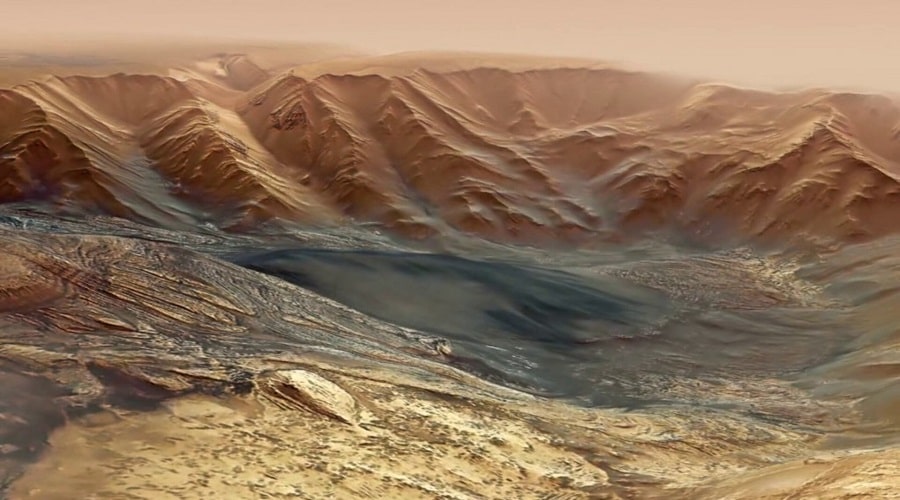
There are higher temperatures near the equator on Mars, so researchers believe there must be some special conditions that allow water to remain in the Grand Canyon and be replenished.
"This finding is an amazing first step, but we need more observations to know for sure what form of water we are dealing with," said Håkan Svedhem, one of the researchers.
See also: NASA selects Intuitive Machines for new lunar delivery
"The finding demonstrates the unrivaled capabilities of TGO's instruments, which allow us to 'see' beneath the surface of Mars," he added.
Future missions to Mars will attempt to penetrate even deeper into the planet's surface. This discovery in Valles Marineris suggests that there is a place that needs to be explored more in the coming years, as this water may be much more "accessible" than other water sources discovered on Mars.
Source: CNN International
