

Scientists believe they have seen light pouring out of a black hole , and more specifically from its merger with another one .
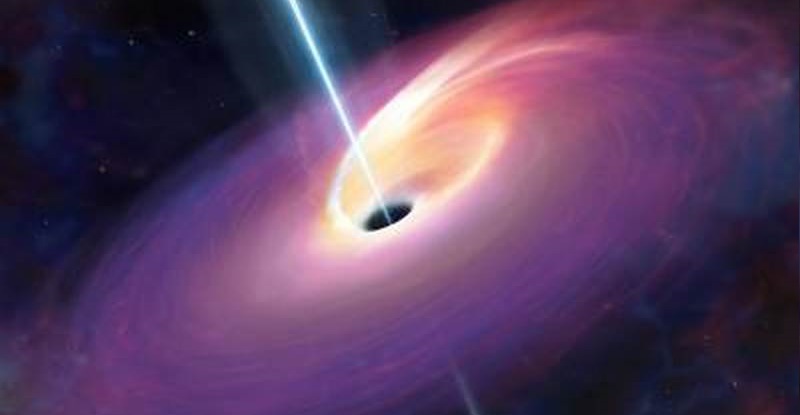
When black holes spin and collide, they create tiny ripplesthat travel through space-time. Earth's gravitational waves can pick them up, but scientists thought that if something like that happened, it wouldn't look like light.
However, astronomers have spotted what they believe may be a beam of light and was created when one black hole merged with another.
The event, dubbed "S190521g," was first detected last year by detectors . It was the clue that told researchers that something intense was happening deep in space.
Around the same time,Caltech's Zwicky Transient Facilitywas observing the sky for research purposes.They caughtthe light beam, and it was later traced back to the same area where they detected the gravitational wave. That's how they were able to connect the two events.
"This massive black hole was 'boiling' for years until it finally made this sudden flare. The light came at the right time and in the right location, so it's not a coincidence and there is a connection to the gravitational wave. In our study, we concluded that the beam of light is likely the result of the merger of two black holes, but we can't completely rule out other possibilities," said Matthew Graham, professor of astronomy at Celtech and researcher on the ZTF project.
Astronomers may have already thought that something like this could happen, but they had never seen it in action. They hypothesize that this can happen when one black hole "nests" with another in a disk, which is surrounded by a larger one.
"At the center of most galaxies lurks a giant black hole. It is surrounded by a cluster of stars and dead stars, including smaller black holes," said one of the study's authors, KE Saavik Ford.
«These objects circle like wild bees around the monstrous queen at the center. They can quickly find a gravitational partner and merge with it, but they usually lose it in the crazy dance. Inside the disk, the flowing gas turns the frantic dance into a classical minuet, and so the holes merge harmoniously.»
Their merger creates a new black hole, even larger than the others, and has such momentum that it pierces the gas in the disk. As it accelerates, it reacts and creates a bright flash that is visible on Earth.

The results of the discovery were reported in the research "A Candidate Electromagnetic Counterpart to the Binary Black Hole Merger Gravitational Wave Event GW190521g", recently published in Physical Review Letters.
The researchers were only able to gather limited information about the black hole, as the light had disappeared by the time they could detect all the evidence. They hope that in the future they will have the opportunity to develop discovery with similar events.
With more light, and more details about it, they believe they will be able to understand more about space and black holes, but also how they formed.
