

On Friday, a team of researchers at MIT and Georgia Tech unveiled a new camera that uses an imaging technique that allows it to read printed text from a book without flipping through the pages, via a computer.
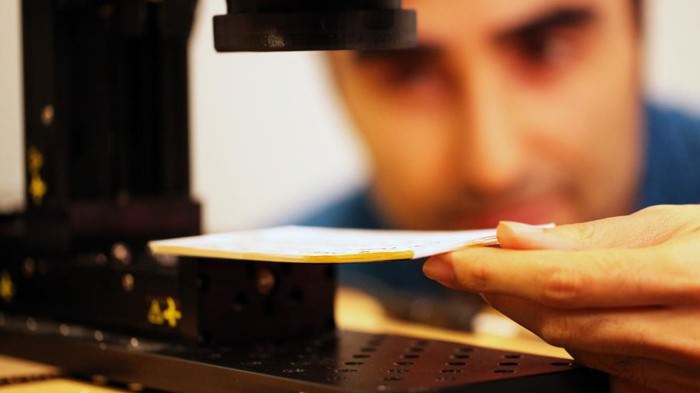
The technique is a bit like the Superman fantasy movies, except instead of using X-ray vision it uses tetrahertz radiation and an interpretive algorithm.
As detailed in a paper published in Nature Communications, the system uses tetrahertz radiation (the range of electromagnetic radiation between microwaves and infrared light) which has a number of advantages over other surface-penetrating waves such as X-rays or ultrasound.
Tetrahertz radiation is absorbed by different chemicals in different ways, which can be used to distinguish between paper and ink in a book. The camera used by the team can also emit the radiation in ultra-short microbursts that measure the depth of a page in a book based on the time it takes for the radiation to reflect off the book back to the camera.
These ultrashort bursts of radiation perceive depth at extremely fine resolution, so much so that researchers are able to measure the distance from the source of radiation to individual pages in a book, separated by air pockets, which can be as small as 20 microns deep (microns = millimetres of a millimeter, or 1/1000th of a millimeter).
The reflection of the tetrahertz radiation from the ink back to the camera is then analyzed by an algorithm developed by the MIT researchers that is designed to capture the time-reflection data as an image. The resulting image of what is printed on a given page is heavily distorted, so the signal is then processed by another algorithm developed by the Georgia Tech team, which is able to interpret individual letters from the distorted image.
MIT Media Lab researcher Barmak Heshmat, referring to the algorithm that interprets the letters, said: “It’s really scary. Many websites have some kind of captchas to make sure you’re not a robot. This algorithm can easily access many of them.”
Tetrahertz imaging is a technology that is still in its infancy, and although researchers at MIT realized this technique could be used to see through envelopes a decade ago, the algorithms weren't quite ready to read the result.
As a demonstration of the technique, the researchers printed a letter on individual sheets of paper and found that their technique could correctly identify letters up to nine pages deep. Beyond that, the reflected signal became too noisy to extract the information from a page, but they hypothesize that as radiation sensors continue to develop and get better, the technique should one day be able to read entire books without ever opening them.
And that was their goal for this project, as Heshmat said that the Metropolitan Museum of Art in New York is very interested in their work, since it will allow them to look at books they own that are so old that touching them would damage them irreparably. Furthermore, because the tetrahertz radiation imaging technique is able to separate chemicals from an object, the technique could not only be used for reading books but also to “read” something that is printed on a thin layer, such as the film of a pill.
Watch the relevant video from the presentation of the new technology below:
