

Its design is based on the internal structure of the fruit, giving it a long shelf life
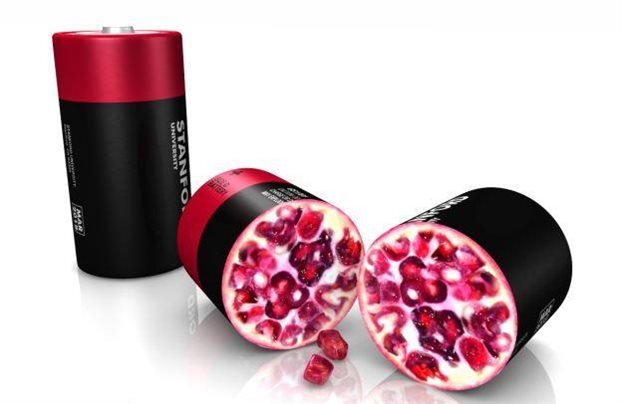
American researchers from Stanford University have created an electrode that resembles the internal structure of a pomegranate and could extend the battery life of gadgets and other small devices.
"While there are still some challenges that we need to solve, this design brings us closer to creating powerful yet smaller and lighter batteries for devices such as smartphones, tablets and electric cars," explains professor and study leader Yi Cui.
"Experiments showed that the anode electrode that we inspired by the pomegranate is capable of operating at 97% even after 1,000 charge-discharge cycles, which makes it suitable for commercialization," the expert emphasizes.
Battery in… "clusters"
The anode, or negative electrode, is where energy is stored during battery charging. A silicon anode, according to scientists, is capable of storing up to 10 times more energy than a graphite anode in today's lithium-ion batteries.
However, the silicon anode is more brittle than graphite, causing it to break during charging and appears to react with the battery's electrolytes. To address this problem, Dr. Cui's team replaced the silicon anode with clusters of silicon nanowires, which could resemble pomegranate seeds. These clusters are enclosed in a protective sheath within which the nanowires have room to contract and expand when they receive an electrical charge.
The interesting findings are published in the journal "Nature Nanotechnology".
Source: tovima.gr
