Imagination is a «collective» work, regarding the neurons of our brain. Scientists «saw» the network that activates when imagination is mobilized, as well as the areas that act as «regulators» of our attention
Perhaps you think that imagination is a trait that not all people have. If so, you are wrong. Even if you do not possess the extremely creative imagination of great writers and artists, the fact is that you use your imagination daily very often and in a creative way. Not only to «escape» into daydreams but also to perform many other «mundane» activities, such as, for example, calculating the bill for your shopping, finding a way to prevent a door from «slamming» by the wind, «preempt» an imagined conversation with your boss to ask for leave or a raise, or thinking about what a friend would do in your place so that you act accordingly.
This «mental representation» which comes to you so naturally is actually a trait that distinguishes humans from animals – or at least from most of them, as experts believe. It is therefore not accidental that the identification of the «center» of imagination in the human brain constitutes one of the main goals of neuroscience research. Until recently this goal seemed rather unattainable, but a recent study by scientists of Dartmouth College in New Hampshire, United States, came to give the most «tangible» answer that has been provided so far to this search. The researchers not only identified a network of imagination in the brains of volunteers but also managed to «see», depending on the patterns of information flow, exactly how they used their imagination – in general what they roughly imagined. Beyond its impressive aspect, their findings are also considered significant because they provide strong support for a perception that has begun to dominate in recent years in cognitive sciences and neuroscience regarding the way our brain functions.
Τι είναι ο «νοητικός χώρος εργασίας»
Let's take things in order, however. As, for only a few decades now, the exploration of the human brain has begun to become increasingly «deep» thanks to the valuable help of new imaging techniques, scientists started to identify various isolated «centers» and «areas» that seemed to be related to specific functions. So we began to talk, e.g., about the «visual center» or the «reward center» and so on. However, over time and as studies and knowledge expanded, experts began to conclude that at least the most complex, higher-order functions of the brain – such as scientific, mathematical and artistic thinking or imagination – cannot be performed in isolated centers but require the cooperation of multiple regions.
Thus was born the theory of the so‑called «cognitive workspace», an expanded neural network which combines and processes information – images, symbols, memories and other mental constructs – that originate from different «centers» of the brain. Although this theory sounds perfectly logical, the existence of this neural network has not yet found its full scientific proof. The main obstacle to its identification is due to the fact that the methods used in studies of this kind focus on brain activity at isolated points and are not able to «capture» the information distribution processes in the brain's networks.
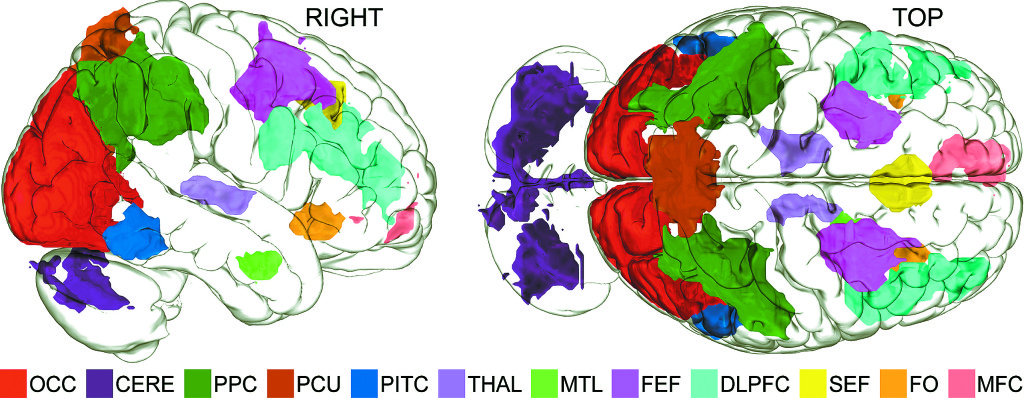
The researchers' brain imaging shows that almost the entire brain is activated for imagination
Recently, however, with the application of new techniques, some studies have begun to identify evidence that supports the theory of the mental workspace. The work of scientists from Dartmouth College is considered to be a particularly important step in this effort as it comes to "click" with previous studies, offering the most "tangible" evidence that has been found to date. "Our study is part of a growing series of evidence. We are not the first to find evidence that the mental workspace exists, but our work in combination with others begins to outline it," says Alex Schlegel , a doctoral student in cognitive sciences at Dartmouth College and lead author of the relevant article published in the journal "Proceedings of the National Academy of Sciences" , speaking to " Vima". "We had some ideas that the brain should have some kind of system to flexibly handle the mental representation of things. But our findings, combined with a number of other pieces of evidence, begin to show for the first time how the brain can do this, namely the neural networks involved in such a function . "
They captured the imagination… ’ on the spot
The innovation of the Dartmouth researchers lies in that they succeeded for the first time to see imagination in action in real time in the volunteers' brains and to show that, in order for «be born» the cognitive representation, different regions communicated with each other in an expanded network. They even found that the communication between the regions changed depending on the type of cognitive representation in which the volunteers were engaged – they saw that they could understand what the volunteers imagined solely by looking at the pattern of communication among the various regions of the network!
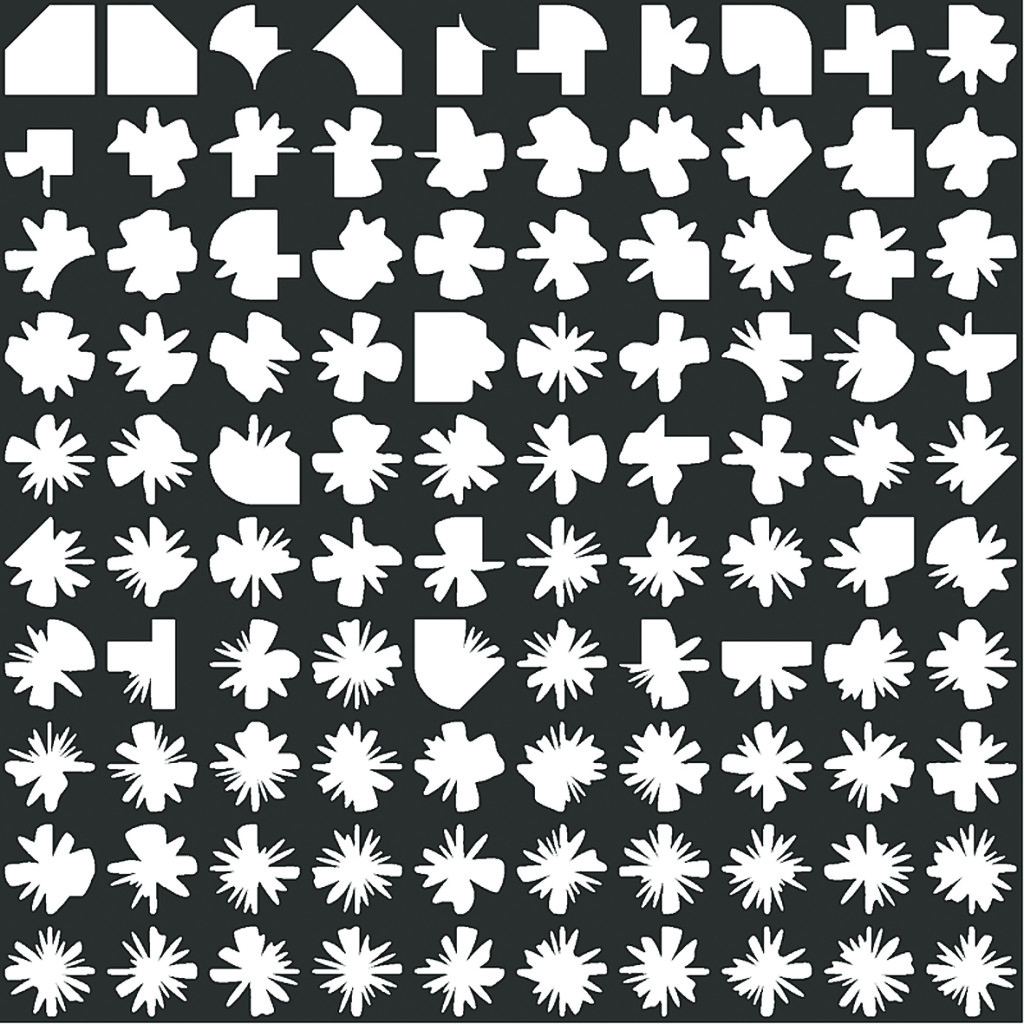
To get there, however, they had to carefully design their experiments. “You know, we’re all very interested in these mysterious behaviors like imagination and creativity—what makes an artist an artist, for example. But to approach these issues scientifically, you have to put in a lot of controls and make things as simple as possible,” says Schlegel. That’s why the scientists chose to ask volunteers to perform three different “mental imagery tasks,” as they call them. In the lab, they excluded auditory stimuli and allowed only visual ones, showing the volunteers a series of shapes they had drawn themselves that could be put together into more complex representations or “decomposed” into simpler shapes.
The experiment
A series of shapes that the volunteers had to remember, compose and decomposeIn the first task, volunteers viewed a shape for eight seconds and later had to distinguish it among four different shapes – a simple functional memory test, which requires the mental representation of an image. In the other two tasks, volunteers again saw some shapes for eight seconds and later had to either combine them to create another shape or break them down into smaller pieces – think of something akin to trying to imagine a dog with a lion's head or a headless rider, and both images require either the assembly of other images retrieved from your memory or their disassembly. «The two projects required processing of the images since they had been formed in the mind» explains the researcher. «In essence, that is, with what we did we had two different functions of mental representation. And the question was: can we distinguish when a person assembles or disassembles an image based on brain activity? And which areas were involved in these projects?».
As the scientists saw, both of these functions were not the work of isolated areas but of an entire network. “This was something very interesting, that it was not just one or two parts of the brain that seemed to be involved in these functions but a network that seemed to extend throughout the brain,” says Schlegel. “And not only that, but in some subsets of this network we could see, we could actually tell from the pattern of information flow whether a person was assembling or disassembling an image. You know, the press says of these techniques that they ‘read the mind.’ Well, that’s what we did with the techniques we used.” Furthermore, the scientists saw that the way the regions involved connected to each other – the pattern of ‘connectivity’ – was different from the other two when the volunteers simply recalled an image in the first simple test of working memory.
How attention is directed
Although the mental workspace network seemed to extend throughout the brain, some areas seemed to be particularly involved. These were the lateral prefrontal cortex and the posterior parietal cortex, two areas that make up the so-called “frontal parietal network,” which is associated with higher cognitive functions such as working memory, mathematical calculations, or analogical reasoning. “One is in the frontal lobe, at the front of the brain, and the other is in the parietal lobe, towards the back,” explains Schlegel. “A lot of studies are investigating these areas, and we’re starting to understand what they specialize in. "So it seems that the fronto-parietal network is particularly involved in the flexibility of the direction of attention, sometimes directing our attention to external stimuli, other times directing it to our internal world, the images of our mind or working memory.
Mysterious and wondrous "everyday" human qualities
The human brain's ability to create stories and images and "travel" to different places is unique but also "elusive" for scientists. "We don't know, we still don't know enough about it, the real core of how the brain does this is eluding us. But if you think about your own experience alone, this is something that really happens, and it happens all the time," says Alex Schlegel, adding that many different individual qualities are involved in this function. One of them, as he emphasizes, is our ability to make analogies and metaphors. “Let’s say I’m a classical composer and I’m thinking about my composition,” he explains. “I want to give, for example, the feeling that a wolf is entering the scene, and to do that, I’m able to bring to mind images that I have of the wolf and connect them with sounds that I again retrieve from my memory to make a parallel.
This, the researcher points out, shows beyond any doubt that the human brain has the ability to move with enormous flexibility to arrive at a kind of common language or common representation for all things – a property that is also unique. “It can unite different elements and extract similarities, analogies between them. Analogical reasoning is at the core of the characteristics that make humans unique,” he emphasizes. “We say that someone spreads their arms like an eagle, we can see common properties in things that seemingly have no connection with each other. And that is unique.