

According to new research, the surface of the Earth's inner core may be changing in shape.
See also: A "donut" was found hidden inside the Earth's core
The research, published February 10 in the journal Nature, analyzed seismic waves that crossed the boundary of the Earth's inner core, at a depth of 5,150 kilometers. The findings revealed that, even when the core was in a position that had already been observed in the past, subtle, almost imperceptible differences were often recorded.

These differences indicate that the surface of the inner core, although solid, can exhibit significant changes in short time intervals.
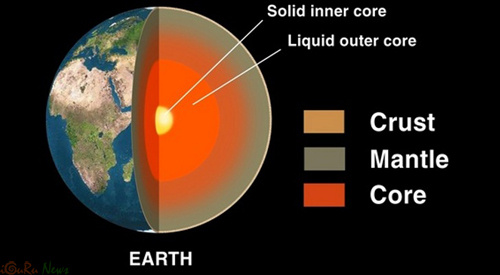
The Earth's outer core is made of molten metal, mainly iron and nickel, and acts as a protective shield for the solid inner core, which is also made mostly of the same elements. Each year, a small portion of the liquid outer core crystallizes, adding material to the solid inner core. This process leads to its slow but steady growth, at a rate of about one millimeter per year.
See also: Study: Earth's core wobbles every 8.5 years
At the boundary between the outer and inner cores, the inner core is right at its melting point. Although it is solid, it is not completely rigid. This may explain why it appears to be “deforming” slightly, as the new study suggests. However, accurately estimating the dimensions of these changes remains a challenge, as explained by seismologist John Vidale, who led the study.
In a previous study published by Vidale and his team, it was revealed that the Earth's inner core does not rotate at a constant rate. Until about 2010, it rotated faster than the rest of the planet. However, since then it has begun to slow down, resulting in it now lagging behind the rest of the Earth's rotation.
Through this research, scientists were able to determine the times when the same point in the Earth's core was found below the same geographic point on the surface, between 1991 and 2023.To study the core, they used pairs of earthquakes originating from the same area in the South Sandwich Islands, in the South Atlantic Ocean. The seismic waves produced crossed the Earth's core and were initially recorded in North America, providing valuable data for understanding the dynamics of the core.
See also: Earth's interior is cooling faster than previously thought
Using data from 168 pairs of earthquakes, the researchers observed little change in seismic waves passing through the same point in the core at different times as they traveled deep into the interior. However, they found significant variations at the same points for waves just touching the surface of the core, providing valuable information about the structure of its outer layer.
Source: livescience
