

The secret expenditures, known also as the «black funds» of the state, are expenses for which there is absolutely no transparency, since they are exempt from the obligation to post on Diavgeia and the procurements paid with this money are not published in the Central Register of Public Contracts (KHEMDIS) – and their receipts are destroyed after six months. Consequently, there is no accountability, nor is public oversight possible for exactly where this money is spent and who receives it.
State secret
According to the Criminal Code, a state secret is a fact, object or information, access to which is possible only for a specified circle of persons and is characterized as secret in order to avoid the risk of violating the territorial integrity, defense capability, international relations or economic interests of the Greek state and international peace.
In recent years, various public tenders, projects and million-dollar expenditures seem to fit comfortably within this definition. One example is the tender that started in 2020 and was cancelled in September 2022 – amid revelations about surveillance – and concerned the new digital identities and other security forms of the Ministry of Citizen Protection. The project «Υπερίων»» was also classified as confidential, under the responsibility of the Ministry of Migration and Asylum, also funded by EU funds. This project concerns the design, implementation, installation and operation of an access control and monitoring system for the provisions of refugees and migrants residing in Temporary Reception and Hosting Facilities.
Among other things, there was also a contract of the Greek public sector with Krikel, interests of businessman Giannis Lavrano (who is at the center of publications about the wiretaps), which was signed under the SYRIZA government by the then Minister of Citizen Protection Nikos Toska, with the purpose of maintenance and technical support of the police's encrypted communications system, TETRA. According to data that inside story has at its disposal, the contract was worth €10.8 million (including VAT).
Web of opacity
In a related report in Solomon we read: «Project contracts that are declared confidential for the protection of intellectual property rights, technical specifications and commercial interests, but also for security reasons, do not impose the same regime on the project expenditures. Declaring the entire information of a project as confidential is a controversial and rare approach». With this the Commission also appears to agree, which, responding to journalists, states that «the classification of a procurement process as confidential for national security reasons explicitly depends on the provisions of Greek national legislation and must be consistent with Directive 2014/24/EU on public contracts. This classification does not imply the classification of the expenditures that were made within the framework of the project».
In other words, the fact that the details of a procurement/project must be kept secret does not mean that the expenses arising from it (who took what and for what purpose) must also be covered by the same veil of secrecy. For example, in the project of the Ministry of Citizen Protection that started in 2016 and was approved in December 2020 for the «expansion of the automated surveillance system, in the riverside section of the Greek‑Turkish borders, in the Evros region and interconnection of the Regional Integrated Border Management and Migration» centers, one can find in Diavgeia and the award of the competition results (thus also which companies ultimately received the project, as well as which submitted financial offers but were rejected) and the payments of the two contractors.
Another special treatment of confidential expenditures is that, by exception, the deadline for submitting the account for the related prepaid monetary allowances may be extended up to one year. Normally, the account submission deadline cannot be set beyond one month after the end of the fiscal year in which the prepaid monetary allowance was issued. In other words, confidential expenditures paid today can be accounted for in the next year.
The new confidential expenditures
During the days of New Democracy, the practice of incorporating secret expenses into ministries and agencies that did not previously manage such funds has been observed. In May 2020, a law of the Ministry of Immigration and Asylum provided for the registration of a special credit for secret national needs. The allocation of any amount from this credit is carried out by decision of the Minister of Immigration and Asylum and after the opinion of the three-member Special Expenditure Committee. A special credit for secret national needs had been registered in February of the same year in the budget of the General Secretariat of Civil Protection, under the leadership of Nikos Hardalias (it was upgraded to a ministry). As the MIIR journalism group wrote at the time in a report, "it is questionable what exactly 'national interests' are secured by the concealment of funds allocated to dealing with fires, earthquakes, floods and recently to dealing with the health crisis." And the Ministry of Shipping, up until 2018, had no secret expenditures at all, while in 2019 it reported expenditures of 743,597 euros.
Regarding the classified expenses managed by the ministries, the wording of the definition is broader than that of the Penal Code for state secrets. For example, the relevant provision for the Ministry of Migration states that: «Such national needs and expenditures, which cannot be known without harming the country's interests, are considered those that fall, directly or indirectly, within the fulfillment of the mission of the aforementioned Ministry, as each time specified by the competent bodies, the safeguarding of whose fulfillment constitutes protection of national interests in this area, within or outside Greece».
The respective ministerial decision for the allocation of secret credits is not published in the Government Gazette, nor is it posted on any information system or platform, while payments with secret funds are exempt from any withholding, fee or contribution in favor of the State, Social Security Institutions, Legal Entities under Public Law or third parties. In the meantime, all supporting documents of the expenditure and any other element referring to the recognition and execution of the expenditure are destroyed, no later than six months after the issuance of the relevant ministerial decision. A typical case is the case of a military supplier (General Staff), which was visited by an audit team for imputation as the team did not accept the way its revenues were displayed, resulting in the General Staff intervening to stop the audit, which according to the legislation should not have been carried out.
The journalist Paschos Mandravelis, commenting on the inclusion of secret funds in the Ministry of Migration and Asylum, wrote in an article of his in Kathimerini in May 2020: «With article 55 – which, moreover, was not even included in the consultation but was added at the last minute – “a special credit of secret national needs is recorded”! In the Ministry of Migration! We all know the waste and mismanagement of the secret funds of ministries, money that ended up with opportunistic journalists and dark publishers. From time to time there was discussion about abolishing them or at least overseeing them by a special parliamentary committee. Now they are being expanded, and will be made available with a single minister's signature and the documents will… be destroyed!»
The secrets of the State
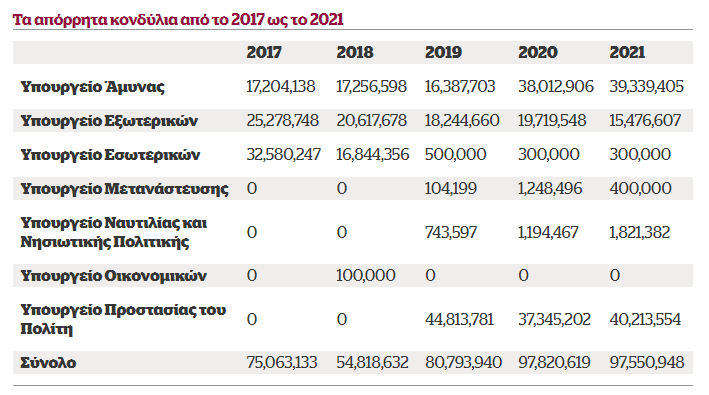
The inside story studied the revenue-expenditure reports of the central administration (includes ministries, Presidency of the Republic, Parliament and Government Presidency), the latest available five-year period, i.e., 2017-2021, as drafted by the General Accounting Office of the State and approved by the Parliament and found the following:
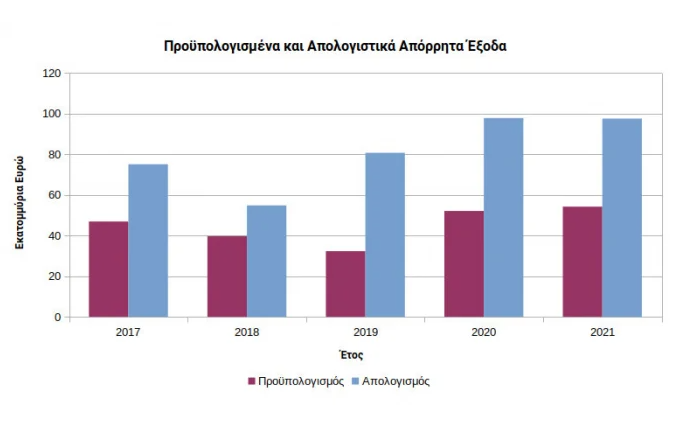
- For 2021 the amount of secret expenses was budgeted at €54.2 million and ultimately spent almost double that amount, i.e., €97.5 million. This is a deviation of about 80%. The €97.5 million is roughly what was spent on electricity for the whole year and the 18 ministries of the country together with the Presidency of the Republic, the Parliament and the Government Presidency.
- 2021 is the second year that secret expenditures approached close to 100 billion euros. In 2020, 97.8 billion euros were spent out of the 52.1 billion euros that had been budgeted. From 2017 to 2021, secret expenditures cumulatively exceeded 400 billion euros.
- The largest deviation between the amount budgeted by the Ministry of Finance and the amount actually spent was recorded in 2019 (a year divided between the SYRIZA-ANEL and ND administrations). Instead of 32.3 million euros, 80.7 million euros were ultimately spent, i.e., more than double the money (150% deviation).
- The largest annual difference is observed between the years 2019 and 2020. During this period the classified expenses that were spent increased by 21% – from €80.7 million in 2019 to €97.8 million in 2020. It is recalled that 2020 was the year of the crisis in Evros with the migratory flows from Turkey.
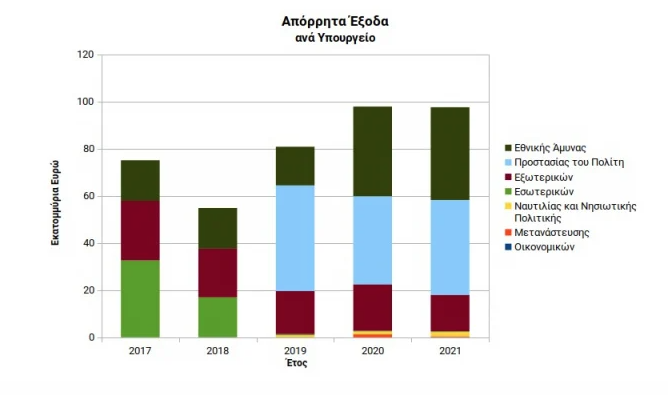
- In 2021 secret funds were managed by the ministries (alphabetically): Defense, Foreign Affairs, Interior, Immigration, Shipping and Citizen Protection. From the total of €97.5 million at Central Administration level, the majority, i.e., €40.2 million, were spent by the Ministry of Citizen Protection (over half by the General Secretariat of Public Order, which also oversees the Hellenic Police – until 2018 the ELAS was under the Ministry of Interior), almost €40 million were the secret expenditures of the Ministry of Defense (the Greek Police is financially attached to it) and followed by the Ministry of Foreign Affairs with almost €15.5 million.
- From 2020 (previously these codes did not exist) apart from the Ministry of Migration and more specifically the General Secretariat of Migration Policy, Reception and Asylum, secret expenditures for migration flows are managed by the Ministry of National Defense, the Ministry of Shipping and Island Policy, and the Ministry of Citizen Protection. The secret (spent according to the report of the General Accounting Office of the State) expenses for migration issues in 2020 amounted in total to 19 million euros (the 15 million went abruptly to Defense, i.e., they were not budgeted at all) and in 2021 they decreased slightly to about 13 million euros.
- For public order and security (including the classified expenses of the Hellenic Police, the General Secretariat for Public Order and the Coast Guard/Harbor Police) in 2021, 54.3 million euros were spent, a record amount for the examined period 2017-2021. In 2020 it was 50.1 million euros and in 2019 45.1 million euros.
The classified expenses of the Hellenic Police
The National Intelligence Service, every year we studied, records deviations of at least 60% between the classified expenses budgeted each year and those that are actually spent. However, in 2021 the difference surpassed any previous, reaching 480%. The classified expenses that had been budgeted for that year were €4.7 million and were ultimately spent €27.5 million, i.e., €22.7 million more. In 2020 the deviation was almost 206% – instead of the €4.7 million budget, the GLK report wrote €14.4 million. The immediately previous larger percentage deviation (76%) was in 2018. The agency employee who manages these expenses remains the same person for decades.
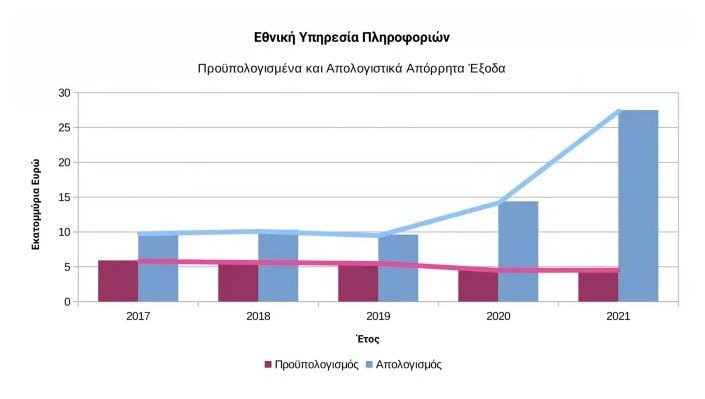
Cumulatively, from 2017 to 2021, the secret expenses of the EUF have risen to €71.7 million, with more than half (€42 million) spent in the 2020-2021 biennium.
The secrets and the «sources» of the EUF
Earlier the secret funds were allocated by the EYP mainly for the payment of «sources», both abroad and mainly within the country. In many cases the «sources» were controversial or even non‑existent, as some operators simply put the money in their pockets. Nevertheless the amounts were considerably smaller than those that foreign services had and possess for gathering information. Regarding payments abroad, under the SYRIZA/ANEL government the EYP administration limited its station chiefs to three countries (Brussels, Skopje, Amman which was later transferred to Cairo), while the new EYP director Themistocles Demiris «opened» again accredited positions in Ankara, Tirana and Belgrade after many years.
The account that doesn't log out
The inside story is in a position to know that between 2020 and 2021 the –unbudgeted– classified funds of the EYP, which reached 32,485 million euros, were used to cover at least one procurement concerning the development of software for the country's defense, in a sector where Turkey until recently maintained superiority, as two independent sources told inside story who managed this procurement. The cost was 16 million euros. The amount is not enough to justify the discrepancy between the budgeted and the finally executed classified expenditures of the EYP for the 20-21 biennium, as another 16,485 million euros (32,485 minus 16) remain whose needs we do not know were covered.
What we know is that during the same controversial two‑year period the illegal use of the surveillance software Predator began. According to information from Inside Story, part of the high cost of the Predator spyware used for illegal monitoring of politicians, journalists, entrepreneurs and officials was covered by the government’s secret funds. As we wrote in a previous report titled “Greek public sector and Intellexa: yet they are known» the purchase of this surveillance software cost the Greek side 7 million euros and beyond that the cost for ten targets per month, which rotate, is about 150,000 euros. The system, according to Inside Story, was installed in a space of the Hellenic Police in Agia Paraskevi. The first two domain‑traps (out of a total now exceeding 50) which were created to generate links to infect the mobile phones of the persons who were targeted, were purchased in July 2020, four months after Intellexa was installed in Greece, the company that markets Predator. 2020 is also the year when several high‑ranking officials of Israeli origin of this corporate group were regularly in Athens and had meetings with Greek government officials.
Source of information: insidestory.gr
