

NASA is observing a supernova remnant, named SNR 0519-69.0, in order to determine the timing of the stellar explosion.
While astronomers have seen the debris from dozens of exploded stars in our galaxy and nearby galaxies, it's often difficult to pinpoint the exact time of a star's death. By studying the spectacular remnants of a supernova in a neighboring galaxy and using NASA, a team of astronomers has found several clues that could help turn back the clock.
See also: NASA: SpaceX will carry out 5 more astronaut missions to the ISS

The supernova remnant called SNR 0519-69.0 (SNR 0519 for short) is the debris from the explosion of a white dwarf. After reaching a critical mass, either by pulling matter from another star or by merging with another white dwarf, the star underwent a thermonuclear explosion and was destroyed. Scientists use this type of supernova, called Type Ia, for a wide range of scientific studies ranging from studying thermonuclear explosions to measuring distances to galaxies billions of light years away.
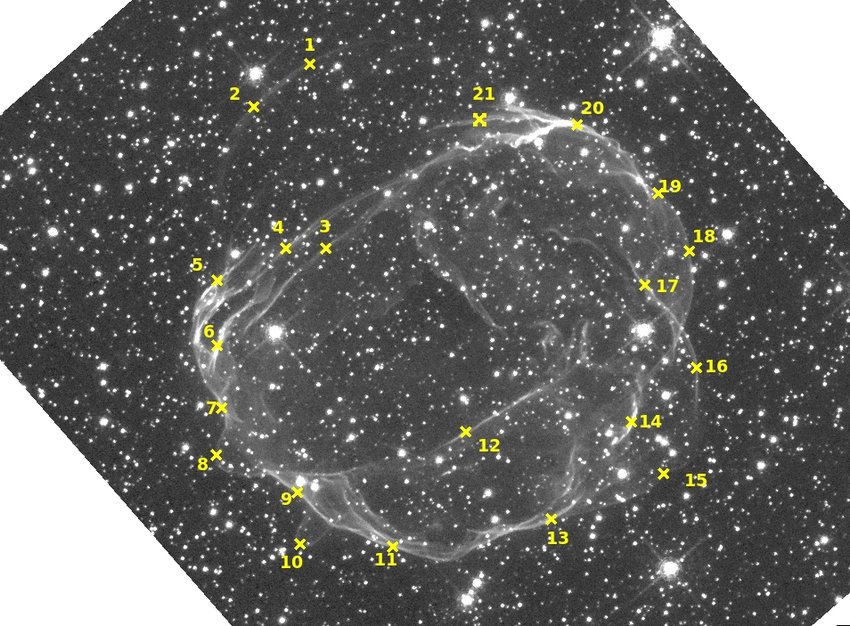
SNR 0519 is located in the Large Magellanic Cloud , a small galaxy 160,000 light-years from Earth. This composite image shows X-ray data from NASA's Chandra X-ray Observatory and optical data from the Hubble Space Telescope . Low-, medium-, and high-energy X-rays from SNR 0519 appear in green, blue, and purple, respectively, with some of these colors overlapping to appear white. The optical data shows the remnant's perimeter in red and the stars surrounding the remnant in white.
Astronomers combined data from Chandra and Hubble with data from NASA's retired Spitzer to determine how long ago the star SNR 0519 exploded and learn about the environment in which the supernova occurred. This data provides scientists with the opportunity to "rewind" the tape of stellar evolution that has occurred since then and understand when it began.
The researchers compared Hubble images from 2010, 2011 and 2020 to measure the velocities of the material in SNR 0519's blast wave, which range from about 3.8 million to 5.5 million miles (9 million kilometers) per hour. If the speed was toward the higher end of these estimated speeds, the astronomers determined that light from the blast would have reached Earth about 670 years ago, or during the Hundred Years' War between England and France and the height of the Ming Dynasty in China.
See also: James Webb & Hubble: Impressive combined image of the Phantom Galaxy
However, it is possible that the material has slowed down since the initial explosion and that the explosion occurred less than 670 years ago. Chandra and Spitzer data provide evidence that this is the case. Astronomers found that the brightest regions in X-rays of the SNR 0519 remnant are where the slower-moving material is located, and no X-ray emission is associated with the faster-moving material.
These results suggest that part of the blast wave has impacted dense gas around the remnant, causing it to slow down as it traveled. Astronomers can use additional observations with Hubble to more precisely determine when the time of the collapse of the star SNR 0519 should actually be set.
A paper describing these results was published in the August issue of The Astrophysical Journal , and a preprint is available online.
Source: phys.org
