


For individuals with gluten allergy or celiac disease, the idea of eating out at restaurants can be frightening. It usually involves checking the menu and food labels, interrogating the waiter, or meals that are taken ready from home.
But now, a discreet new device, small enough to fit in a pocket or bag, could make eating out an easier and safer experience for people with gluten intolerance.
Made by San Francisco-based 6SensorLabs, the wearable device, called Nima, can test foods for the presence of gluten and provide results within minutes, reducing anxiety for those with gluten sensitivity. The device could also provide greater social freedom, making mealtimes more enjoyable, said 6SensorLabs co-founder and Chief Technology Officer Scott Sundvor.
Using the Nima device, people can ensure that their food is gluten‑free by placing a small piece of the food inside a single‑use capsule, twisting the closed lid and inserting the capsule into Nima’s main sensor unit. Within 2‑3 minutes, Nima will allow users to know whether the foods are safe to consume, displaying a smiling face on the screen if there is no gluten, or a frowning face if the result is positive for the protein, the company says.
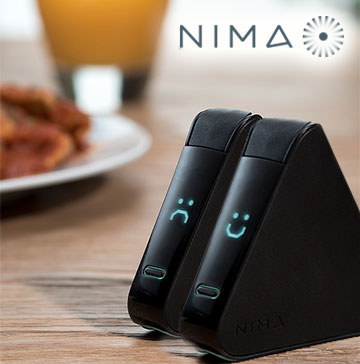
The device can test a range of foods, from soups and sauces to more solid foods such as roasted and fried items. Using a combination of chemical and mechanical processes, the Nima grinds any bulk ingredient, breaking down the food into a mixture of enzymes and antibodies to detect any amount of gluten in the mixture. Sundvor claims that these antibodies can detect gluten levels as low as 20 parts per million, the FDA limit for the maximum gluten level considered acceptable in foods labeled as gluten‑free.
But the Nima itself is not an FDA-approved device. It is not intended for medical or diagnostic use. Instead, the Nima is being marketed as a tool to provide more information about food when you eat out, according to Sundvor.
The results of Nima have been validated by two separate external laboratories: Bia Diagnostics and BioAssay Systems. However, further tests will be conducted before the device is released to the market.
There are still some challenges, however. Most importantly, Nima cannot guarantee that an entire meal will be gluten‑free, because the tests are performed only on the portion of the meal that users place in their device. If there is gluten in the salad dressing of a meal, for example, and not in the parmesan crust of the chicken, the device could give a false negative indication if the chicken is the only part of the meal that was tested and not the salad.
Currently, users can pre-order a Starter Kit online, which consists of the Nima main unit and three capsules, for $199. Packs of 12 capsules each will also be available on a subscription basis for $47.95 during the pre-sale. When the device is available, in mid-2016, the company will also have a Nima app, in which users can share their results and experiences at various restaurants, trying different foods.
