

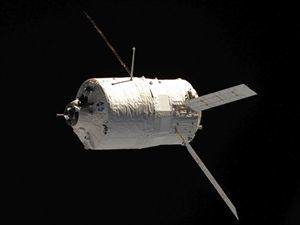
The European Space Agency (ESA) announced that its last robotic "transfer vehicle" (Automated Transfer Vehicle – ATV), which supplied the International Space Station (ISS), burned up last night, as planned, during its re-entry into Earth's atmosphere, after a 186-day stay in space.
The "Georges Lemaître", named after the Belgian priest and astronomer "father" of the "Big Bang" theory of the universe, was the fifth and final automated space shuttle.
They were preceded by "Julius Verne", "Johann Kepler", "Edoardo Amaldi" and "Albert Einstein".
ESA's seven-year ATV program has thus been completed, and now the ISS will be supplied with water, oxygen, food, spare parts, etc. by the Russian Progress cargo ships, the Japanese HTVs, and the private American Dragons from SpaceX and Cygnus from Orbital Sciences, according to Agence France-Presse and Space.com.
The "end of an era" of ATVs (the first launched in March 2008) was celebrated with emotional scenes at the control center in Toulouse, while NASA also sent its congratulations via Twitter. In total, the five ATVs remained in space for 776 days and delivered supplies weighing a total of 32 tons.
The ATVs were launched on an Ariane rocket from ESA's space base in French Guiana, South America, and their journey to the ISS lasted about six months at a time. All of the craft's approach, docking, and departure maneuvers were performed automatically without human intervention.
The ATVs were almost 11 meters long and weighed about 20 tons with their cargo (up to seven tons). Thanks to the engines, when they were attached to the ISS, they could give it the necessary boost from time to time to put it back into the correct orbit or to avoid some dangerous space “junk”. When they returned to Earth, they were loaded with ISS trash and human waste.
The design and advanced technology of the ATV will now be utilized by ESA - with appropriate adaptations - to form part of the European Service Module (ESM) of NASA's new "Orion" spacecraft, which is intended for space exploration.
ESA astronauts will continue to travel to the ISS and conduct experiments at the European laboratory "Columbus".
Source: APE/MPA
