

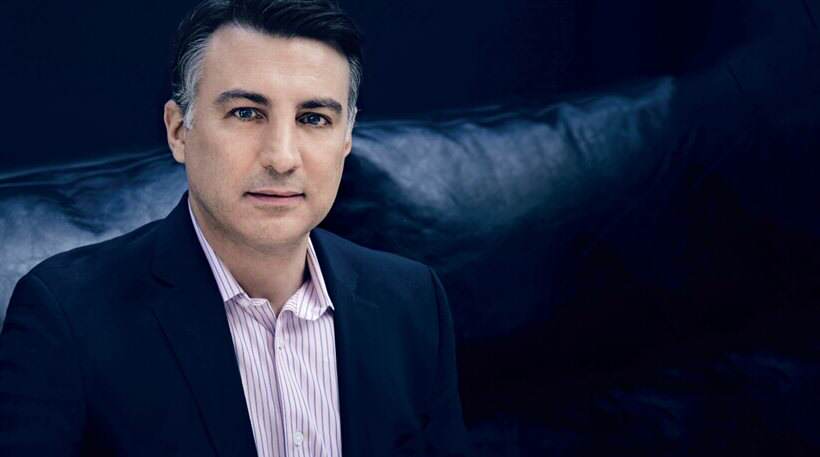
He abandoned electronic surveillance and the secrets of hackers and today he advises the "cinema mecca" on films that would make even the most imaginative conspiracy stories jealous. Michael Panicos speaks to the Greek People and explains why even Obama could be the next cyber-target!
In 2014, Sony saw confidential emails exchanged between its top executives leaked by unknown individuals, scenes from its film The Interview were released online before its premiere, and anonymous messages threatening a terrorist attack on cinemas that would screen the film – a parody of the North Korean leader. Obama immediately “showed” the North Korean as “culpable” for the hack. Two months later, Sony announced that it had lost $30 million from the cyberattack. As for the perpetrators, they remain at large.

Cybercrime is the biggest "wound" in the modern economy. According to the website of the Greek Police, every day 700,000 transactions are made on the Internet worldwide, resulting in 5 trillion dollars being moved around the world within twenty-four hours. Hackers want to get their hands on this treasure. As noted by the American Center for Strategic and International Studies (CSIS), cyber-attacks have increased by 48% since 2013, resulting in the global economy losing 445 billion dollars. The United States has consistently been the first target of attacks. In Greece, last year, as announced by the Cybercrime Prosecution Directorate, 2,725 cases were handled and 36 arrests were made.
At the same time that hackers are besieging electronic systems and emptying them of money or personal information, and Obama is declaring war on cybercriminals, Hollywood is getting inspired. It is presenting films with conspiracy stories, in which high technology is the "starring" role. The way was paved by The Italian Job (1969), the first film to have a hacking plot, while more than 130 hi-tech cinematic adventures followed.
Today, in Blackhat, the protagonist (Chris Hemsworth) is a jailed hacker who collaborates with the authorities to dismantle a cybercrime network. For the believability of the script, the assistance of a former FBI agent was requested. Michael Panicos was the FBI's strong card in prosecuting cybercrime for ten years, while he does not resemble the cliché image we have of agents: He is not difficult to communicate, talkative and unsmiling, but he knows how to put periods in the conversation.
What made you leave the FBI, where you were a high-ranking agent in the cyber security unit, and go to Hollywood to work as a script consultant?
I joined the FBI because I like solving puzzles and helping. After ten years on the front lines, I think my offer has come full circle. The private sector is very exciting, and that's how I ended up in Hollywood, consulting on films about cybercrime.
What is your role in films like Blackhat?
Authenticity and verisimilitude are the most important elements in such projects, which is why I am constantly present throughout the film process and contribute to the realism of the script. In Blackhat I showed the actors the ways hackers type, talk to their team, communicate with others and of course how they work with computers. Fortunately, Chris is a very good "student" and the result justified us.
What is the true profile of a hacker? Is he a nerd who lives in a dark room?
The hacker is not in his own world. He does not have to have much to do with computers, since it is now very easy and cheap for anyone to buy a package of "malicious software" and infect any computer they want. Their main characteristic is the innate ability to see behind the obvious and connect the disjointed. As for gender, they can also be women, and there is no age limit. Anyone who is malicious can become a hacker.
Judging from your experience, what happened with the Sony hacking case?
I believe it is a combination of many different forms of hacking. Perhaps it has to do with the creation of networks, which led to the sabotage of systems. It is noteworthy, however, that for the first time we have a state attacking a business.
In 2004, you were the FBI's head of the Athens Olympics. Were the Olympics threatened by cyberattacks?
I'm not allowed to answer your question. All I can tell you is that we did our job very well!
How secure is the average person's computer?
Not every user is the same. We should know where they work, what kind of information they have at their disposal, the sites they usually visit and whether they open all the e-mails they receive indiscriminately. Once we get the answers, we will know if someone's computer is secure, but also the degree of risk it exposes them to.
Is there a "secret" to protect ourselves from the possibility of our computer being hacked?
The "secret" is related to the password. Change it often. Do not choose obvious numbers, e.g. birthdays. Do not use the same one in your various transactions and avoid "1234". Choose long passwords!
Do you think Obama is vulnerable to a future cyber-attack?
I couldn't rule it out. After all, anyone in such a position could be attacked! We are all potential victims!
Source: protothema.gr
