

Cybercriminals are increasingly exploiting Microsoft Exchange inbox rules to maintain their presence in systems and extract data in corporate environments. A new tool, Inboxfuscation, uses Unicode-based obfuscation to create malicious inbox rules that bypass conventional security checks.

Developed by Permiso, the Inboxfuscation framework shows how attackers can exploit Exchange's rule engine, creating discrete presence mechanisms that evade both human review and code-based detection.
Inboxfuscation: Unicode-Based detection evasion
Traditional inbox rules attacks relied on plaintext keywords and simple actions such as forwarding or deleting messages. These attacks are easily detected by keyword-based detection systems and regex matching. Inboxfuscation alters data, replacing ASCII characters with identical Unicode variants. It introduces zero-width characters, manipulates bidirectional text, and combines multiple obfuscation techniques.
See also: HoundBytes launches an automated security analyzer
For example, the word “secret” can be hidden as:
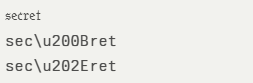
Permiso reported that by exploiting character classes such as MATHEMATICAL ALPHANUMERIC SYMBOLS (U+1D4B6), ZERO-WIDTH SPACES (U+200B), and RIGHT-TO-LEFT OVERRIDE (U+202E), attackers can create rules that look innocent in Get-InboxRule output , but functionally match sensitive keywords.
Inboxfuscation also introduces functional obfuscation tricks, such as rules that forward emails to the Calendar folder or insert null characters (\u0000) to make rules invisible and unrecoverable.
Detection and mitigation strategies
Conventional detection tools fail against Unicode obfuscation because they assume ASCII-based pattern matching and visual similarity. The Inboxfuscation detection framework extends Permiso's Arbiter Detection module to analyze events in mailboxes and reconstruct multi-step rule generation behaviors. The key components include:
- Character Category Analysis
- Multi-Format Log Parsing: Supports JSON, CSV, Exchange export, and Microsoft 365 Graph API logs
- Rules Control and Historical Analysis
- SIEM Integration
A structured output includes rule_name, mailbox, risk_score and unicode_char_count.
See also: Chrome: Critical type confusion vulnerability analysis

To mitigate this threat, security teams should implement Unicode-aware detection rules, perform comprehensive inbox rule checks , and simulate obfuscated rules in test environments. Organizations should update Exchange trace lines to flag suspicious Unicode categories and use sandbox environments to inspect rule normalization behaviors.
While these Unicode obfuscation techniques have not yet been observed in real-world attacks, their technical potential reveals a critical blind spot in email security postures. By proactively adopting Inboxfuscation’s detection framework and understanding Unicode-based obfuscation mechanisms, security teams can stay ahead of emerging APT tactics and protect corporate communications from persistence techniques.
The Inboxfuscation incident highlights an often underestimated reality in the cybersecurity world: attacks are evolving not only at the malware level, but also at the “language” and data interpretation level. The fact that cybercriminals are turning to Unicode to bypass detectors shows that the defense game is no longer limited to catching suspicious patterns, but requires a deeper understanding of how technology represents and manipulates information.
See also: Hackers target ICS computers with malicious scripts
🔒 Protect your privacy with Proton VPN
Swiss VPN from the creators of Proton Mail — strict no-logs policy, strong encryption, and built-in NetShield that blocks ads, trackers, & malware.
- ✔ No-logs, based in Switzerland (except 14-Eyes)
- ✔ NetShield: blocks ads, trackers & malicious domains
- ✔ Covers all devices — free version available
The link is an affiliate link — SecNews may receive a commission at no additional cost to you. It does not affect the independence of our article writing.

The challenge for businesses is that such obfuscation techniques don’t “scream” in the traditional way that a virus or trojan would; instead, they nest within seemingly innocent structures that administrators are accustomed to trusting. This means that security teams must redefine the way they monitor, emphasizing not only what is visible on the interface but also how the data is structured beneath the surface.
Inboxfuscation is a bellwether for a more holistic approach: strengthening detection pipelines with Unicode normalization, integrating threat hunting techniques that analyze historical patterns, and most importantly, continuous collaboration with the research community.
