

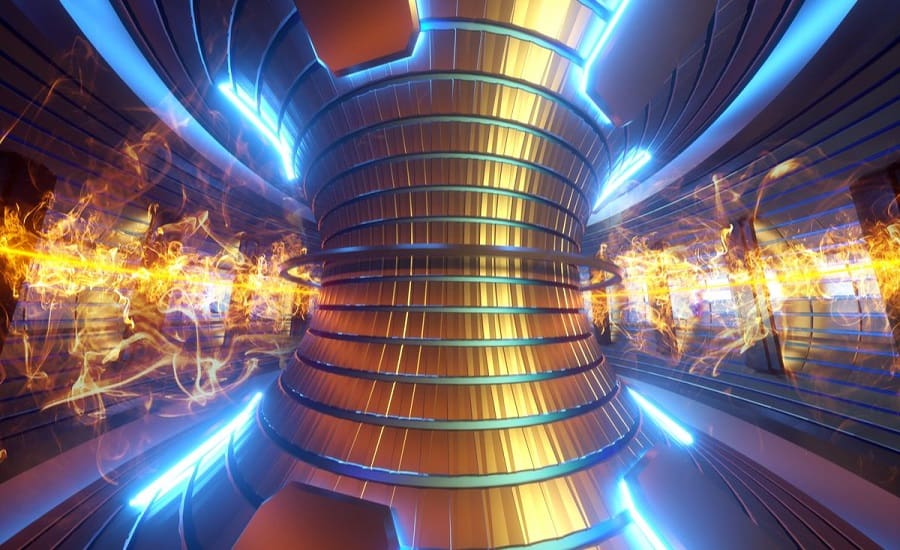
China has achieved a new milestone in humanity's efforts to harness the power of the stars. On Friday, the Chinese Academy of Sciences' nuclear fusion engine, also known as the "Artificial Sun," reached 120 million degrees Celsius and stayed there for 101 seconds.
See also: China: Turns to automation to address population issues
The last time EAST (Experimental Advanced Superconducting Tokamak or HT-7U) held a plasma loop for such a long time was in 2017, but the temperature only reached 50 million °C.
In 2018, the reactor maintained heated gas beyond the 100 million degree Celsius benchmark, considered critical for power generation, but could only maintain the plasma for about 10 seconds.
Now holding plasma at eight times the Sun's core temperature of 15 million °C for such a long time, the new record has pushed the world a little closer to this elusive, but highly sought-after clean energy source.
"This breakthrough is a great advance, and the ultimate goal should be to maintain the temperature at a constant level for a long time," Southern University of Science and Technology physicist Li Miao told the Global Times.
Fusion power harnesses the reactions that take place deep inside the Sun, squeezing hydrogen atoms together into larger elements like helium. Where the Sun relies on gravity to force atoms together, here on Earth we have to resort to less subtle means, raising temperatures in specially built generators to create the forces of atomic fusion.
See also: How does the Solar Orbiter not burn from the Sun's temperature?
Researchers estimate that the amount of Deuterium – a stable form of hydrogen containing one proton and one neutron – in one liter of seawater could produce the energy equivalent of 300 liters of gasoline through nuclear fusion.
It takes about 300 scientists and engineers to support and operate the experimental facility that EAST is located in. This large, doughnut-shaped metal tube has a series of magnetic coils used to contain superheated streams of hydrogen plasma around the core.
The challenge is to keep the plasma in place long enough for fusion to occur. It needs to be even hotter than the Sun, because its much stronger gravity helps compress the nuclei, something we can't replicate here on Earth.
With the ability to safely such vast amounts of energy with no greenhouse gases and almost no radioactive waste, fusion power is considered by some to be the cradle of clean energy.

However, nuclear fusion is not yet ready, with a fully functional “artificial sun” still likely decades away. We also haven’t yet reached the point where a fusion reactor can produce more energy than it consumes, but some experts believe we are getting closer.
See also: Scientists make a major discovery about spiders on Mars
Korea held the previous record of 100 million degrees Celsius (220 million degrees Fahrenheit) for 20 seconds. Now, China's Artificial Sun has also managed to reach 160 million degrees Celsius (288 million degrees Fahrenheit) for 20 seconds, but there's still a long way to go before the plasma can stabilize at the high temperatures required.
Of course, all governments around the world must adopt more sustainable and ecological practices now, in order to ensure the future of our planet.
