

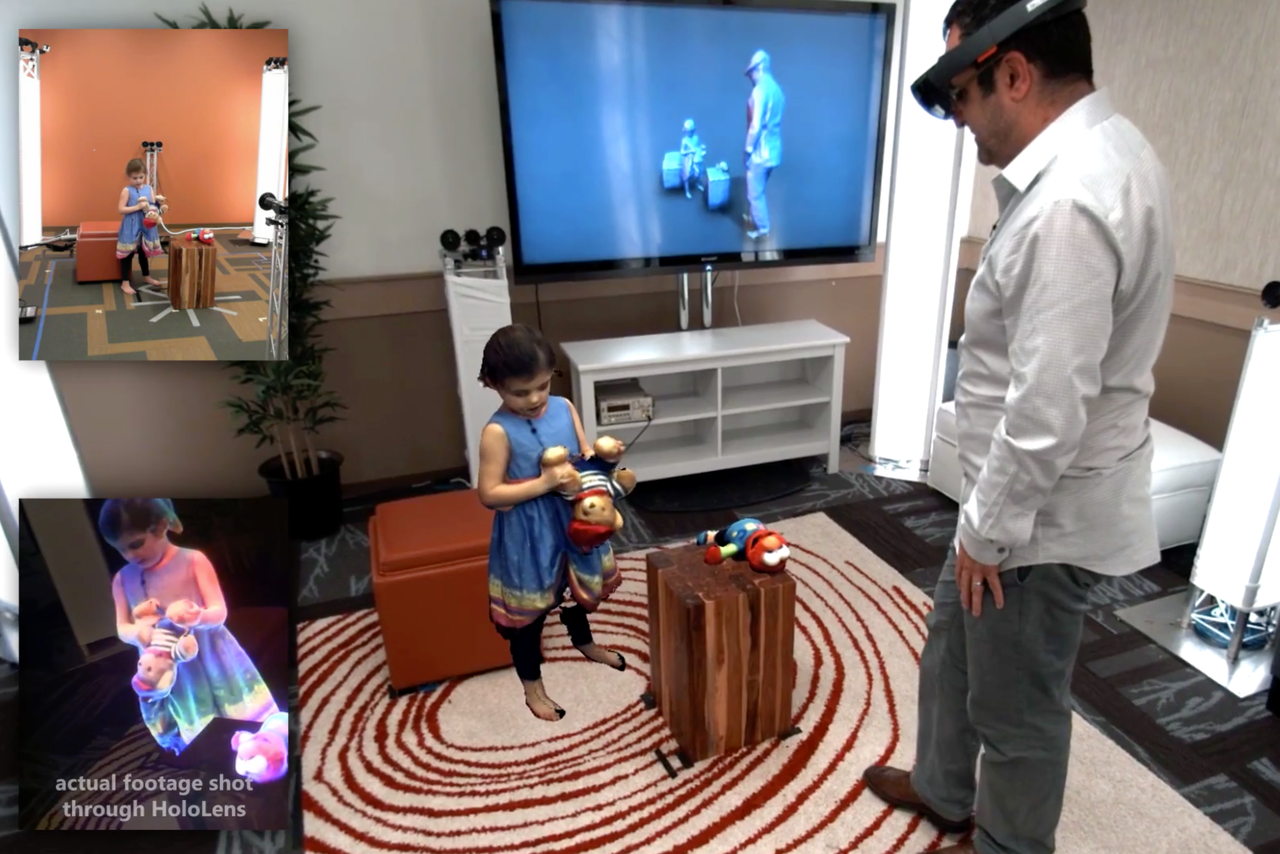
As we mentioned in our previous article, Microsoft has introduced the next generation of teleportation, with the all-new HoloLens. Microsoft Research’s latest demo, called “Holoportation,” showcases its new engagement technology, which has the potential to enable high-quality 3D models of people in remote locations, in real time, using HoloLens. In other words, HoloLens lets you see a live hologram of a person in another location.
Here is how this is defined by Microsoft Research:
Holoportation is a new type of 3D capture technology that allows high-quality 3D models of people to be reconstructed, compressed, and transmitted worldwide in real time. When combined with mixed reality displays, such as HoloLens, this technology enables users to see, hear, and interact with remote participants in 3D as if they were truly present in the same physical space. Communication and interaction with remote users becomes as natural as face-to-face communication.
So how does HoloLens?
HoloLens creates interaction with a holographic version of the face and space on the other end. 3D cameras are also used to capture the user's speech before sending the data to another HoloLens user, making virtual conversations between Darth Vader and the Emperor in Star Wars a very real possibility.
Another useful feature is that the «Holoportation» can be recorded and reproduced at a later time – and it can even shrink or enlarge the images to the size you want them displayed.
The developer edition costs $3,000. Microsoft's Build 2016 developer conference kicks off on Wednesday this week, and the HoloLens version is set to launch soon. While the technology is still in its early stages of development, it has a long way to go before it's available to consumers, as the holograms sometimes flicker and don't track properly.
