

 As unrealistic as it may seem, once the appropriate data is entered, it can print in life-size anything that can come to mind

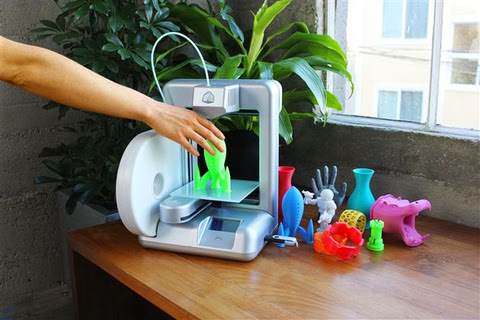
3D printer technology is now available at affordable prices. But what is a 3D printer?
As unrealistic as it may seem, it is a type of printer that can, if the appropriate data is entered, print life-size things out of paper, cardboard, plastic, and even metal. That means you can print shoes, bicycles, straws, and generally anything your mind can imagine.
Of course, the quality of things is not the same as the original, but nevertheless, printers are considered quite useful in industrial society, as it is possible to test some products without any costs, e.g. car parts, fitness equipment, etc. In general, one could say that their possibilities are... infinite!
3D printer technology also finds use in the fields of jewelry, footwear, industrial design, architecture, engineering and construction (AEC), automotive, aerospace, dental and medical industries, education, information systems mapping, civil engineering projects, and many more.
A strategic advantage of 3D printing is the ability to produce complex objects using exactly the amount of material needed. 3D printing also helps reduce CO2 emissions due to less logistics.
Until relatively recently, 3D printers could only print plastic, but now they can use metals such as titanium as raw materials. Even large generator parts can be created layer by layer with the help of a laser that locally melts a metal powder.
The areas where 3D printing makes or can make a difference
Dentistry: Most of us may not know it, but 3D printing technology has penetrated the dental industry in recent years. Until recently, to create a crown for a tooth, we had to bite off a piece of special clay to create an impression of our teeth. Based on this, the dentist would make the crown by hand. Today, crowns can be created exclusively using a 3D printer. All the doctor needs to do is scan our mouth with a special machine and a 3D printer prepares it immediately.
Prosthetic Limbs: The impact that 3D printing can have on medicine is great. At present, the new technology is most widely used in the creation of artificial limbs. Manufacturing speeds are much faster. The main advantage is that new prosthetic limbs can be easily manufactured to suit the needs of each individual. This is important, since no two people are the same. Some walk differently, others are more agile, and everyone's proportions are unique.
Household needs: The most optimistic predict that one day in the future, every household will have its own 3D printer, which it will use on a regular basis. And if you're wondering why we would use such machines at home, just calculate how many runs to the mall we will save by making our own toys for the children, plates, cutlery and anything else we can imagine!
Source: protothema.gr
