

What do Qantas, former "Beetle" Paul McCartney, the Norwegian University of Science and Technology and the... North Evia Tourist Accommodation Association have in common? That they all give a "vote of confidence" to virtual reality, that is, to the technology that, with the help of a special mask, "transports" the wearer to the environment that is being reproduced at that moment by their computer or smartphone . A technology that seems ready to take off, as more and more businesses, film studios and scientists have begun to utilize the realistic experience it provides in various applications.
"Interactivity makes virtual reality a very effective technological tool for promoting tourism. In fact, the Region of Crete and the Municipality of Chios have already invited us to develop similar applications," says Panagiotis Tzinis, founder of the community.
The application for Northern Evia is making its “premiere” (yesterday and today) at the Grekland Panorama exhibition in Stockholm, and is based on Google Cardboard, the assembled cardboard “mask” that two Google employees created. “Its main advantage is that it costs very cheaply, less than $12, thus enabling developers and users to get acquainted with virtual reality,” notes Mr. Tzinis. Among those who have already taken advantage of this advantage is Paul McCartney, who made his recent concert in San Francisco available in a panoramic video for Google Cardboard.
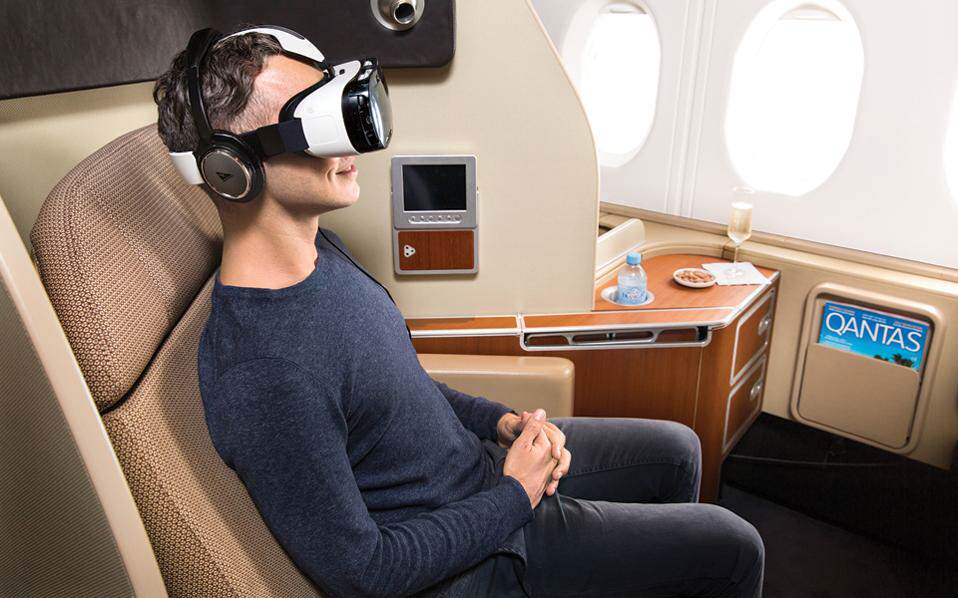
At the same time, the Australian airline Qantas "sees" virtual reality as a new entertainment option during air travel, using Samsung's Gear VR "mask" for this purpose.
Thus, from mid-March, it will initially provide the Gear VR in a pilot phase to business class passengers on routes from Melbourne and Sydney to Los Angeles, so that, among other things, they can take boat "rides" in Australia's Kakadu National Park. The Gear VR is compatible with the Galaxy Note 4 and has motion sensors, so that it adapts the "virtual" environment to head movements with greater accuracy, since it does not rely solely on the smartphone's sensors.
The Korean company's "mask" has been available in the US since late December, although initially in limited numbers, while in Greece it is expected in late May. Priced at $200 on the other side of the Atlantic, the Gear VR was launched along with the online store Milk VR, where one can find compatible hardware.
For Milk VR, Samsung has secured content from film studios IMAX and DreamWorks, Cirque de Soleil, and video game producers. The company will also release a special camera, Project Beyond, so anyone can capture video and images in a compatible format.

The Gear VR was developed in collaboration with Oculus VR, the company that gave a boost to virtual reality with the Oculus Rift "mask" and which was acquired by Facebook last March for $2 billion.
Although Facebook talked about a "revolution in communication and education" in its announcement of the acquisition, it seems that the next model of the "mask" will be released with an emphasis on entertainment. This is because Oculus VR recently opened a film studio specifically for virtual reality films.
At the same time, however, independent applications are already showing many other possibilities, such as the virtual environment created by Toyota for safe driving training or the application of the Norwegian University of Science and Technology for the "practical training" of nurses.
The protagonists
"Virtual reality is certainly one of the most important next "chapters" of technological development, since it will affect many areas of everyday life. Imagine, for example, that in a few years museums will be able to offer realistic "tours" of their collections to people who are miles away, or that real estate agencies will allow their clients to "tour" the houses they offer for rent, without them having to step out of their chair," notes Panagiotis Tzinis from Google Developers Group in Thessaloniki.
Thus, alongside the Project Morpheus "mask" that Sony is preparing for the PlayStation 4 and PlayStation Vita game consoles, the German lens manufacturer Carl Zeiss announced last October the VR One, a "mask" that will be released in 2015, at a price of $99.
The company claims that the VR One will be compatible with any smartphone measuring 4.7 to 5.2 inches. Razer is also betting on flexibility of use with the product it announced at the CES technology show, the OSVR, which will be compatible with Windows, Android and Linux devices, and will be launched this summer, priced at $170.
In contrast, Microsoft took a different approach, introducing Windows HoloLens, a glasses system based on holography.
Source: kathimerini.gr
