

After years of delays and technical challenges, NASA is preparing to write a new chapter in the history of space exploration with the Artemis II. It is the first manned mission to the Moon in more than 50 years, marking humanity's return to lunar orbit and paving the way for future landing and permanent presence missions.
The crew that makes history
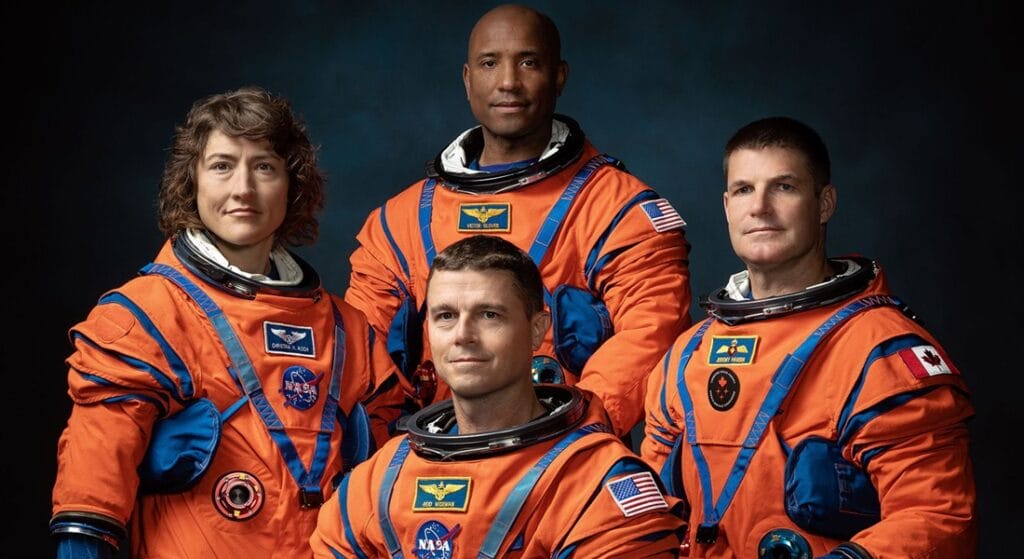
The mission brings with it a high-caliber crew, consisting of Commander Reid Wiseman, Pilot Victor Glover, Mission Specialist Christina Koch and Canadian Jeremy Hansen. Their selection is not accidental, as they combine experience, technical training and international cooperation. Artemis II is not only a technological test, but also a symbolic mission that reflects the new era of space exploration.
The crew will launch from Kennedy Space Center aboard the Space Launch System rocket and travel aboard the Orion capsule in a “free-return” orbit. This means they will reach orbit around the Moon and return to Earth without the need for additional maneuvers. The mission is expected to last about 10 days , providing valuable data for the next phases of the Artemis program.
See also: “Electrical hell” on Jupiter: Lightning of unimaginable power
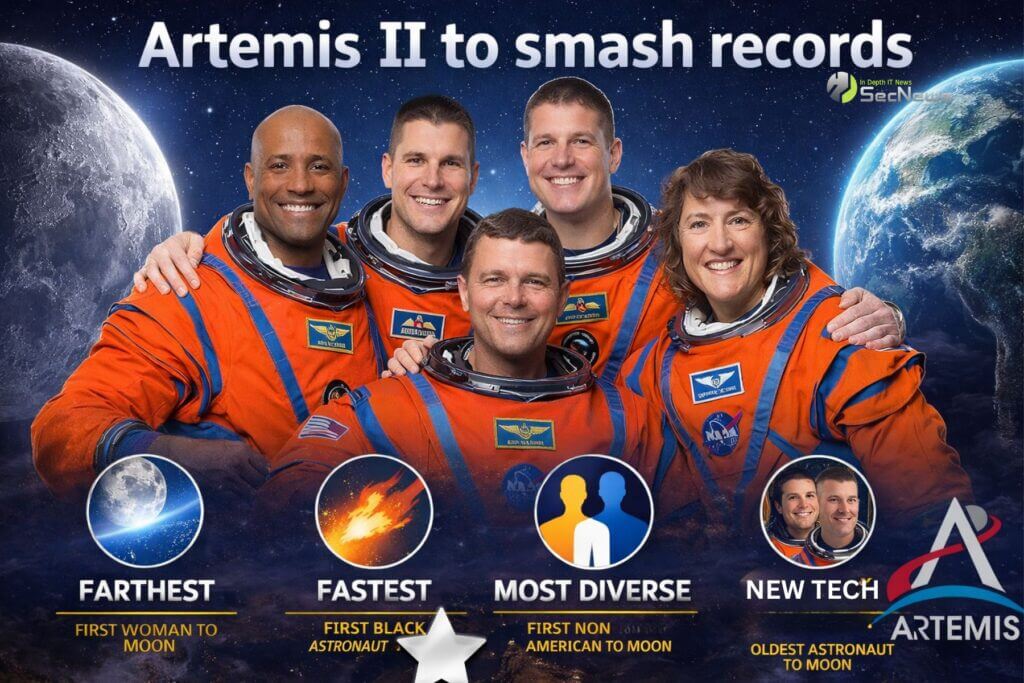
Records and firsts that change the data
The Artemis II mission stands out for the historical milestones it will achieve:
1. The first woman to travel to the Moon
Christina Koch ’s presence on the mission marks another historic step, as she will become the first woman to travel beyond low Earth orbit and reach the lunar environment . Koch is no stranger to space firsts, having already held the record for the longest continuous stay in space by a woman, with 328 days on the International Space Station . She also participated in the first all-female spacewalk with Jessica Meir , further enhancing her profile as a pioneer. On Artemis II, her role will be more than just symbolic. Along with Hansen, she will be among the first to move inside the capsule after launch, activating and adjusting critical life support systems . Her experience on long-duration missions makes her ideally suited for this demanding task, while her presence marks the transition to a more inclusive era for space exploration.
2. The first astronaut of color to reach the lunar environment
Victor Glover ’s participation in the Artemis II mission is not just a personal distinction, but a historic milestone for representation and diversity in space exploration . Glover will become the first astronaut of color to travel beyond low Earth orbit and reach lunar orbit, breaking a long-standing barrier in the space of manned missions. In addition to its symbolic significance, his role on the mission is also operationally critical. During a specific window of time, known as “ prox ops ,” he will take manual control of the Orion capsule , which otherwise operates autonomously. This process, which will take place while the spacecraft is still in Earth orbit, will provide valuable data for future missions that will require precise handling to dock with other spacecraft. Essentially, Glover's contribution will help lay the foundation for the technical processes for the next phases of the Artemis program.
See also: Artemis II: NASA aims for a more realistic approach to returning to the Moon
3. The first non-American on a lunar orbit mission
Jeremy Hansen is also making history as the first non-American astronaut to fly to the Moon. His participation reflects the internationalization of space programs and the close collaboration between NASA and the Canadian Space Agency. Although he is the only one on the crew with no previous space experience, his selection underscores confidence in his abilities. However, this means he may experience what is known as “space adaptation syndrome,” a form of severe motion sickness that affects many new astronauts. He has acknowledged this possibility, saying he will need to be extra careful during the first few hours of the mission. Despite the challenges, Hansen’s participation paves the way for even greater international cooperation on future missions.
4. The oldest astronaut to reach the Moon
The commander of the mission, Reid Wiseman, is expected to break another record, as he will become the oldest person to travel to the lunar environment. At 50 years, he surpasses the previous record held by Alan Shepard from the Apollo 14 mission. This choice is not accidental, as NASA seems to place particular emphasis on the experience and maturity of its crews. It is characteristic that almost all the members of the mission are in a similar age category, which indicates a strategic choice: in such critical missions, experience is considered more important than youth. Wiseman, with his leadership position, is called upon to manage not only the technical challenges of the mission, but also the cohesion of the team in one of the most demanding environments that man has ever faced.
5. The farthest human journey into space
One of the most impressive aspects of the mission is the distance the crew will travel. The astronauts will travel approximately 402,000 kilometers from Earth, breaking previous records and reaching further than any other human in history. During the flight, there will be a period of complete loss of communication when the spacecraft passes the "dark" side of the Moon.
6. The fastest re-entry in the history of space missions
The return to Earth will be just as spectacular, as Orion will re-enter the atmosphere at speeds exceeding 25,000 mph (40,000 km/h). This will make the Artemis II crew the fastest humans ever. The heat shield challenge is enormous, but NASA is confident in its technology.
See also: Venera-D: Russia will go to Venus again!

New technology and innovations in flight
The mission is not limited to the above records, but also brings significant technological innovations. Orion will test for the first time communication system laser, which promises faster and more reliable data transmission. In addition, the spacecraft has improved life support systems, making it more suitable for future long-duration missions.
The basis for the future of lunar exploration
Artemis II is a critical step towards the next phase, which includes the Artemis III mission and the return of humans to the lunar surface. It also lays the foundation for the creation of a permanent lunar base and, in the long term, for missions to Mars.
A mission that marks a new era
NASA's return to the Moon is not just a rehash of the past, but an investment in humanity's future in space. Artemis II combines technology, international collaboration, and historic milestones, demonstrating that space exploration remains one of the most ambitious and defining goals of the modern era.
