

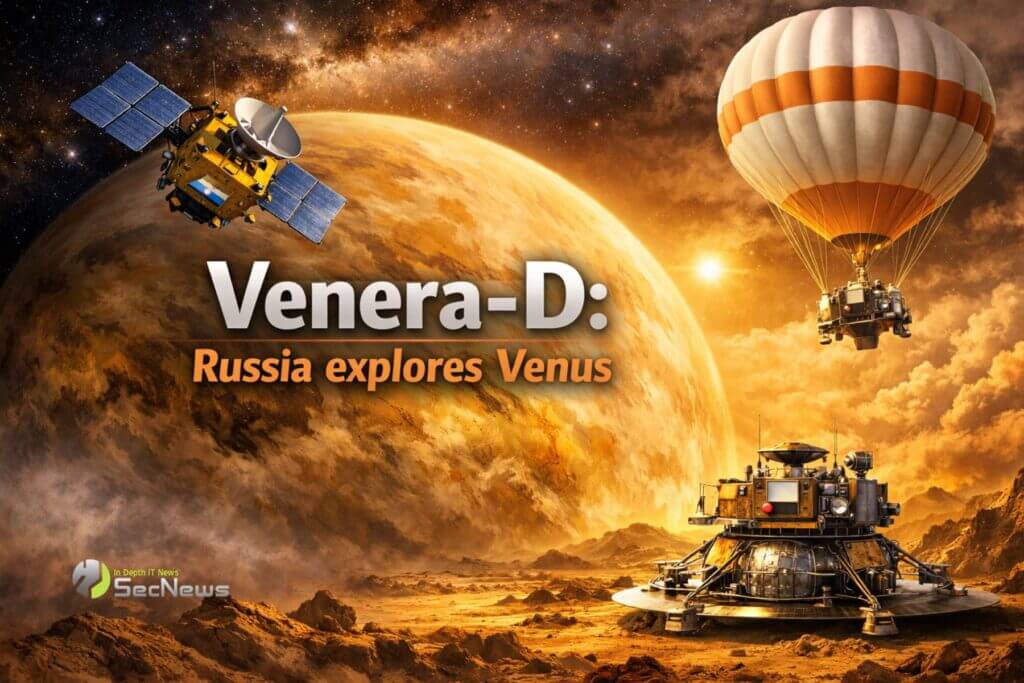
Russia appears poised to revive exploration of one of most inhospitable the Solar System's planets . According to state media , Russia plans to launch its new Venera-D space mission to Venus in 2036. It is a highly ambitious program that will include multiple exploration vehicles , including a lander, an atmospheric study balloon and an orbiter .
This mission is part of Russia's long-term strategy for space exploration and is considered a key element of the future plans of the Roscosmos space agency . Despite the geopolitical developments of recent years, Moscow continues to invest in high-risk and scientific space missions
The Venera‑D plan and its long development history
The Venera-D program is not new. According to information from Russian sources, its development has been underway since 2003. In the early stages of planning, cooperation with NASA was even considered , which could create one of the most important international missions to Venus.
See also: Underground lava tunnel on Venus: Signs of geological activity
However, after the Russian invasion of Ukraine in 2022 and the deterioration of relations with the West, this cooperation did not progress. Today, Russia seems determined to continue the mission autonomously.
Russia's First Deputy Prime Minister, Denis Manturov , said in an interview that the Moon and Venus exploration programs are now at the center of the country's space ambitions. The development of a new generation of robotic missions is considered crucial for Russia's scientific and technological presence in space.
The Soviet legacy in the exploration of Venus
The choice of Venus is not accidental. The Soviet Union managed to successfully land spacecraft on its surface many years ago. During the 1960s, 1970s and 1980s, a series of missions called Venera, which made history in space exploration.
The most iconic of these was Venera 7, which in 1970 made a successful landing on Venus.
In total, more than a dozen Venera missions were launched over a 22-year period. Some of them failed to return data, but subsequent missions provided crucial information about the planet's atmosphere and surface. The last successful mission in the series was Venera 16 in 1983.
See also: Invisible asteroids around Venus may threaten Earth
The extreme conditions of Venus's surface
Venus is considered one of the most inhospitable worlds in the Solar System. Its surface temperatures reach around 480 degrees Celsius, while the atmospheric pressure is over 90 times that of Earth at sea level.

The Soviet missions, which managed to operate for a short time on the surface, revealed a landscape full of volcanic rocks and a characteristic yellowish hue in the sky. This hue is due to the thick clouds of sulfuric acid that dominate the planet's atmosphere.
The operation of scientific instruments under such conditions is a huge technological challenge, a fact that makes every successful mission extremely important for the scientific community.
Search for possible life in the planet's clouds
One of the main scientific goals of the Venera-D will be to investigate the possibility of microbial life in the clouds of Venus. In recent years, studies have been published suggesting that the planet's atmosphere may contain traces of elements such as phosphine and ammonia.
These elements are considered potential biomarkers, i.e. chemical compounds that in some cases are associated with biological processes. Although these findings remain controversial, they have rekindled interest in Venus as a potential target for the search for life.
See also: NASA: Venus may finally be geologically "alive"
The balloon, which the mission is planned to include, could collect data directly from the upper atmosphere, where conditions are less extreme than at the surface.
A new international race for Venus
Russia is not the only country that is turning its attention again toward the second planet from the Sun. In recent years, a new "course" of exploration of Venus by various space agencies has been observed.
NASA is developing the VERITAS and DAVINCI missions , which focus on the planet's geology and atmosphere. The European Space Agency is planning its own mission, while India is considering its first mission to Venus around 2028.
Even the private sector is showing growing interest. Rocket Lab in collaboration with MIT , is working on the Venus Life Finder, which aims to examine the planet's clouds for possible signs of life.
All this shows that Venus is dynamically returning to the forefront of space exploration, with the Venera-D mission likely representing one of the most ambitious efforts of the next decade.
