

Scientists have shown how swirling winds and scorching heat on Venus work together in a revealing new study.
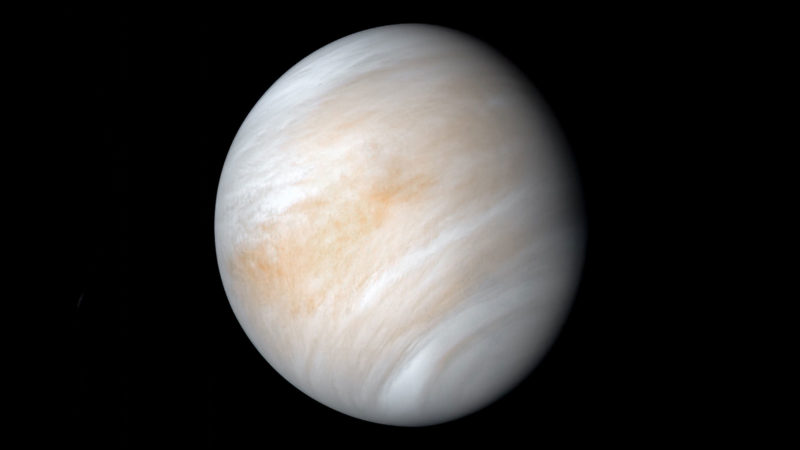
Venus' surface is hot enough to melt lead, with an average temperature of 872 degrees Fahrenheit (467 degrees Celsius). This extreme heat is maintained by a thick atmosphere of carbon dioxide that traps heat on the planet , creating a greenhouse effect. This atmosphere also includes acidic sulfur clouds and a perpetual, swirling windstorm. In a new study, researchers reveal new insights into the planet's strange wind and heat.

See also: NASA captures the moment of a brilliant solar flare
Lead author Pedro Machado, a researcher at the University of Lisbon in Portugal, said that winds speed up as we move upwards to increasing altitudes, but we don't yet know why this happens. However, the new study helps us understand the phenomenon. Specifically, the team studied the wind speed of Venus at two different altitudes that were about 20 kilometers apart in the planet's atmosphere. They monitored the clouds at regular one-hour intervals as they used indirect methods to estimate the speed of the wind pushing the clouds. They found that the winds were 150 kilometers per hour faster at the highest altitude at the top of the clouds than at the lowest altitude. This finding supports the previously proposed idea that energy from heat in the lower levels of Venus' atmosphere is transported upward, accelerating the rate of circulation of the planet's atmosphere. We conclude, therefore, that surface heat is the source of Venus's strange atmospheric winds.
Machado said they were able to study the vertical component of the wind for the first time, that is, how energy from the lower, warmer layers is transported to the top of the clouds, where it also leads to the acceleration of the winds. The extreme surface temperatures on Venus produce infrared radiation, or thermal energy, which rises into the air to the clouds located about 48 kilometers above the surface. This thermal energy originating from the surface and traveling upward can be identified through infrared observations of Venus.
See also: SpaceX rocket part is on collision course with the moon
The team used the Galileo in the Canary Islands to observe the planet. These observations were made on the same days that the European Space Agency's Venus Express orbiter observed visible light at the planet's cloud tops. In addition to the findings of the study itself, the team aimed to show how ground-based observations could complement the work of space-based detectors.
This study is important for discovering the conditions on Venus. Japan's JAXA space agency has a mission launched to visit Venus. In 2021, NASA planned two new missions to study Venus. The names of the 2 missions were Deep Atmosphere Venus Investigation of Noble Gasses, Chemistry and Imaging (DAVINCI+) and Venus Emissivity, Radio Science, InSAR, Topography and Spectroscopy (VERITAS). At the same time, Europe is also heading to Venus with the European Space Agency's EnVision mission, which aims to study the planet's surface and investigate its history.
