

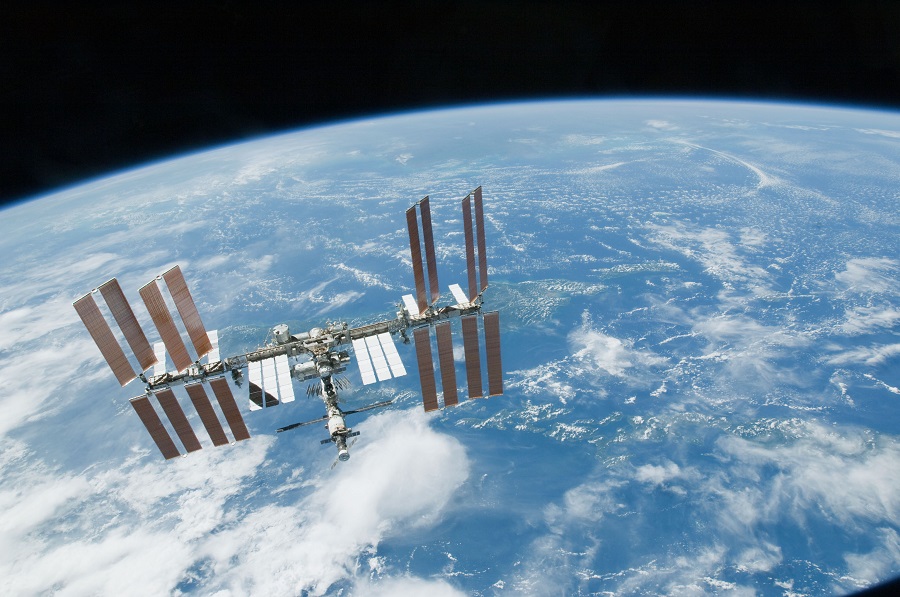
A SpaceX Crew Dragon capsule carried four astronauts to the International Space Station, which orbits more than 200 miles above Earth, beginning the astronauts' six-month stay aboard the space station.
See also: Elon Musk: SpaceX's Starlink project starts next month
This mission, called Crew-3, is the fourth in a partnership between SpaceX and NASAthat makes routine trips to the ISS to keep the space station adequately staffed. This is something NASA has wanted to have more control over since the Space Shuttle program was retired in 2011, leaving Russia as the only country with the ability to provide transportation to the ISS.
The Crew-3 mission began Wednesday night, when astronauts boarded the Crew Dragon capsule atop one of SpaceX's 200-foot-tall Falcon 9 rockets at a launch pad at Kennedy Space Center in Florida. The rocket lifted off shortly after 9 p.m. ET, putting the capsule into orbit before the spacecraft began maneuvering into orbit on its own and approaching the ISS.
This mission comes as SpaceX and NASA teams are addressing two issues with the design of the Crew Dragon capsule. The first, an issue that caused a leak in the spacecraft's toilet, was fixed in the Crew-3 capsule before liftoff.
The Crew-2 astronauts discovered that their leaking toilet had contaminated the walls of their spacecraft.
The other issue NASA and SpaceX are currently facing has to do with the Crew Dragon's parachutes. During the Crew-2 splashdown on Monday, one of the four parachutes took a little longer than the others to fully deploy.
See also: NASA's solar probe is bombarded by plasma explosions
Kathy Lueders, NASA's head of human spaceflight, told the reporter that this prompted SpaceX and NASA to take another look at Crew-3's parachutes in hopes of avoiding a similar issue when it returns from the ISS in six months from now.
Kayla Barron, who holds a master's degree in nuclear engineering from the University of Cambridge, was selected as a NASA astronaut in 2017 and comes directly from a field of work that involves extreme living conditions and long periods of isolation: submarines. Barron became one of the first women ever to serve on a Navy submarine in 2010.
Raja Chari also joined NASA's astronaut corps in 2017 as one of the newest members, and this trip marks his first space flight. He holds a master's degree in aeronautical engineering from MIT and is a graduate of the U.S. Naval Test Pilot School, which has a long history of providing pipelines to the astronaut corps.
German Matthias Maurer will also have the opportunity to make a spacewalk and activate a new robotic arm, which was recently transported to the space station by a Russian spacecraft.
See also: NASA: Shows the first images of Earth from the Landsat 9 satellite
The mission's pilot, Tom Marshburn , is the only veteran astronaut among the crew. He has a background in physics, holds a doctorate in medicine, and first joined NASA in the early 1990s. The ISS has hosted astronauts from around the world to conduct scientific research for two decades.
The space station is unlike any laboratory in the world. In the microgravity environment, physical and biological phenomena are unaffected by Earth's gravity. So, doing an experiment on the station that has been done on the ground can give scientists a better fundamental understanding of how something works.
