

Fedora developers have released a new version of their Linux distribution. In Fedora Linux 35, they have worked hard to consolidate changes that were already implemented in previous releases – such as the “Pipewire” sound server that was introduced with Fedora 34 as a replacement for PulseAudio.
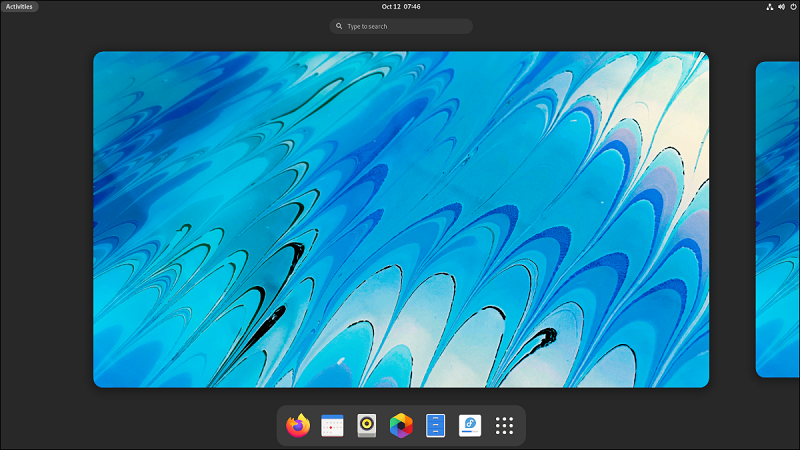
Gnome is making the leap to version 41 as the main desktop environment of this distribution, with the “Gnome-Software” package manager integrating the most popular Flatpak packages from flathub.org via an additional repository. The “system resolver” service, which is responsible for name resolution for network connections since Fedora 33, has the ability to handle “DNS over TLS” (DoT).
Another innovation: Fedora “Kinoite,” a modular Linux system that keeps system partitions in read-only mode and updates them separately from installed applications.
See also: Microsoft Edge browser for Linux: It is now available for everyone
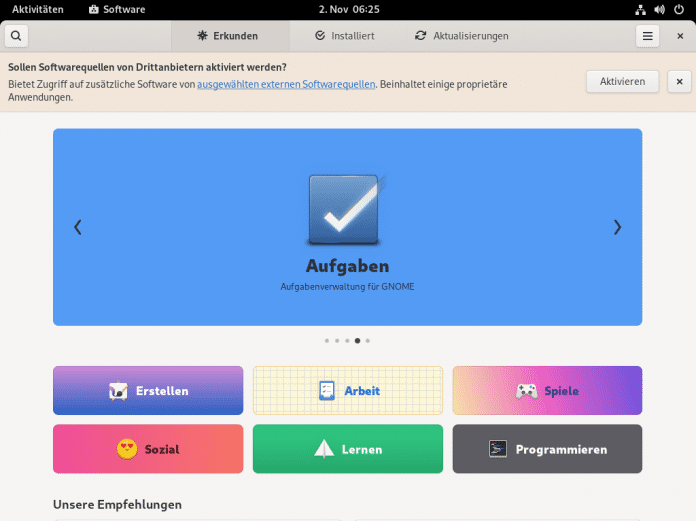
Optional installation of Flatpaks
Before selected programs from Flathub are available in the package manager, this additional source must be enabled.
Wireplumber: Session manager for Pipewire
Fedora 34 had already replaced the PulseAudio sound server with Pipewire. This project by Red Hat developer Wim Taymans has evolved from handling video streams to a full replacement for PulseAudio over the past six years. The benefits include multiple APIs in a single sound server and low latency.
In addition to bug fixes, Fedora Linux 35 also includes the Wireplumber session manager. Wireplumber replaces the management of output and input interfaces, as well as sound cards and Bluetooth devices that were previously only available in the mainstream market. Pipewire is supposed to be a bit more robust and easier to configure when multiple output devices are available. In terms of controlling Bluetooth devices, Pipewire supports newer codecs, such as mSBC and CVSD narrowband.
See also: SUSE Linux Enterprise Micro 5.1 is available for everyone
Package management: Selected flat packages
The Fedora 35 release date has been pushed back twice by a week each time – not unusual for the distribution, which aims for a bi-annual release frequency. The last persistent bugs before Fedora’s release concerned the new integration of Flatpaks from flathub.org through the “Gnome Software” package manager.
However, not all Flatpaks are offered, but only the 50 most popular programs that are not available as a regular package in the Fedora package sources and are also completely undisputed in terms of licensing. This includes Microsoft Teams, the Zoom client for Linux, Anydesk, Discord, WPS Office, OnlyOffice, and Minecraft. Integration only occurs if these are enabled after installation with an option in the package manager in Gnome.
Fedora Kinoite: KDE instead of Gnome
Since Fedora 29 there has been a separate version of “Silverblue”, a modular system with a Gnome desktop, which integrates the base system in read-only mode and updates it separately from the programs. This approach is intended to provide a Linux system that is as robust as possible, which on the one hand consists of variable RPM packages, but on the other hand updates the operating system kernel separately. This modularization of Fedora for desktop is possible FAQ zu Silverblue originally from the server system “CoreOS”, which was created for containers and flat packs.
The “Silverblue” version with Gnome is now available from the new “Kinoite” variant supplemented with KDE Plasma 5.22, which has been in development since 2018. Here too, the installation is carried out using the Anaconda tool, but the system has been set up and updated not via “dnf”, but via “rpm-ostree” and via Flatpaks.
See also: 7 important commands for every Linux user
Further variations and download
The preferred desktop on Fedora is still Gnome, now in version 41, which, among other things, brings new touchpad gestures to the overview page. Gnome has always been available on Fedora without pre-installed extensions or custom themes. So the discussion about GTK4's limited compatibility with libadwaita is irrelevant for Fedora.
As usual, Fedora Linux 35 is also available in variants with other desktops as a live system. In addition to Gnome and KDE Plasma, these "spins" are also provided by XFCE, MATE, Cinnamon, the particularly thin desktops LXQT and LXDE as a desktop environment and the tiled window manager i3. There is also a server version of Fedora, which allows the selection of package groups during installation. All variants are available for the processor architectures x86_64 and ARM (aarch64). A summary of the important changes can be found in the currently pending, but will soon be available in the Release-Notes zu Fedora 35.
Information source: marketresearchtelecast.com
