

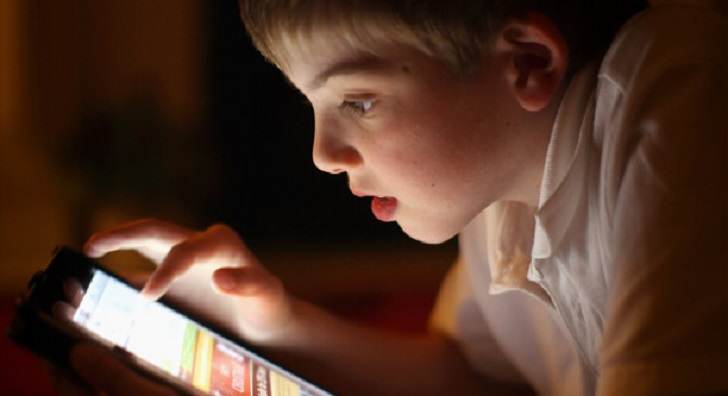
 More and more parents are using smart devices such as tablets and smartphones, instead of the TV as they once did, to keep their young children busy. However, a new American scientific study raises serious doubts as to whether this, beyond being convenient for parents, is actually good for children, as it may "slow down" the social and emotional development of their brains.
Researchers at Boston University School of Medicine, led by pediatrician Jenny Radesky, who published the relevant study in the journal "Pediatrics" of the American Academy of Pediatrics, according to the British "Guardian", evaluated the studies published so far on the possible effects of frequent computer and mobile phone use by children.
Researchers warn that while a parent can distract a child in this way, allowing the child to become absorbed in their new "toy" and quiet down, the price may be the child's incomplete development, especially in terms of their ability to control themselves and communicate with others.
Scientists point out that while the impact of television and video games on young preschool children has been extensively studied to date, the same is not true for tablets and smartphones.
“If these devices become the dominant method for calming and engaging children, will they be able to develop their own internal self-regulation mechanisms?” the researchers ask. Among other things, they point out that there is evidence that children under the age of three who spend a lot of time in front of an interactive touch screen have difficulty developing the necessary skills for mathematics and science in general.
Jenny Radesky recommends that parents encourage their children to have “direct, interactive human-to-human contact” early on. As she said, it is vital that the entire family dedicate time daily to contact and communication, leaving aside television, computers, and cell phones.
Studies already show that children learn more and develop more naturally in this case than through screens, as, among other things, they develop empathy (the ability to feel those around them and put themselves in their place), as well as solve problems in a group way.
Furthermore, according to researchers, playing with blocks can ultimately help a young child develop mathematical skills more than being glued to a screen, even an interactive one. The interactive programs (e.g., electronic children's books) offered by tablets and smartphones become more educationally useful as a child approaches school age, but not until they are two to three years old.
The researchers' main conclusion is that the impact of electronic devices on the development and behavior of young children remains a big question mark for now, which is why parents should be particularly cautious and not easily give their child a tablet or cell phone - just because it's convenient - to pass the time.
Source: Proto Thema
