

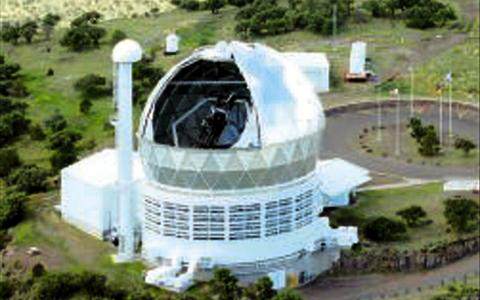
 Greece will host, at the premises of the National Observatory of Athens, the first of the European centers for the collection and redistribution of data from the Sentinel Earth observation satellites of the "Copernicus" program. The relevant agreement - the first of its kind in Europe - was signed today, in the context of an international conference at the Eugenides Foundation, between the President of the Observatory, Professor Kanaris Tsiganos, and, on behalf of the European Space Agency (ESA), the Director of Earth Observation Programs, Professor Volker Liebig. Similar agreements by ESA will follow with other countries in the future.
The under-developed European Earth observation satellite program "Copernicus" and the multitude of useful applications it will provide, thus contributing to the improvement of public services, the addressing of various social and environmental problems and the emergence of new business opportunities in Europe, is the subject of an international two-day event, which began today at the Eugenides Foundation and concludes tomorrow.
The event, entitled "Copernicus - Sentinels at the service of society and the environment", is attended by numerous representatives from government agencies, European institutions, academia, research institutions, data and service providers, as well as representatives of the business community from Greece and many other European countries. The conference is organized by the General Secretariat for Research & Technology (GSRT), in collaboration with ESA and the European Commission, under the auspices of the Greek Presidency of the Council of the European Union.
The Space sector, as emphasized, is increasingly recognized in the EU as an important parameter for strengthening European competitiveness, for protecting the environment and for serving societies and citizens.
The Secretary General of Research and Technology, Christos Vasilakos, highlighted "Greece's strong interest in the Copernicus program" and assured that the country "will participate in the broader European effort through its specialized scientific base, its research institutes, private enterprises in the scientific and technological sector, as well as existing and planned infrastructure.".
He also emphasized that "space will be the driving force for economic growth in the coming decades" by contributing to "the birth of new knowledge, innovative products and services" which, as he said, "will help Greece on its path towards economic recovery and the establishment of tomorrow's knowledge economy.".
The Copernicus programme, formerly known as the Global Monitoring for Environment and Security programme (GMES), is a collaboration between the European Commission and the European Space Agency. It uses high-precision data from Sentinel observation satellites and other sources to provide a wide range of information services to improve environmental management and mitigate the effects of climate change.
At the same time, as highlighted at the event, “Copernicus” is expected to create new jobs and business opportunities across Europe, especially in the field of new technologies. “Investing in space today is equivalent to investing in growth and employment tomorrow,” stressed Paul Weissenberg, Deputy Head of the European Commission’s Directorate-General for Industry and Entrepreneurship, adding that “never before has space been so high on Europe’s agenda.”.
ESA's first 2.3-tonne Sentinel-1A satellite, launched from French Guiana on 3 April this year aboard a Russian Soyuz rocket, reached an altitude of 693 km and has already sent back its first radar observations of Earth. It will provide all-weather, day and night images of the Earth's surface and the oceans of Europe and the polar regions in near real time. Its ability to "see" through clouds, rain and darkness makes it particularly useful for monitoring floods and responding to various emergencies.
Sentinel-1 is a constellation of two satellites: Sentinel-1B will be launched in 2015. In total, seven European Sentinel satellites are planned to be put into orbit in the coming years. Their data will not only be open to users around the world, but will also be available free of charge.
“Every citizen has the right to free public access to satellite data,” said MEP Vittorio Prodi, chairman of the European Parliament’s Space Committee. But he added that “for this data to be useful, it needs to be ‘translated’ into practical applications by intermediary providers.”.
For this reason, the raw data will be analyzed and processed, subsequently, by interested public and private service providers. These services will concern, among others, monitoring of risks arising from land movements on the Earth's surface such as earthquakes, mapping of the land (forests, waters and soil), surveillance of the marine environment (including oil spill monitoring and ship tracking), border security, sustainable agriculture, mapping to support humanitarian aid activities in crisis situations, climate monitoring, etc.
The development of the technical infrastructure of the Greek center (known as the ESA Mirror Site of Collaborative Ground Segment) is already at an advanced pilot stage and is being carried out in collaboration with ESA, the General Secretariat for Research and Technology and the National Research and Technology Network (GRTN SA). The domestic satellite center will also cover important monitoring needs for fires, earthquakes, floods, heat waves, dust transport, smoke and haze dispersion, but also even more extreme phenomena, such as tsunamis.
The Greek center will be a center for transmitting satellite information to the wider geographical area of the southeastern Mediterranean, the Middle East and the Balkans. As Mr. Tsiganos said, the Athens Observatory aspires to become a regional service provider in the wider area of SE Europe and the Mediterranean.
Also, the Observatory, thanks to its new satellite infrastructure, will be able to further develop the services it provides to the Greek state in various operational matters, as it will now have the ability to provide new information and services in minimal time and with the best possible spatial resolution (of the order of ten meters), while it will also develop new research activities.
Source: imerisia.gr
