

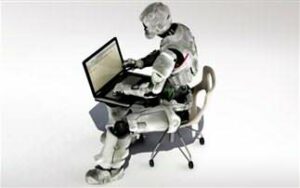
The profession of journalist is rapidly fading away..
The robot editor not only made his debut in the world of journalism but also writes well enough to be hired by the famous Los Angeles newspaper.
But let's start from the beginning, as the news is shocking.
Within 3 minutes of Enceladus hitting the City of Angels on Monday, the Los Angeles Times had already published the news! But how is that possible, one might reasonably ask?
And this is exactly where Quakebot comes in, the fear and terror of journalists around the world.
Quakebot is a program developed by programmer and LA Times journalist Ken Schwencke to relieve him of the boring daily news. So whenever seismic activity is recorded that is considered serious, the algorithm extracts the earthquake's numerical data and automatically incorporates it into (pre-written) text.
 So when the "lazy" journalist woke up at 6:25 in the morning, terrified by the passage of Enceladus, all he had to do was go to the Times website and review the text that his robot had already written! And so the online edition of the newspaper hosted the news first, and Schwencke took credit for his journalistic success.
And if the 3 minutes to post the news sounds humanly impossible, that's because it really is! Because the article may have been signed by Ken Schwencke, everyone learned that the real author was his application, Quakebot, which the struggling journalist developed 2 years ago.
 And if the automated texts of the robotic editor, the first of its kind, do not claim literary laurels and Pulitzers, what news text about seismic activity does anyway? The purpose of Quakebot is not to produce moving and penetrating texts, that is left to humans for the time being. In the future, we see…
Of course, in the defense of the robotic journalist, his role is simply ancillary to human-made journalism and no one is in danger from his actions. Besides, since Quakebot's immediate - and simple - post, so many editors (71, to be exact) have taken up the topic, producing brilliant and extensive articles for the front pages of their newspapers.
 And one more thing: the robot, in such simple cases as the magnitude of seismic activity, may be better at assessing the importance of the news than their human colleagues. Quakebot knows, for example, that a magnitude 3 earthquake is not an event to panic about, something that many editors willing to do anything for a "click" seem to ignore..
Source: newsbeast.gr
